
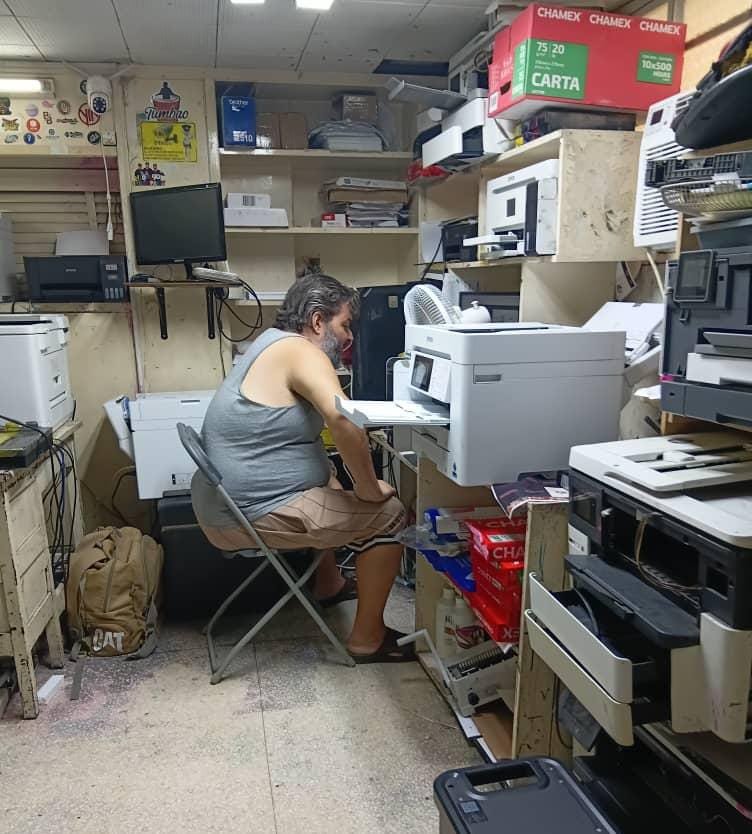

HAVANA TIMES – In an ordinary Havana neighborhood, behind a door that could easily go unnoticed, is the print shop that Luis runs. It’s a small space and almost completely full of computers, printers, boxes of paper, spare parts and cables. Not a centimeter of space has been left empty. Every corner has a function, and every object seems to be there because at some moment it was needed.
The smell of toner mixes with the smell of dampness. On one side, several red boxes with the Chamex logo are piled up against the wall. To Luis, those 75-gram reams of paper are much more than routine work supplies.
“That’s my white gold,” he remarks, pointing to them. Obtaining paper is an odyssey in itself. When it appears on the market, he has to snap it up even if it’s expensive. Otherwise, business stops.
Sitting in front of one of the computers, Luis looks through a recently printed document. He examines it carefully, confirms that no page is missing, then goes back to the screen. Very different kinds of orders come to his shop.
“All kinds of things come here,” he tells me while he adjusts the print settings. “Students needing their theses, people seeking work outside the country who need an impeccable resume, neighbors who want to print out a rent contract. We try to process our orders as quickly as possible here; we always want to meet our customers’ needs.”

The walls of the workshop also tell its story. On wooden shelves, worn from use, boxes of Brother equipment mix with packs of paper, random supplies and small objects that seem to have found a permanent home there. Cables crisscross back and forth; several have been spliced more than once. There are posters from local businesses, tools, and a plastic fan that struggles to circulate the hot air of the shop.
On the ground, a backpack sits against the wall, waiting. It will probably leave there when the next order is done.
“The hardest thing isn’t the machines – it’s the supplies,” Luis explains, all the while carefully cleaning the heads on one of his printers. “Sometimes I have to repair the same old printer again and again because there aren’t any spare parts. But here we are, holding on. This workshop is my way of getting ahead, of not having to depend on anyone.
All around Luis are printers of different sizes and makes. Some are relatively new; others bear the marks of years and repairs. None of them appear to be there by chance. In a business where a stopped machine can mean losing an order, learning to repair them has also become a way of keeping the workshop open.
The sound of the printers forms part of the background. A sheet of paper goes in, the rollers begin to turn, and seconds later the paper reappears with the contents someone needed preserved in a document: a thesis, a resume, a contract, an application.
Behind every print job is a concrete need, and behind every order that leaves the shop is Luis’ handiwork.
In a country where obtaining paper, ink, or a spare part can become a task far more complex than printing a document, keeping a small print shop going requires more than machines. You need to search, repair, save, improvise … try and try again.
Luis knows this, and that’s why he continues turning his printers on every day. Sheet by sheet, order by order, the small shop goes on, behind a door that, from the street, barely stands out.
Read more from the diary of Safie M. González aquí en Havana Times.