
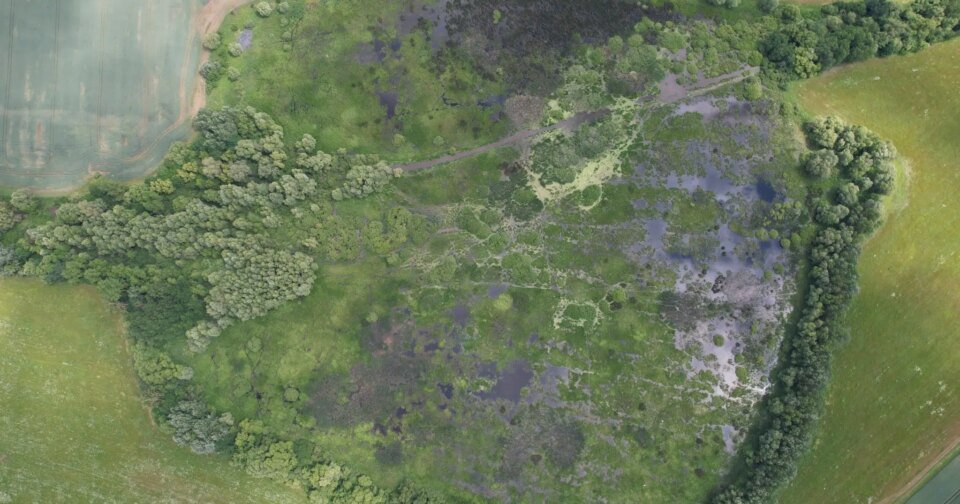

In southern Paraguay, that question takes shape within one of the last major remnants of the Upper Paraná Atlantic Forest, a landscape that, against all odds, still stands.
San Rafael is a Key Biodiversity Area that shelters 440 bird species, 7 of them found nowhere else in the region. It regulates water for downstream communities; stores carbon accumulated over centuries and provides habitat for species that have already lost most of their range elsewhere in the Atlantic Forest biome. The area is also declared a Reserve for a National Park; much of the land within the park is privately held, and government enforcement of the protected area is underfunded and insufficient.
In many ways, it is a forest that should not exist. A century of agricultural expansion, cattle ranching, infrastructure pressure, and land-use change has reduced the Atlantic Forest, once stretching across vast areas of Paraguay, Brazil, and Argentina, to fragments. The San Rafael landscape is one of the largest of those fragments: 72,489 hectares of forest and natural grasslands at the edge of what remains.

In many ways, it is a forest that should not exist. A century of agricultural expansion, cattle ranching, infrastructure pressure, and land-use change has reduced the Atlantic Forest, once stretching across vast areas of Paraguay, Brazil, and Argentina, to fragments. The San Rafael landscape is one of the largest of those fragments: 72,489 hectares of forest and natural grasslands at the edge of what remains.
It is also one of the most threatened landscapes in Paraguay. In November 2020, fires of unprecedented scale burned approximately 33,000 hectares, nearly 45% of the reserve, according to Paraguay’s Ministry of Environment (MADES), as reported by Mongabay. While some areas show early signs of natural recovery, other areas still bear visible scars from the fires, with stands of burned trees remaining across parts of the landscape. Experts warn that full biodiversity restoration could take 20 to 30 years. The risk that fires return before regeneration can take hold, and that burned areas are converted to farmland rather than restored, remains real and pressing. An additional 800 hectares per year continue to be lost to illegal farming. The pressure is constant and accelerating.
Guyra Paraguay has worked for more than two decades to protect this landscape by acquiring more than 7,000 hectares of land that form part of their private reserve network, working with the Mby’a Guarani indigenous communities to promote sustainable land use, monitoring biodiversity, restoring degraded areas, and advocating for stronger legal protection and government involvement in the management of the park. Ecological knowledge is deep, and institutional presence is real. However, protecting a landscape under this level of sustained pressure requires continuous financial investment that does not stop when a grant cycle ends.
That is the structural challenge Tangará was built to address.

For decades, conservation across much of the world has depended on philanthropy, international cooperation, public funding, and time-bound projects. Those mechanisms remain essential; in many places, they are what allow conservation work to exist at all. Without them, local organizations would not have the reserves, the science, or the community relationships built over a generation.
Nevertheless, ecosystems do not operate according to funding calendars.
Forest restoration takes decades. Species recovery is measured in generations. Governance requires continuity across political cycles. Moreover, the economic pressures threatening a landscape like San Rafael move faster than conservation gains: a soy field can replace a forest in a season; restoring that forest takes far longer.
The numbers make this tension concrete. According to international estimates, the global biodiversity financing gap ranges between US$598 billion and US$824 billion annually. Current spending on conservation covers roughly one-fifth of what is needed. Increasingly, conservation organizations around the world are developing ways to make local sustainable economies part of the long-term financing solution.
This does not diminish the importance of philanthropy. If anything, it reinforces it. Many of today’s most important conservation efforts would not exist without donors and allies willing to support long-term environmental work, experimentation, and the acceptance of uncertainty. However, it raises the question that conservation organizations around the world are increasingly confronting: can local sustainable economies be part of the long-term solution?

“Across the Americas, many conservation initiatives face the same structural challenge: ecosystems require long-term protection, but funding cycles are often temporary. Tangará is valuable not because it claims to solve that tension entirely, but because it explores how conservation, local economies, and landscape resilience can become more connected over time.”
Fabricio Astudillo, Forest Program Manager | BirdLife International Americas
A forest trying to become its own donor
Founded in 2021, Tangará is a social enterprise created by Guyra Paraguay to generate revenue from the landscapes it helps protect. The goal is not to replace philanthropy, but to complement it. Tangará’s central objective is to generate at least 30 percent of Guyra Paraguay’s reserve maintenance costs through commercial activity: revenue that does not depend on grant cycles or donor timelines, but on whether a product reaches a buyer.
The logic is precise. Standing forests generate enormous value, such as water regulation, carbon storage, habitat for hundreds of species, and resources for communities living in and around the landscape. Almost none of that value is currently captured by the organizations working to protect the forest. Tangará is an attempt to change that equation: building economic activities that are only viable because the forest is standing, and that therefore gives producers and communities a direct stake in its survival. In simpler terms, what would it look like for a forest to help sustain the people and institutions working to protect it?
Now Tangará focuses on developing four revenue streams: shade-grown organic yerba mate, honey production, petitgrain essential oil, and low-impact ecotourism. Each is connected to Guyra Paraguay’s network of private reserves and to the communities around San Rafael. None of these activities require clearing the forest. They require it to remain intact.

Tangará was developed with technical support from BirdLife International’s Forest Impact Accelerator, which works with BirdLife Partners to build conservation finance solutions across tropical forest landscapes, offering hands-on mentoring, peer learning, and tailored support from concept to implementation.
Early results and honest limits
The initiative was launched with a catalytic seed grant from the Hempel Foundation, which absorbed the early-stage financial risk before revenues could be demonstrated. Since then, additional support from the Darwin Initiative, the Jensen Foundation, and other strategic partners has helped advance complementary areas of work, including the development of carbon finance opportunities and broader landscape-scale conservation efforts aligned with Tangará’s long-term vision.
“Before, the forest was just there. Now it’s what feeds my family. If the forest goes, so does everything we’ve built.”
Lalo Baez, yerba mate producer, Oga Ita community
The most developed revenue stream to date is yerba mate. Tangará has now managed the production and sale of more than 110,000 kilograms of shade-grown, certified organic, and Fair for Life yerba mate, which have been produced and exported to the United States. Petitgrain essential oil has reached Lush, a UK cosmetics company, through collaboration with more than 50 local producers. Ecotourism, the earliest stage of the four lines, has welcomed more than 180 visitors into the landscape, including international travelers. Currently, the Yerba Mate tour includes stops at the Kangüery Biological Station, the Consorcio de Ganaderos para Experimentación Agropecuaria (CEA), and five model farms run by producers from the Ka’a Ka’aguy Association.

These results are both real and uneven. Honey production, developed in two of Guyra’s reserves, has so far produced 60 kilograms for commercialization. The gap between 110,000 kilograms of exported yerba mate and 60 kilograms of honey is not a failure. It is an honest reflection of where each business sits in its development. Tangará is not one enterprise at the same stage across all its activities. It comprises four distinct business lines, each at a different level of market readiness, with different supply chains, buyer relationships, and timelines for viability. Future opportunities may also include medicinal plants and white grapefruit production for Lush Cosmetics. However, as with other business lines, producer interest will depend on the ability to demonstrate viable returns over time.
Rather than relying on a single product or market, Tangará was intentionally designed to draw revenue from multiple sources. This diversification helps reduce exposure to fluctuations in commodity prices, shifts in demand, climate impacts, or operational risks affecting any single activity. In this sense, the initiative reflects a broader conservation finance principle increasingly explored across tropical landscapes: resilience is often built by stacking complementary sources of value rather than relying on one.
Tangará’s conservation work currently benefits 132 families from eleven communities and two indigenous groups in the San Rafael landscape. Many of these families practice shade-grown agriculture, a productive system that depends entirely on the integrity of forest cover. For them, the forest is not a backdrop; it is the foundation of their livelihood. The goal is to reach 250 families as conservation efforts consolidate across the landscape.

Looking further ahead, Guyra Paraguay is currently participating in the fifth cohort of BirdLife International’s Forest Impact Accelerator, which is supported by the Darwin Initiative. Through this process, the organization is designing an Afforestation, Reforestation and Revegetation (ARR) carbon project linked to yerba mate agroforestry systems. If successful, this emerging revenue stream could further strengthen the long-term financial sustainability of conservation efforts across the landscape.
Building Tangará has required Guyra Paraguay to develop capabilities it was not designed to have.
“One of the biggest lessons from Tangará has been understanding that conservation alone is not enough. Long-term sustainability also requires market understanding, logistics, partnerships, governance structures, and constant adaptation. It pushes conservation organizations beyond their traditional roles and forces us to think more holistically about what sustaining a landscape really means.”
Ana Barriga, Forest Program Coordinator | BirdLife International Americas
The challenge has been concrete. Tangará spans four distinct business areas: yerba mate, honey, petitgrain, and ecotourism, each with its own market and supply chain dynamics. For an organization whose expertise lies in biodiversity science, certification, and landscape governance, building those commercial capabilities has meant learning an entirely different set of skills. Through the BirdLife Forest Impact Accelerator, Terranomics provided hands-on training and market strategy support, particularly for the yerba mate line
Some of the most important outcomes and impacts that localized conservation programming can generate are also among the hardest to measure within short-term economic logic. Biodiversity protection, ecological connectivity, climate resilience, and cultural relationships with territory do not always translate easily into immediate financial metrics. Nevertheless, conservation initiatives are frequently expected to demonstrate returns within systems that rarely account for the full value of healthy ecosystems. For Tangará, building credible systems to measure and communicate biodiversity benefits, community income, and product traceability remains a priority and a work in progress.

Rather than concealing these tensions, the organizations involved have come to see them as central to the initiative’s value. The difficulties are not incidental to what Tangará set out to do. They are part of what it means to fundamentally change how conservation organizations create the conditions for sustainable development, and to accept that this shift carries real risks worth taking.
“Tangará has proven that conservation and commerce can reinforce each other in a real landscape, with real costs to cover. The next step is to build on that foundation by stacking our four revenue streams into a proposition that can attract impact investors and, in time, enable us to take on debt to scale operations across our reserve network. The goal is not just financial sustainability for Guyra Paraguay. It is to show that a conservation organization can become the kind of institution that investors want to go back to.”
Rodrigo Zárate, Guyra Paraguay
Conservation as a system
The logic behind Tangará reflects something that conservation practitioners are increasingly recognizing: protecting biodiversity is not only a biological challenge. It is also a social, economic, governance, and financial one. It cannot be addressed by any single actor or funding mechanism alone.
In this sense, the model resembles the ecosystems it seeks to protect. Resilience in nature does not depend on a single species or mechanism. It emerges from the interaction between diverse roles, each sustaining the others over time. The same may be true for conservation: a forest stays standing because communities have reasons to protect it, because markets reward sustainable production, because science and traditional knowledge inform decisions, and because philanthropy absorbs the risks that no other actor will take.

Within that system, philanthropy remains irreplaceable. Not as a temporary measure, but as the actor uniquely positioned to fund what markets cannot, to support innovation before it is proven, and to sustain work across timescales that no business model can accommodate. For the Hempel Foundation, supporting Tangará with a catalytic seed grant was precisely this kind of commitment: absorbing early risk to allow an experiment that could not otherwise begin.
“Philanthropy continues to play a fundamental role in conservation, particularly by supporting innovation and absorbing early-stage risk. What interests us about initiatives like Tangará is their potential to explore new forms of resilience, where biodiversity protection, local livelihoods, and sustainable economic models can reinforce one another rather than operate separately.”
Casper Thulstrup, Head of Strategic Development, Quality & Analysis | Hempel Foundation
An unfinished bet and why that matters
Tangará does not claim to have entirely re-shaped the conservation finance landscape in San Rafael. Nor does it offer a universal model ready to be replicated anywhere. The conditions that make it possible: Guyra Paraguay’s decades of institutional presence in San Rafael, the combination of philanthropic capital and technical support, and the existence of markets willing to pay for certified forest products, are not available everywhere.
What Tangará offers is something different: a working test of whether conservation and commerce can genuinely reinforce each other in a specific landscape, with real producers, buyers, and costs to cover.

The question it raises is one that conservation organizations everywhere are being forced to answer: can the systems built to protect nature become resilient enough to outlast the funding cycles they depend on? The future of conservation will continue depending on philanthropy, public investment, science, communities, and political will. Nevertheless, initiatives like Tangará suggest that sustaining biodiversity over the long term also requires new forms of collaboration between conservation organizations and local economies, particularly in landscapes where both remain deeply intertwined.
In San Rafael, at least for now, the forest is still standing.

About the Forest Impact Accelerator
The Forest Impact Accelerator has run for five successful years with generous support from the Hempel Foundation, Waterloo Foundation and the King Charles III Charitable Fund, as well as £6 million of additional funding sourced in collaboration with our Partners. Overall, it is benefiting 38,000 local people, has improved protection for 400 threatened species, and has impacted over 1 million hectares.
Last year, we were awarded an important Darwin Initiative Extra grant through the UK government’s Biodiversity Challenge Awards, a program that supports global biodiversity conservation, reduces poverty, and addresses climate change. The £4,978,335 award will expand and scale these achievements to secure 1 million hectares of Key Biodiversity Areas while generating economic benefits for 200,000 local people.
