

Photo-Illustration: by The Cut; Photos: Getty Images
If rogue AI agents wipe out humanity in the next decade, who cares what’s in your 401(k)? If your job won’t exist in five years, does it matter if you get a promotion now? Why try to plan for a future that’s increasingly governed by reckless billionaires and other forces beyond our control? “It seems like we’re five seconds away from an apocalypse, and I’m over here investing in my Roth IRA,” says Melissa Jean-Baptiste, a financial educator and author of So … This Is Why I’m Broke. “Sometimes I’m like, What’s the point?”
Conventional financial advice involves making sacrifices now so that your future self will benefit. But that premise starts to break down in the face of precarity, when it’s less clear if those trade-offs will ever be worth it. Here we are, shuffling dollars between accounts, gritting our teeth at skyrocketing gas prices, and all for what — a financial future that, according to a recent Gallup poll, the majority of Americans believe is getting worse? No wonder financial nihilism is spreading: “I can’t afford to buy a house, so why don’t I just be gorgeous?” posited a viral piece in Bustle last year about millennials who’ve given up on homeownership and are spending their money on Botox instead.
This cynicism can be contagious, says Hanna Horvath, a certified financial planner and writer of the personal-finance newsletter Your Brain on Money. “My social-media feed is so doomerous about the economy,” she observes. “There’s a crisis every other day. It’s hard not to fall into a panic spiral.” But it’s also clear to her that doing nothing — surrendering to the bad vibes, if you will — could easily turn our fears into a self-fulfilling prophecy. “For most of us, the future is probably going to arrive,” she says. “Don’t you want to give yourself the option of having more choices when it does?”
Even in a hypothetical worst-case-scenario, it’s likely that money might come in handy. “Let’s take the nihilism on its face,” writes financial reporter Alicia Adamczyk in a recent essay, “Saving for the Future at the End of the World.” “Weather events will be more extreme, AI may lead to widespread job loss, and our political leaders will continue to leave us to fend for ourselves. From that perspective, it is unlikely you will be better off having less money set aside. Having savings may save your life.” But if you’re scrambling already, what does preparing yourself even look like? Here, financial experts share how they’re bracing for the worst, just in case — and what you can do too.
Instead of freaking out whenever you check your bank account (or the news), set a specific date to do so in the future. “I will literally block out time to worry about my money,” Horvath says. “I have a standing 30-minute appointment on my calendar, typically every few weeks. Whenever I get stressed about something, I’ll write it in the calendar notes.”
Then, when the appointment arrives, she reviews what she’s written and makes a plan for how to deal with it — or let it go. “Ninety percent of the time, I’m not worried about that thing anymore, and I don’t even remember why I was worried about it,” she says. “But it helps me close the loop.”
These appointments also give her time to come up with contingency plans. “I’ve done a mini run-through of what I would do if, hypothetically, I lost my job — it’s basically a checklist,” she adds. “Knowing that I have steps to follow is enormously calming.”
Finally, writing down your financial anxieties can help you figure out what exactly is driving them. “Did you read a scary headline? Did you see that your friend just bought a house, and then it made you feel jealous? What was the trigger?” asks Horvath. “Is it the fear of falling behind your friends? Is it the fear of losing everything?” Those fears are valid, but identifying what pushes your buttons will help keep your anxiety from getting out of hand.
The advice to “save more” can be deeply annoying, especially when many people aren’t in a position to do so. Still, taking stock of your spending is always a good idea. “Getting clear on your own cashflow is the first step in understanding where your money is going and feeling more in control of it, even if things are very tight,” Horvath says.
Fixed expenses are tough to reduce; most people can’t just move to a cheaper home or cut their health-care costs tomorrow. But researching your options to potentially do so in the future — say, when your lease ends, or when open enrollment begins — is a good thought exercise. “Lowering your overhead costs will give you a lot more freedom with your money. It’s one of the biggest levers you can pull,” Horvath says.
Keeping her rent as low as possible is how Adamczyk, currently a writer for the Purse, managed to save up a healthy emergency fund over the past decade. “I’ve lived in some apartments that were really not nice,” she says. “It’s not for everybody. But ultimately, it was worth it for me to be able to save money that gave me more freedom.”
The internet is awash with books and programs and influencers who claim that you can save money fast and easily, without feeling deprived or jealous or grumpy about it. But for most of us, that’s just not realistic, and we might as well get used to it. “All the things you’re supposed to do — saving money, having an emergency fund — it’s hard,” Adamczyk says. “It just is. It has always been hard, and it’s always going to be hard.”
It also takes patience. “It took me 12 years to get to a place with my own money where I feel fine,” she says. “Could I have done a better job along the way? Sure, I probably could have spent less. But now I am at a place where I am okay.”
Creating a consistent, doable habit, like setting aside a certain amount each week or month, is key — even when it feels like it’s not enough. “I can’t control AI or the war in Iran or interest rates, and those things stress me out,” Adamczyk continues. “So what can I do? I can set up a $50-a-month deposit from my checking account into my savings account.” It’s not a ton of money, she says, but whenever she can, she transfers extra. “And it’s added up over time. Now, looking at that number does make me feel better. Like, Okay, I did this. I have this.”
Jean-Baptiste is also keeping her budget tight these days, and, while she doesn’t enjoy it, she tries to stay positive. “I know it’s a privilege to be able to spend less,” she says. “Some people literally can’t. I can’t go get my nails done every four weeks, and I hate that for me. But I know I’m lucky to have things I can cut.”
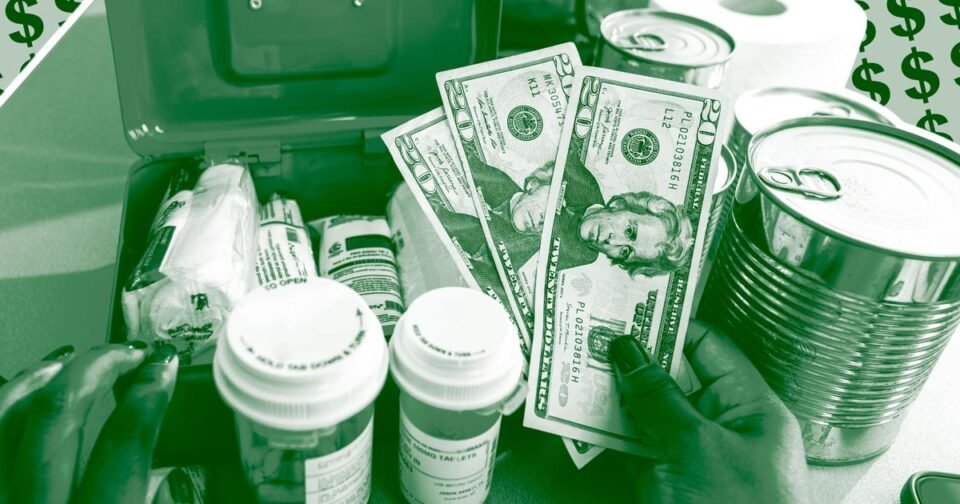
“I’m not keeping thousands of dollars under my mattress,” Jean-Baptiste says. “But I do keep a good amount of cash on hand, at home, just in case of emergency — if the power goes out, I can’t get to a bank, can’t get gas, can’t get money out of the ATM. It’s enough to keep us afloat for a few days if something really bad happens.”
She also uses a few different investment accounts and banks. “We don’t keep everything in one place,” she says. “The idea is that if one bank or one brokerage goes down, we can access our money someplace else.” She admits this line of thinking borders on paranoia, but it helps her sleep at night. “I think that spreading your eggs among several baskets, across the financial spectrum, is a smart thing to do in general.”
It’s isolating and scary to feel unprepared for the future. But remember, you don’t have to do it alone. “One of the most practical ways to help yourself is to build community,” Horvath says. “That support can be direct, through local mutual-aid organizations, or it can be more indirect.” Set up a carpool, join a co-op, launch a meal train, organize a clothing swap (or local buy-nothing group), arrange a rotating child-care situation — all are good examples.
Jean-Baptiste knows someone who recently started a neighborhood potluck to help feed people who’d lost their jobs. “It became a fun activity, instead of something that people might feel awkward or embarrassed about,” she says. She also recently set up an informal bartering system: She helped several of her neighbors set up a Roth IRA for the first time, and they repaid her by giving her supplies at their community garden. “The barter system can be surprisingly beneficial, both mentally and financially.”
“To say that a healthy dose of cognitive dissonance is required to keep on trucking day to day is perhaps an understatement,” writes Adamczyk. It takes a certain level of denial to put down your phone, load the dishwasher, read your toddler Harold and the Purple Crayon, and go to bed, but there comes a point where you have to accept that you’ve done what you can with the resources you have.
“How do you get to a place where you decide, This is good enough? You’re taking steps toward where you want to go, and you’re not going to spend any more mental energy thinking about it for now?” asks Horvath. “I tell myself that I have a plan and it’s going to work in some capacity. But it’s never going to be perfect.”
Email your money conundrums to mytwocents@nymag.com (and read our submission terms here).