

Stocks rose, gold shrugged, and traders dropped a Fed rate hike from their forecasts even as bond yields kept climbing. Are the markets turning the inflation story into something else?
- The tech-heavy Nasdaq 100 pushed toward a breakout even as long-term Treasury yields climbed further
- Markets now see a 76% chance the Fed holds in October and price one fewer rate hike through 2027
- Minutes from the Fed’s September meeting and University of Michigan sentiment data are due this week
Stock markets tried to break higher even as long-term US borrowing costs extended their climb. The tech-heavy Nasdaq 100 pushed through the top of a range that has capped it since June. The S&P 500 edged up but stayed below its mid-August top. Even the small-cap Russell 2000, the index hit hardest by the rise in rates, managed a solid day.
Assets that have struggled with rising rates held their ground too. Gold and silver steadied at the bottom of their recent ranges, and Bitcoin ticked up. Outside of the euro, the US dollar looked stuck. As for the single currency, it clawed back nearly all of a sharp drop at the weekly open driven by Europe’s sovereign debt worries, while the Australian dollar, which tends echo stock market sentiment, looked firmer. If rising long-term yields carried the weight they did a few weeks ago, markets would likely look different.
Markets are scaling back Fed rate hike bets
The Russell 2000 shows how much the rate hike story has driven stocks. The index peaked in mid-August, almost exactly as two-year Treasury yields bottomed. Its break lower came after Fed Chair Kevin Warsh signaled a hawkish turn at the Jackson Hole symposium late that month, a shift that culminated in a rate hike in September. The Russell is still trading within the downtrend that followed, but its resilience on Monday came as traders were rethinking that hawkish path.
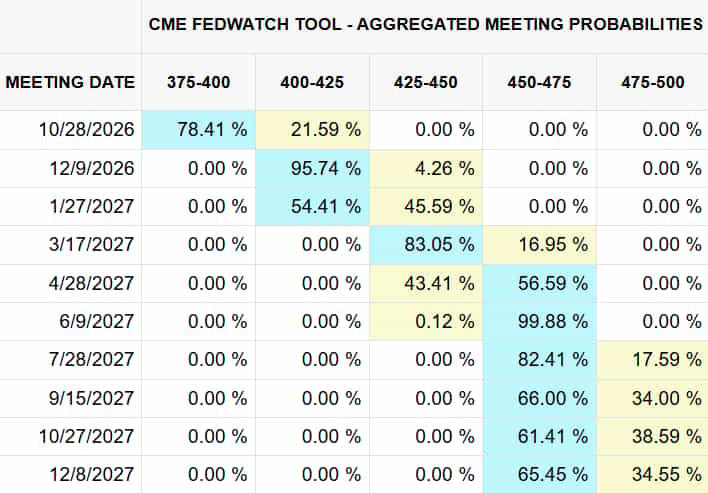
Fed funds futures now put the odds of the central bank standing pat in October at about 76%. A week ago, they priced a 70% chance of a 25-basis-point (bps) hike at that meeting. A December increase remains near certain at around 95%, matching the Fed’s own projections. For 2027, markets now price two more hikes, one by March and another by June. That’s down from three of them a week ago, narrowing the gap between traders and central bank officials expecting no more hikes next year.
Crude oil does not explain the change. It has been a key channel for inflation fears since the US-Iran war began, but West Texas Intermediate (WTI) crude remains stuck in a range between roughly $88 and $95 per barrel. What has cooled is the inflation and growth data. The latest personal consumption expenditure (PCE) report showed three-month annualized inflation has fallen to the Fed’s 2% target after peaking in May. The smoother and slower-moving six-month rate has eased since June, though it remains slightly above 2%.
Is the Fed story shifting from inflation to growth?
Fears of a turn in the economy itself may be at play. Friday’s jobs report was weak in both its headline and its details. A mere 29k were added to nonfarm payrolls instead of the expected 90k, and the unemployment rate unexpectedly rose for the first time in seven months, to 4.2%. The payrolls tally for the prior two months was also revised down by 60k. The Atlanta Fed’s GDPNow model had already cut its third-quarter estimate to 3.7%, from between 5% and 6% when tracking began. It may tick lower still once the jobs data is included in this week’s update. Meanwhile, the Conference Board’s consumer confidence index recently sank to its weakest since 2014.
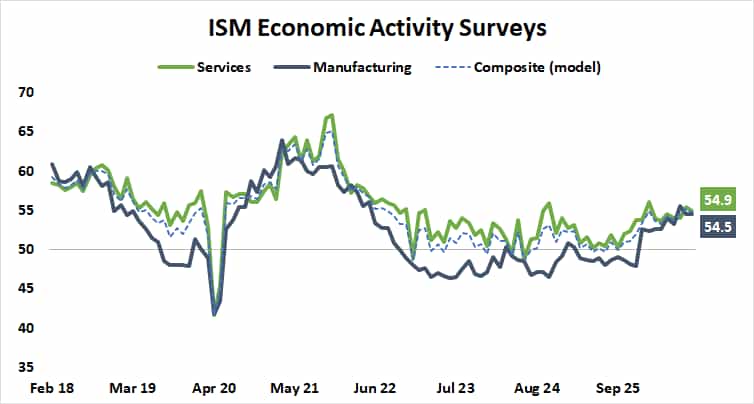
Service sector purchasing managers index (PMI) data from the Institute for Supply Management (ISM) looked steadier. The headline index slipped to 54.9, just below the 55.0 expected. Employment grew, new orders held up well, and the prices gauge surged again, a reminder that inflation pressure has not gone away. Taken together with last week’s manufacturing ISM survey, the data show overall growth holding steady near the top of its post-COVID range. That is far tamer than the S&P Global PMI surveys, where a final revision of September’s data argued for an explosive surge in business activity.
The result looks like an economy running at two speeds. The AI buildout is lifting tech stocks and business investment, while consumers look increasingly squeezed. Household spending makes up roughly 68% of US economic output. Business investment, where the AI firepower lives, is about 14%. If households retrench in earnest, the data center boom probably cannot offset it, and the tech lift under the major stock indexes could wobble too.
This week brings two tests of that balance. Minutes from the Fed’s September meeting arrive Wednesday, offering a window into how policymakers weigh short- and long-term inflation against the business cycle. Friday brings the University of Michigan’s consumer sentiment survey, which is expected to show another downtick.
Ilya Spivak, tastylive Head of Global Macro, has over 15 years of experience in trading strategy. He specializes in identifying thematic moves in currencies, commodities, interest rates and equities. He hosts Macro Money and co-hosts Overtime, Monday-Thursday. @Ilyaspivak
For live daily programming, market news and commentary, visit tastylive.com or @tastyliveshow on YouTube
Trade with a better broker, open a tastytrade account today. tastylive, Inc. and tastytrade, Inc. are separate but affiliated companies.