
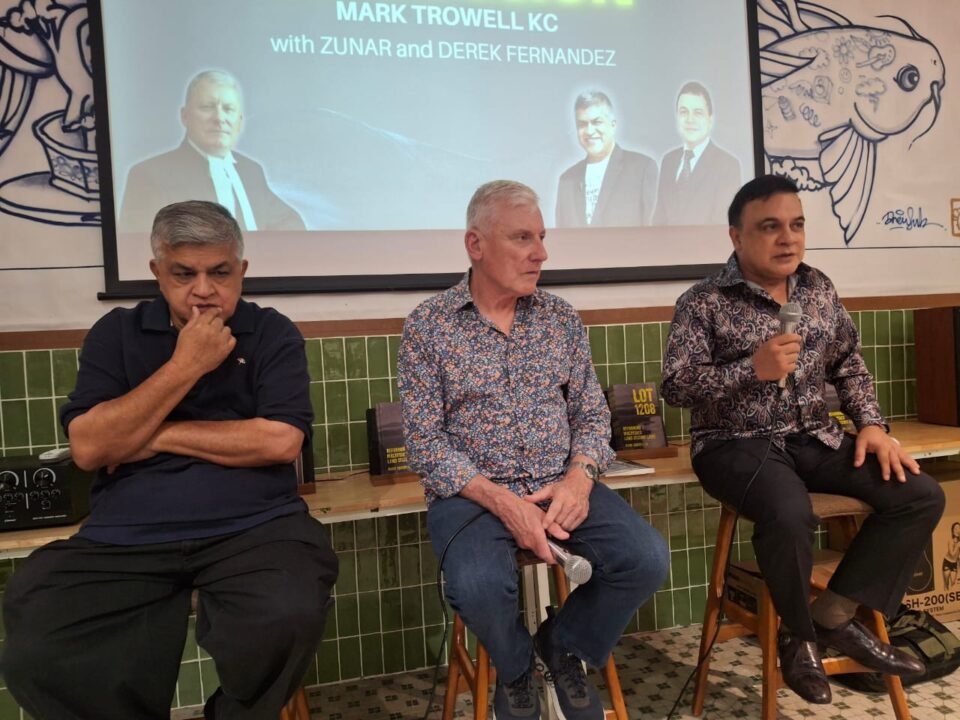
KUALA LUMPUR – Sections of the Land Acquisition Act 1960 that allow the government to compulsorily acquire private property for commercial purposes—beyond genuine public infrastructure—must be repealed to curb systemic abuse, lawyer and Malaysian Communications and Multimedia Commission (MCMC) Commissioner Derek Fernandez has warned.
Speaking at a panel discussion in conjunction with the launch of Mark Trowell’s new book, LOT 1208: Reforming Malaysia’s Land Seizure Laws, Fernandez urged lawmakers to strip away Sections 3(1)(b) and 3(1)(c) of the Act and restrict state acquisition powers strictly to verified public utilities.
“Just take off B and C. You can only acquire land for a public purpose. Full stop,” Fernandez declared during the forum.
Under existing legislation, Section 3(1)(a) empowers state authorities to acquire land for public utilities such as schools, hospitals, police stations, and major transport networks.
However, Section 3(1)(b) allows acquisition for private individuals or corporations if the state considers the project beneficial to economic development, while Section 3(1)(c) permits forced acquisition for general commercial, residential, agricultural, mining, or recreational projects.
Fernandez cautioned that the extreme breadth of these two sub-sections effectively allows private commercial interests to weaponize state power against landowners, drastically escalating the risk of abuse.
Ignored statutory safeguards
Fernandez stressed that beyond legislative reform, state authorities routinely fail to enforce existing statutory checks—most notably Section 3(6) of the Act.
Section 3(6) explicitly prohibits forced acquisition under sub-sections (b) and (c) if the original landowner has already obtained planning approval for the site and the acquisition is not intended for a public utility.
“This is the section that is completely ignored,” Fernandez said, pointing to historical land disputes including Kampung Baru, Kampung Buah Pala, and Kim Teng Park.
He emphasized that if Parliament refuses to outright repeal sub-sections (b) and (c), executive authorities must at minimum strictly enforce Section 3(6) controls.
Furthermore, Fernandez noted that statutory frameworks already exist allowing landowners to negotiate commercial joint ventures or equity participation with developers rather than being stripped of their titles outright—options he questioned are rarely offered in land disputes.
‘Living in fear’: Prolonged disruption for homeowners
Fernandez also targeted Section 4 notices, which allow state authorities to mark land in a specified locality as “likely needed” for acquisition without a firm timeline.
He noted that these preliminary notices leave property owners in legal limbo, unable to redevelop, sell, or negotiate their properties while living under constant threat of eviction.
“It’s really inconvenient. And you’re living in fear,” Fernandez said, urging affected communities to pursue class-action lawsuits to share legal costs and challenge questionable acquisitions in court.
“I would use collective action and go to court. If you’re united, you can actually achieve something,” he added.
Poor urban planning driving forced evictions
Addressing valuation and urban planning, Fernandez warned that affected landowners are frequently outgunned during land inquiries because securing fair market compensation requires costly private legal representation and independent professional valuers.
He assigned blame to flawed local council planning, where high-density commercial developments are routinely approved without adequate road infrastructure, prompting subsequent compulsory land acquisitions to fix traffic bottlenecks.
“Why does the road need to be widened? The traffic is very heavy. Why is the traffic heavy? Because you approved all those high-density developments over there, and now my house goes,” he remarked.
Fernandez warned that unchecked land acquisition powers erode both public trust in the rule of law and foreign investor confidence, calling on citizens to lobby their elected representatives.
“The violation of my neighbour’s rights is a violation of my rights,” he stressed.
Author Mark Trowell noted that his book LOT 1208 aims to humanize the issue through case studies, making complex legal mechanisms accessible to the public.
“Ultimately, the whole question about law is it should be fair. It should be fair for everybody,” Trowell said. – October 18, 2026