
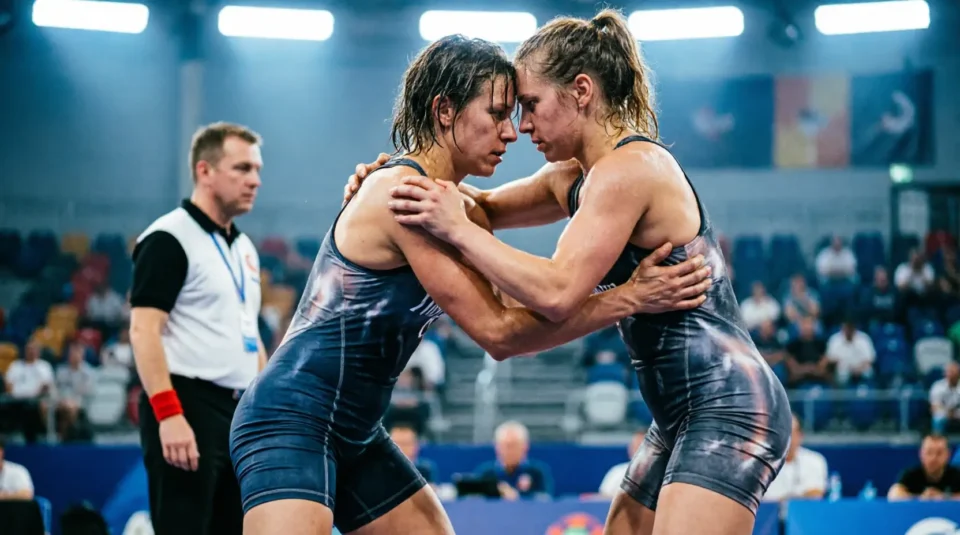
Indian wrestler Amruta Pujari delivered one of the standout performances of her young career by winning silver in the women’s 72 kg category at the U-23 World Wrestling Championships in Las Vegas, United States, on October 17.
The 22-year-old Maharashtra wrestler advanced to the gold-medal bout after two decisive victories by fall, defeating Kazakhstan’s Zhibekzhan Sabyrzhanova in the quarterfinal and China’s Wenjin Qiu in the semifinal. Her victory over Qiu was particularly significant because the Chinese wrestler had previously won major age-group titles.
Pujari could not complete the campaign with gold. In the final, Ukraine’s Iryna Zablotska took a 6–0 lead before pinning the Indian wrestler to secure the world title. Pujari therefore finished second in the 72 kg division, earning a silver medal at the international championship.
Although the final did not go her way, reaching the title bout required Pujari to defeat two international opponents in succession. Her performance demonstrated her ability to compete successfully against wrestlers from established wrestling nations and progress through the elimination rounds of a world-level event.
Two pinfall victories carried Pujari into the final
Pujari’s route to the final was built on decisive results rather than narrow points victories.
In the quarterfinal, she defeated Kazakhstan’s Zhibekzhan Sabyrzhanova by fall. She then produced another pinfall victory in the semifinal against China’s Wenjin Qiu, securing her place in the gold-medal match.
The semifinal result added weight to her campaign because Qiu was a highly regarded opponent with previous success in international age-group wrestling. Pujari’s victory gave India a representative in the 72 kg final and created an opportunity to compete for the world title.
The final against Zablotska proved more difficult. The Ukrainian wrestler established a 6–0 advantage and then ended the bout by pinning Pujari. The result confirmed Zablotska as champion, while Pujari took silver.
For a wrestler moving through the under-23 international circuit, the campaign provided both a major medal and experience against a range of opponents. The contrasting outcomes of the semifinal and final also underline how quickly wrestling bouts can change through exposure points, control and pinning opportunities.
A second international milestone in the same year
Pujari’s silver in Las Vegas followed a bronze medal at the U-23 Asian Championships in May 2026. The progression from a continental medal to a world championship final marks a notable step in her development.
The Maharashtra wrestler comes from Shirol in Kolhapur district, a region with a strong wrestling culture. Her rise has also been linked to a sporting environment in which wrestling has long been part of local life and family traditions.
Progress at under-23 level can be important for athletes seeking to establish themselves in senior international competition. Results at this stage do not guarantee future senior titles, but they provide evidence of an athlete’s ability to handle international opponents, tournament pressure and the demands of multi-round competitions.
Pujari’s two pinfall victories before the final were particularly valuable because they showed that she could finish bouts decisively. The next challenge will be to build on that performance, refine her approach against top-level opponents and translate her age-group success into sustained results.
India’s women wrestlers finish with two medals
Pujari’s silver was one of two medals won by India’s women wrestlers at the championship. Komal secured bronze in the women’s 59 kg category earlier in the tournament.
India’s Sweety narrowly missed another medal in the 53 kg division, losing her bronze-medal bout to Ukraine’s Anastasiia Polska by technical superiority. Sweety had reached the medal contest after defeating China’s Xiaotong Zeng in the repechage round.
Vaishnavi Patil also had a repechage opportunity but lost to Japan’s Haruka Kobaru. These results show that India had several athletes competing in the medal rounds, even though only two women returned with medals.
At the wider tournament level, Pujari’s silver also added to India’s overall medal count. Greco-Roman wrestler Vishvajit More had earlier won silver in the men’s 55 kg category, a historic result for India in that discipline at the U-23 world championships.
The performances offer a useful picture of India’s under-23 wrestling prospects: individual athletes are reaching finals and medal bouts, while consistency across weight categories remains an important area for continued development.
Why the result matters beyond one medal
A world championship medal is a meaningful achievement, but Pujari’s campaign also provides a clearer indication of the level required to progress internationally.
Her quarterfinal and semifinal victories showed the value of converting attacking opportunities into decisive finishes. The final, meanwhile, exposed the difference that a small number of scoring sequences and a pinning position can make at the highest level of age-group competition.
For developing wrestlers, such experience can inform future training in defence, positional awareness, match management and recovery between bouts. The medal itself is a positive outcome, while the final also gives Pujari and her coaching team specific areas to review.
India’s wrestling programme will benefit most if strong individual results are supported by consistent competition exposure, coaching and a pathway from junior and under-23 events into the senior circuit.
What happens next?
Pujari’s immediate achievement is a silver medal at the U-23 World Championships. Her next steps will depend on upcoming selection decisions, training plans and the international competitions available in her weight category.
The result does not automatically determine selection for senior world championships or future multi-sport events. Those opportunities depend on the relevant selection criteria, performance requirements and decisions by the national wrestling authorities.
Her performance in Las Vegas nevertheless gives her a strong result to build on. Reaching a world final at 22, after winning a continental bronze earlier in the year, places her among the Indian wrestlers to watch as she continues developing at international level.