
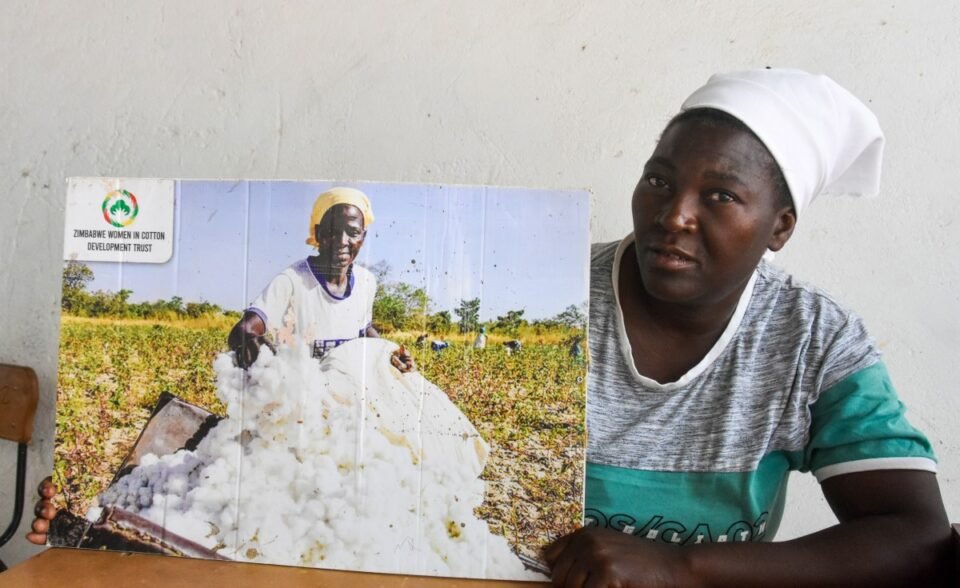
Women cotton farmers in Zimbabwe’s Shamva district are turning to sewing and collective savings to diversify their incomes and adapt to a changing climate. Making school uniforms and taking clothing orders, they are creating earning opportunities beyond the crop they call their “white gold”.
For Brenda Dzuda, cotton is “white gold” that helps support her household in a community where, she says, women have few alternatives for earning a living.
But the 48-year-old widow who farms four hectares in Shamva, Mashonaland Central, says unpredictable weather, poor seed and disappointing prices are making it harder to realise the value in her gold.
“Shamva is a very dry region, and most men survive on illegal gold mining. But for us as women, cotton is our white gold,” she said.
Dzuda and other women farmers say cultural expectations and traditional restrictions limit their participation in mining. Cotton offers a way to earn, but increasingly, they are looking beyond the fields to sustain their households.
Through sewing and collective savings, women in Shamva are creating another source of income when harvests disappoint, or cotton payments arrive late.
Keep up with the latest headlines on WhatsApp | LinkedIn
When the Weather Becomes an Economic Burden
Across the fields, dry stalks remain where cotton plants once stood. The harvest has been packed into sacks, some already sold by farmers hoping to turn a season’s labour into household income.
But returns have not always matched expectations. Seed, fertiliser, chemicals and labour demand investment before farmers know what the harvest will bring. Unpredictable rainfall, prolonged dry spells and high temperatures add to the uncertainty.
“Cotton does not require much water, but the rains are no longer reliable. Sometimes they come earlier than expected or heavier, and sometimes the dry spells last longer than cotton can withstand. We are worried because our livelihoods depend on this crop,” said Dzuda.
Zimbabwe’s Meteorological Services Department had forecast an erratic start to the 2025–26 rainfall season, followed by improved rainfall prospects from December. For farmers such as Dzuda, the timing and distribution of rain shape planting decisions and crop development.
Dzuda said she was selling her cotton for US$0.24 a kilogram, questioning both the price and the quality of seed supplied to farmers.
“The money we are selling per kilogram versus the world market price is very upsetting. We are also not getting the best seed, then our cotton is sold as a third grade; then on the other side we are constantly attacked by the shift in weather patterns. This is a double blow for us,” she said.
For her, adapting means getting the crop through the season and earning enough to justify the investment. She also wants support for women to turn cotton into products beyond the raw crop.
“We had an exchange with women cotton farmers in Malawi, and they are doing value addition. As Zimbabwe Women in Cotton, we also wish to have backyard industries because in cotton we get toilet paper, cooking oil, stock feed and many others. We can do that on our own,” she said.
Seventy-four and Still Waiting
About 60 kilometres from Dzuda’s farming area, 74-year-old widow Getrude Motsi faces another part of the struggle.
At her home, sacks of harvested cotton remain stored, waiting to be sold. The crop represents months of work and money that could meet household needs or help finance another season.
“I have been growing cotton since 2014, and for the past seasons everything seemed to be going well; weather conditions are worsening, and the severity of it is the most scariest,” she said.
Motsi said delayed payments compounded the difficulties caused by the weather, weakening the economic security she had relied on cotton to provide.
Her experience shows how uncertainty can continue after the work in the fields is complete. A farmer must grow and protect the crop, harvest it, find a buyer and then receive payment.
Until then, the value of that work remains tied up in the cotton.
How Cotton is Priced and Paid For
Responding to farmers’ concerns about prices, grading and payments, the Cotton Company of Zimbabwe (COTTCO) said producer prices were benchmarked against international market fundamentals in consultation with regulators.
A company representative said cotton was graded from A to D based on fibre maturity, cleanliness, colour and trash content.
Farmers initially receive a base payment at the lowest grade, D, paid 70% in US dollars and 30% in Zimbabwe Gold, or ZiG. COTTCO said these initial payments had been made in full for the past season.
The company said it was completing laboratory grading and raising funds for additional payments to farmers whose cotton qualified for Grades A, B or C.
COTTCO also said it worked with the government’s Presidential Input Programme to provide subsidised seed, fertiliser, chemicals, herbicides and mechanised tillage services.
Addressing concerns about seed quality and weather risks, it said it supplied certified seed, including drought-tolerant, early-maturing varieties. Extension officers trained farmers in moisture conservation, input placement, weed control and integrated pest management.
For farmers, payment timing and the income remaining after production costs help determine whether they can support their households and plant again.
Another Way to Earn
Patience Zhakata, national chairperson of Zimbabwe Women in Cotton, said the restrictions women described around mining reflected wider questions about their ability to make economic decisions, own productive assets and control the proceeds of their labour.
“So as an organisation, cotton is white gold because that is the only field we can mine without restrictions,” she said.
Cotton has offered women a route into agricultural enterprise. Now, they are working to create income beyond the crop.
In 2022, the group approached Zimbabwe’s First Lady, Auxillia Mnangagwa, who assisted them with sewing machines, to which they started a sewing project in February 2023. Women are using the machines to make clothes and mend garments for people in their communities.

Sign up for free AllAfrica Newsletters
Get the latest in African news delivered straight to your inbox
Happiness Marape, a trainer in the sewing project, said 60 women in Shamva participated, meeting on different days so everyone could use the machines.
“The initiative has 60 women in Shamva who meet weekly but on different days so that we all get access to the sewing machines. The sewing machines initiative came as an idea to counter climate shocks which are always attacking women, cotton farmers.”
The group takes orders for school uniforms and other garments, as well as repairs. Members also save together, creating a fund they can draw on for household needs and farming expenses.
“We also do savings as a group to assist each other financially or loan when we want to buy farming inputs,” Marape said.
The sewing work provides income beyond the agricultural season and another source of earnings when farming falls short.
“The sewing initiative is helping us a lot. When the fields fail to produce, we then rely on sewing, telling people that we work from cotton to the fabric. We get money from there and put it in our savings, and we all benefit,” she said.
Sewing does not resolve the problems of cotton prices, production costs, or delayed payments. But it gives the women another way to earn while they continue farming.
Back in Shamva, Dzuda’s description of cotton as women’s “white gold” still carries hope. For the women building savings from stitches as well as harvests, its value is measured in what their work can provide: money for their households and a way to begin the next season.