
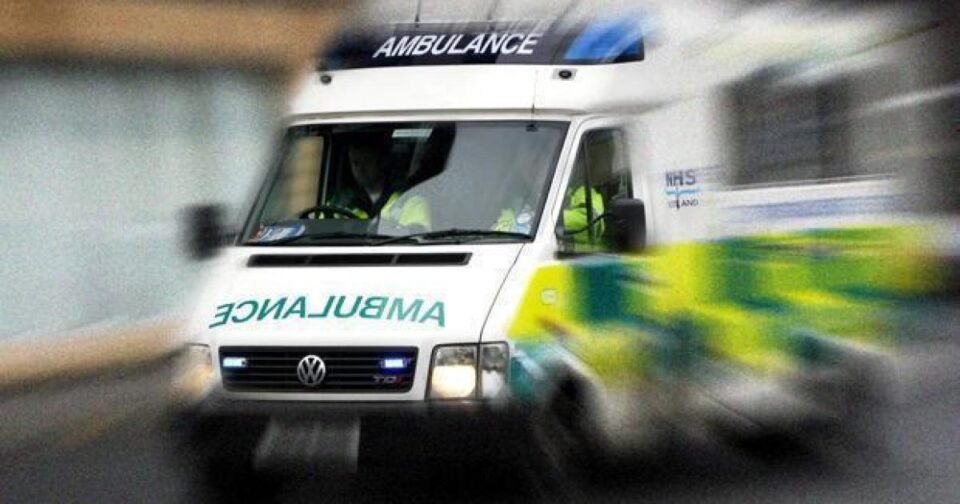
The next day, with the power still out, and concerned that an elderly neighbour may be struggling to heat water, a woman braves the storm and knocks on his door.
She hears him calling for help. Fallen and in pain, he has been on the floor much of the night.
A neighbour is dispatched to the next village to get the doctor. Upon seeing the patient, the doctor must drive back home to summon the ambulance before returning to the invalid’s bedside.
Many hours later, the ambulance arrives. It will be 60 long miles through the night before they finally reach the hospital.
The year? 2026.
Second sight was reported in our family way back in the mists of time, but I don’t need it to know that if something is not done fast about the safety of our rural communities as the analogue switch-off begins to bite, then someone is going to die. At this rate, if it is only one, we should count ourselves lucky.
I live and breathe tech. I love it. I have an unhealthy relationship with my laptop; I’m on first-name terms with more than one AI assistant, and there is little I love more than finding a digital solution to a problem.
I also go outside regularly and touch grass, listen to the forecast, and appreciate the power of nature to play absolute havoc with the strongest of objects. In the islands, things you think are fixed to the ground are often – to your horror – not. I have no doubt that in some cases, new-fangled is the answer. Sometimes, though, new-fangled is not the answer you need.
The equation is extremely simple, and the amount of time I, and others, have spent trying to communicate it is frankly soul-destroying. For argument’s sake, let’s go through it again.

Phones now need two things to work – some form of internet and some form of power. When there is no power, there is no internet. If there is no power and no internet, you cannot use the phone. If you cannot use the phone, then you cannot call 999.
Ah! But there is 4G. Just use your mobile, right? Wrong.
As I had to explain to a Right Honourable Scottish Affairs Committee member in February, 4G is, in fact, the internet. It is in a cable that goes up a mast and is broadcast out the top. The mast needs power to work. So, even if the internet is technically working, if the mast has no power, there is no signal. If there is no signal, you cannot make a call, and if you cannot make a call, you cannot phone 999.
Surely masts have battery back-ups? Well, you would think that, yes. Especially in rural locations, which might be some distance from help, or another mast?
They do. An hour on paper, maybe. In reality, 30 minutes seems to be the length of the battery back-ups in some parts of the Western Isles, according to those who rely on them. That gives you precisely 30 minutes to need 999, or tough chuckies, you will need to dispatch a neighbour to knock on the doctor’s door or hunt down the retained firefighters. Even an hour’s back-up, in the midst of a multi-hour power outage, is far from adequate.
This is 2026. If this story, of a village with no power, no working phones and no mobile signal, where the doctor had to be fetched and then couldn’t call an ambulance without changing location, was a one-off, that might – might – be allowable. But this is not a one-off.
My starting story is true. It played out in a village in Harris last weekend. Crossroads Harris, who look after elderly people living alone, could not reach clients or carers, and “there was absolutely no communication whatsoever available”, as they put it.
The red-button alarms provided through the Comhairle’s Faire service could not raise an alert either, because every mobile network was down at once. The Comhairle says Faire itself was fully functional, but depends on the user’s network. A similar story is being told in Berneray. Raasay and other islands also reported no power and no communications for anyone relying on digital services or mobile signals.
It is a story being repeated far too often. What’s worse is that neither government seems to care enough to do something concrete about it with any urgency.
It has been a year since the same thing happened in Tiree. We kicked up a stink and made headlines. And to date, nothing, not one thing, has changed.
Are communications providers mandated to provide x number of hours of back-up battery? No. When Ofcom updated its guidance in June, it set no minimum number of hours for mobile masts at all.
Are they mandated to have a satellite failover? No. Can people still be issued with fall alarm systems in rural areas that rely entirely on digital connections without anyone stopping to think what happens when the power goes out? Yes, absolutely. Is the analogue switch-off continuing apace? You better believe it, baby. It is due to finish at the end of January.

When Torcuil Crichton, the Western Isles MP, stood up in the Commons on Tuesday and called Openreach’s battery back-up plans “simply not adequate”, the minister answering was Dan Jarvis, who also leads Be Ready, last week’s three-days-of-tins campaign. This problem needs more than tins.
If only there was a solution. If only we could find a way to let people communicate in the absence of power and internet. If there were a tool we could employ, at low voltage, to connect people all over the country and ensure that in every village, if not every house, there was a device to ring the emergency services in the event of a major outage.
If we could use an existing infrastructure to do it, that would be incredible. Think of the money we would save. What if you could plug in a device that requires no power, and still make a call? The mind boggles.
We could pour billions into solving that problem, or, bear with me for a minute, we could resurrect a system we are hell-bent on switching off. It’s an existing infrastructure requiring very little power and generally one which worked very well.
I can’t decide whether the Highlands and Islands are simply expendable, or whether the people in charge are stupid. It’s got to be one or the other, because I can’t believe that anyone can look at the facts as they are and genuinely think that it’s a risk worth taking.
Maybe it’s because the cities appear to be fine. There are lots of mobile masts and power grid workarounds. There are plenty of roads out. Whatever are the yokels moaning about? Surely they can just cling to their cows for warmth, summoning the spirit of the ancestors for guidance.
Some of us are going to start summoning something soon, if people don’t start listening. Do people actually need to die before steps are taken? Before someone in power finds a bit of compassion, and a smidge of common sense, and acknowledges that maybe, just maybe, the great digital future is not so great unless you have some sort of back-up?
And since we have a back-up, might we consider using it rather than throwing it out with the stormwater?
I used to plug my Gran’s old phone in when the forecast turned. I can’t any more. I’ve gone digital, and my old copper line doesn’t work. The Scottish Affairs Committee heard all of this in February. I know, because I was there.
Its report on digital connectivity is due by the end of the year. It had better carry some strong recommendations, because when someone dies, nobody in power will be able to say they weren’t warned.