
| By Scott Jenkins
Poly(dicyclopentadiene), or pDCPD, is a thermoset plastic often used with fiberglass or carbon fibers to make high-strength, lightweight composite materials. Such composites are difficult to recycle practically, leaving environmentally harmful incineration as the most common end-of-life scenario. Now, a team of researchers led by The University of Texas at Austin (www.utexas.edu) and Sandia National Laboratories (Albuquerque, N.M.; www.sandia.gov), and involving collaborators from the University of Illinois at Urbana-Champaign (www.illinois.edu) and the Massachusetts Institute of Technology (Cambridge, Mass., www.mit.edu), has developed a method for breaking down pDCPD composites and allowing the intact fibers to be recovered for re-use.
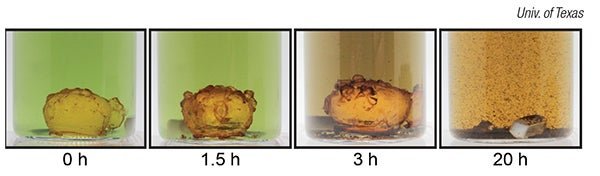
The method is derived from the ruthenium-catalyzed ring-opening metathesis polymerization (ROMP) of pDCPD, in which pDCPD polymers are created as cyclic alkenes open and form covalently linked chains. In the case of the recycling process, the reverse reaction is in play, where ring-closing olefin metathesis is used to deconstruct the polymer structure. The technique for breaking down the pDCPD was discovered inadvertently as the researchers were investigating how metathesis in a post-processing step might alter the polymer network structure. “In a serendipitous and somewhat surprising discovery, we found that a toluene solution of the ruthenium catalyst completely dissolved the pDCPD,” explains Zak Page, a UT Austin associate professor of chemistry and member of the research team. “That discovery prompted us to explore ways to take advantage of these Ru-catalyzed metathesis deconstructions for recycling composites.”
The UT-Sandia team eventually demonstrated the breakdown of pDCPD with the ruthenium catalyst at ambient temperatures using cyclopentyl methyl ether (CPME), a more environmentally benign solvent than toluene and xylenes. The researchers were also able to carry out the dissolution of the polymer without requiring inert atmosphere, Page notes. “As the catalyst enables the ring-closing deconstruction of pDCPD, the fragments dissolve in the solvent,” Page says. “Any glass or carbon fibers that were present in the plastic can be recovered in pristine form for re-use in new materials,” he says. A lifecycle analysis conducted to evaluate the viability of the process indicated that recycling composites using this method could potentially reduce CO2 emissions significantly, but that the economics of the process depend on the ability to effectively recover the ruthenium catalyst, among other factors. The UT-Sandia group is carrying the work forward by investigating scalability questions and catalyst recovery. The team’s work is detailed in a recent issue of Science Advances.