
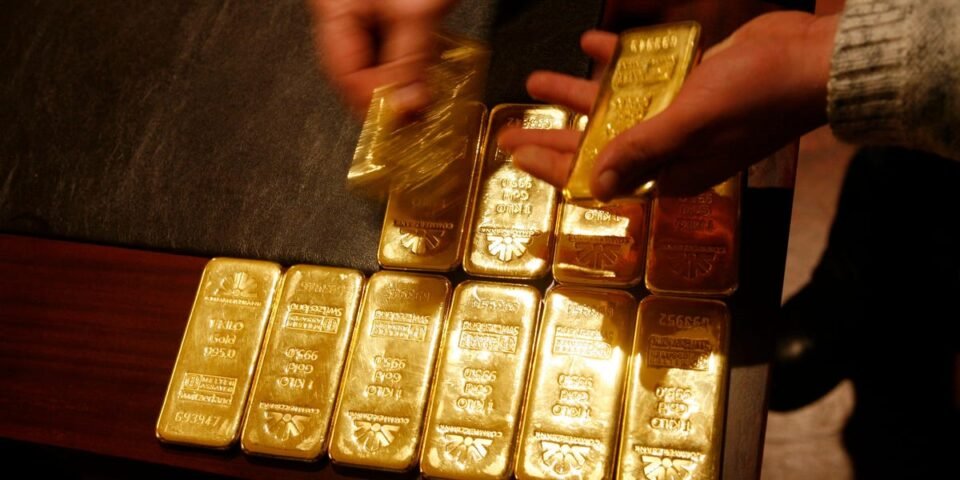
Gold is barreling toward its worst year in over a decade.
The correction in AI stocks has sucked up investors’ attention lately, but it’s overshadowed a quiet, dramatic move in gold prices this year. The yellow metal, which was one of the hottest investments in 2025, is down about 29% from its January high, trading below $4,000 an ounce on Tuesday.
The whipsaw is the result of a few things plaguing the US economy and markets this year, from higher rates to a panicked risk-off move in stocks.
Gold is now down 9% for the year — putting it on track for its worst annual performance in 11 years, when it plunged around 10% in 2015. The precious metal also dropped more than 3% in October, marking its worst October since the Great Financial Crisis, according to an analysis from economist David Rosenberg.
It’s unusual for gold to sell-off in tandem with stocks. The safe haven is thought to slowly appreciate and provide a safe haven when stocks are volatile or when markets get rocked by geopolitical events. Demand for gold also generally picks up when inflation fears are on the rise, as investors see it as a hedge against a devalued fiat currency, but that hasn’t proven true in 2026 either, even as the Iran war causes oil and gas prices to spike.
“Gold is now behaving in too much of a bizarre and unpredictable pattern, and traditional correlations have broken down,” Rosenberg wrote this week. “Gold is increasingly behaving like a risk asset, which is an entirely new dynamic.”
So, what gives?
There are a few unusual reasons the precious metal has continued to slide this year, even amid circumstances that would normally stoke a rally. Here’s what’s been driving the decline — and what it says about the US economy and markets, according to analysts.
Yields are higher
CFOTO/Future Publishing via Getty Images
While fears of hotter inflation have normally boosted gold prices, higher rate expectations lift Treasury yields and the value of the US dollar, two safe-havens that compete with gold for capital.
Treasury yields are elevated across maturity curve, attesting to ongoing fears about the US fiscal outlook and higher inflation overall. The benchmark 10-year US Treasury yield was around 4.91% on Tuesday, up 77 basis points year-to-date.
The weakness in gold also reflects investors’ bullishness for the greenback, Rosenberg said, attesting to how markets are focused on the expectation for higher interest rates. The US Dollar Index, which weighs the dollar’s value against a basket of other major currencies, ticked up to 101 on Tuesday, up 3% since the start of the year.
What it says about the economy: Higher interest rates are the big story. That’s increased the opportunity cost of holding gold, while a stronger US dollar has made it more expensive for international buyers to purchase bullion, Adam Perry, a senior market analyst at Capital.com, said.
The Fed put its rate-hiking cycle on pause at its last policy meeting, but investors expect the central bank to resume tightening heading into 2027. Markets are now pricing in a 75% probability the Fed will raise rates another quarter of a percentage point before the end of the year, and a 21% probability that will be followed by another quarter-point hike in January.
Demand for gold is falling
VCG/VCG via Getty Images
Central banks continue to be major buyers of gold as they diversify their reserves, but demand from other segments is fading. Much of the decline was fueled by people purchasing less physical gold and gold jewelry, the World Gold Council said, noting that bar and coin demand has fallen 19% year-over-year, while global jewelry demand is down 17%.
In the US, gold jewelry revenue is up overall, but unit sales have declined. Gold jewelry growth is concentrated at “higher price points,” though “lower-priced merchandise” is underperforming, according to a September report from the analytics firm Tenoris.
What it says about the economy: The K-shaped economy may be playing a role in gold’s decline this year, with more aspirational luxury shoppers pulling back on gold purchases as inflation curtails spending. A worldwide slowdown in jewelry and luxury goods may also be a factor, particularly as consumers in the US and China rein in spending overall.
“Whether described as a K-shaped economy, market bifurcation, or a shift in the composition of consumer spending, the data point to a jewelry market increasingly divided by price point,” Tenoris wrote in its monthly report.
Gold’s decline is largely a rates story, but consumers pulling back certainly “can move the needle,” Jose Torres, a senior economist at Interactive Brokers, told Business Insider.
“I think it’s been that combination of forces,” he said.
The AI sell-off is rippling across markets
Michael Nagle/Bloomberg via Getty Images
Investors may be looking to sell gold to build up more cash on the sidelines, according to Perry. It’s a testament to how negative investor sentiment has been lately, given the brutal losses in the AI trade, with the Nasdaq 100 slipping into an official correction and shedding around $2 trillion in market cap since hitting a record in early October.
“This helps explain why gold fell sharply alongside equities on Friday, despite heightened uncertainty,” Perry wrote in a note to clients.
Margin calls on tech positions may also have forced investors to sell gold lately, Rosenberg said, noting that those trading on margin may receive calls from their brokerages asking them to deposit more cash to backstop losses on their stock holdings. Debit balances in customers’ margin accounts sat near a record high in October, FINRA data shows.
What it says about markets: Risk-off sentiment may be so extreme that investors are selling gold instead of using it as a safe haven.
“Investors liquidating other assets in the process… if you recall, we saw this take hold briefly in the fall of 2008 and after the 9/11 terrorist attacks as well,” Rosenberg said.
Investors were also highly exposed to gold after its meme-like rally in 2025, Torres noted.
Gold may be in a yearslong technical holding pattern
Mario Tama/Getty Images
Gold has historically seen large upswings before entering a period of near-zero gains, Torres said. He pointed to the metal’s double-digit rally in 2025, which mirrored gold’s explosive rally coming out of the Great Financial Crisis. The metal stagnated for the following decade before seeing a similar run-up, he noted.
Gold may be entering a similar yearslong technical holding pattern with subdued gains, Torres said, adding that investors may be more focused on other assets, like stocks and real estate, for stronger returns.
“If you just generally don’t have the investor demand, then it can’t really rally,” he said of the outlook for gold.