

Hassan Istiila
Friday April 24, 2026

On the roadside in Elasha Biyaha, about 15 kilometers from Mogadishu, Sharmarke Aden sits in his bajaj scrolling through his Samsung phone, trying again and again to retrieve his digital national ID.
The app is called eAqoonsi, part of Somalia’s push to move public services online through digital systems. In theory, it should save Aden the time and cost of traveling to a registration center, waiting in long queues, and losing a day’s income. In practice, weak internet and limited data have turned a simple task into a two-day struggle.
“The problem is not the app, but sometimes my internet is weak, and also my digital skills are not at the level where they help me,” he said.
For Aden, digital government is not just a big policy idea. It is about something very practical: can an ordinary working person get a basic service easily without wasting time, losing income, or becoming frustrated? His experience shows the main challenge in Somalia’s digital transformation. The country wants to build a modern digital government, but many people still face serious obstacles such as weak internet access, limited digital skills, and living far from government services.
This is where Somalia’s digital public infrastructure (DPI), becomes important. DPI includes core systems like digital ID, digital payments, and secure data-sharing that help governments and other actors to deliver services at scale. Experts said it can cut bureaucracy, lower costs, improve transparency, and expand access to services. But if it is not built for real conditions, it can exclude more people instead of helping them.
Somalia is increasingly turning to digital public infrastructure, systems such as digital ID, payments, and data-sharing to improve how citizens access government services. Somalia Digital Public Infrastructure Summit 2026 communique said these tools could reduce bureaucracy, cut costs, and expand access, but warn that if they are not designed for Somalia’s fragile and unequal conditions, they risk excluding the very people they are meant to help.
In Somalia, eAqoonsi is emerging as one of the clearest examples of that ambition. The app is linked to the national identification system and is designed to give users a digital version of their ID and, eventually, access to a wider range of government services.
Officials at National Identification and Registration Authority say the goal is to build a more integrated digital government. But it remains unclear how many Somalis are able to complete the registration process, which still requires an in-person visit to a NIRA center before users can activate the digital ID. There is limited public data on how long the process takes or how many applicants drop out before receiving their credentials.
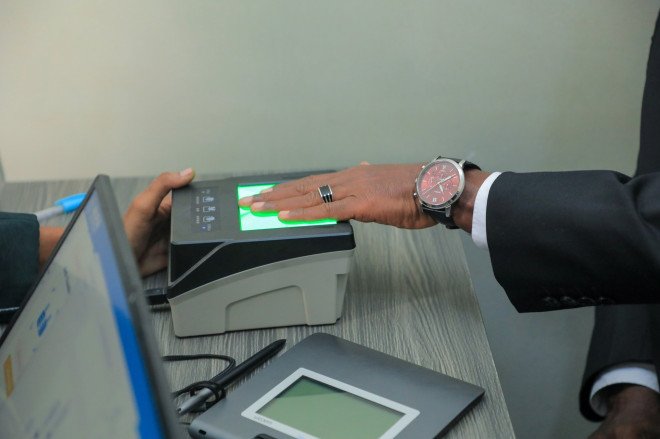
“First, a person must go to the NIRA centers and register physically and be given an 11-digit national ID, then you can make the ID card itself digital, and then you can access government services,” said Mohamed M. Mohamed, NIRA’s director of enterprise services and digital partnerships.

Mohamed M. Mohamed, NIRA’s director of enterprise services and digital partnerships
That process reflects a core principle of digital public infrastructure: once a person’s identity is securely established, that verified identity can be reused across multiple services. In theory, that means citizens do not have to repeat the same paperwork again and again when dealing with different agencies.
But theory is only one part of the story.
For some citizens, eAqoonsi is already delivering on its promise. Sadia Ali, who lives in Mogadishu and has reliable internet access, said she was able to obtain her digital ID without visiting a NIRA center again.
“I would have had to go to the NIRA center and queue up early in the morning, but now I have a valid digital ID at home,” she said. “I would like to see more government services made online so that it is less cumbersome.”
Her experience offers a glimpse of what a functioning digital state could look like: fewer trips, less paperwork, lower transport costs, and easier access to services from home.
But for Aden, who lives in Elasha Biyaha and commutes into Mogadishu for work, the app is far less straightforward. He drives a bajaj for a living, and under a city system that divides the vehicles into two groups, yellow and blue, labeled A and B, one group works one day and rests the next. His off-day is the only time he can deal with paperwork or personal errands. Yet the digital alternative has also proved difficult because of weak internet and limited digital confidence.
Ibrahim Mohamed, an elderly man recently displaced from a rural area in the Bay region but now lives near Mogadishu, is unfamiliar with the digitalization process and faces difficulties accessing services that are becoming more digital.
“I do not understand these new systems, when services move online, people like me are left behind because we do not know how to use them,” he says.
That contrast between the user for whom digital access is liberating and the user for whom it remains frustrating is the real story of Somalia’s digital transition. The issue is not simply whether the app exists. It is whether the social and technical conditions exist for people to use it equally.

Somalia aims to issue 15 million national IDs by 2029, and nearly two million people have registered so far. However, National Identification and Registration Authority has not publicly disclosed how many digital IDs have been downloaded through eAqoonsi, despite Google Play indicating more than 50,000 downloads, or how many registration centers operate nationwide.
Requests for this data sent to NIRA’s data department were not answered. The lack of publicly available figures makes it difficult to assess how widely the system is being used, how effective it is, and whether it is reaching the populations it is intended to serve.
A secure and widely accepted national digital identity can help citizens prove who they are when accessing both public and private services. In many countries, digital ID becomes a gateway to everything from government records and licenses to banking, education, SIM registration, taxation, and commerce.
Using eAqoonsi requires several steps. A person must first register physically with NIRA and receive an 11-digit national ID number. After that, the user can download the app, verify their account through a one-time password sent to a phone or email, upload or confirm information, and access a digital ID. For digitally confident users, those steps may seem routine. But for others, each step can become a barrier.

Associate Professor Dr. Yahye Abukar Ahmed delivering keynotes January 2026
Associate Professor Dr. Yahye Abukar Ahmed, who has led programs related to technology and the facilitation of government services, said the implementation of Somalia’s e-ID system faces challenges in internet availability and digital literacy.
He noted that while mobile connections have expanded significantly, internet usage remains much lower. That means a large share of the population may still struggle to benefit from online-only services.
“There is a risk that this system will leave women, the elderly, and people with disabilities behind,” he said.
Ahmed argues that Somalia should follow the “5A” framework, availability, affordability, awareness, ability, and accessibility. He also recommends multi-channel access, including SMS or USSD options for people without smartphones, as well as disability-friendly design and assisted registration in remote areas and displacement settings.
“Not every woman has a smartphone, internet access, or the knowledge to use digital services. If the system is not made simple and inclusive, it will exclude many women,” Hawo Yare said during a brief interview.
She called for expanded public awareness and digital education efforts to reduce digital illiteracy across the country, particularly in the regions.
Mohamed emphasized that NIRA has legal, data protection, and cybersecurity departments, and that users are asked for consent when their data is accessed. OTP verification, he said, is one of the safeguards intended to reduce misuse.
Somalia’s main legal framework for personal data is the Data Protection Act, 2023, supported by an independent authority. While National Identification and Registration Authority (NIRA) has published a privacy policy, there is little public information on security audits, technical standards, or how breaches are reported.
Those gaps have drawn greater scrutiny since the 2025 e-visa data breach, which exposed vulnerabilities in a key government system. Authorities announced an investigation at the time, but have not publicly released its findings or outlined any reforms. The lack of follow-up has fueled public frustration and raised broader questions about whether citizens can trust new digital services, including eAqoonsi, to protect their personal data.
The national ID matters now because it is increasingly becoming a requirement for accessing essential services in Somalia, including travel, banking, and some forms of public support. As more government systems move online, the ID is also becoming the key that connects citizens to digital services through platforms like eAqoonsi.

Across East Africa, governments are expanding digital service delivery. In Kenya, the eCitizen portal integrates thousands of services across ministries, counties, and agencies into a single platform.
Somalia’s eAqoonsi points in a similar direction, but from a more constrained starting point, shaped by limited infrastructure, uneven internet access, and incomplete national ID coverage. Analysts say Somalia could adopt elements of Kenya’s model such as consolidating services into a single portal and prioritizing high-demand services but a full replication would be difficult without stronger institutional coordination, wider connectivity, and higher levels of public trust in government systems.
Somalia’s digital ID system reflects a strong push to modernize public services, but the real test is whether it works for all citizens, not just those with better internet, stronger digital skills, and easier access. Until barriers such as weak connectivity, low digital literacy, phone ownership, disability access, language barriers, limited transparency, and unequal access are addressed, the benefits of digital government will remain uneven. In that sense, eAqoonsi is not only a story of innovation, but also a test of inclusion, accountability, and public trust.