
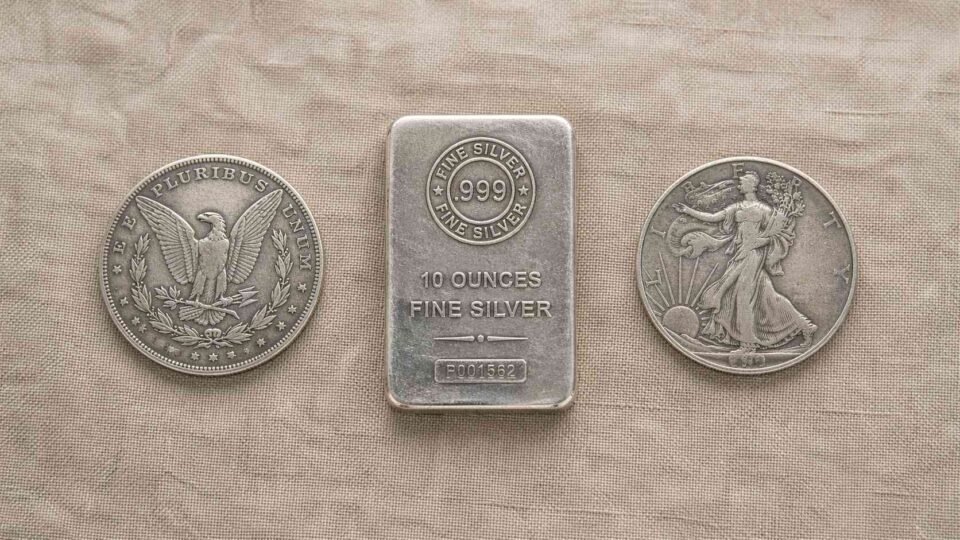
Silver at ~$79 per ounce in April 2026 trades roughly 34% below its January all-time high of $121.64 — and for long-term investors, the core decision isn’t whether to buy silver, but what form to buy it in. Coins, bars, and rounds all contain the same .999 fine silver, but they differ significantly in premiums, liquidity, IRA eligibility, and resale dynamics. This guide breaks down every format so you can make the right choice for your situation.
Silver hit a nominal all-time high of $121.64 on January 29, 2026, then pulled back to around $79 by late April. That ~34% correction looks significant until you consider that silver gained approximately 144–147% across 2025 — its sharpest annual advance since 1979 [BlackRock].
Meanwhile, the structural forces behind that rally are still in place. The silver market is heading into its sixth consecutive annual supply deficit in 2026, with demand outpacing supply by an estimated 46.3 million ounces — a 15% wider shortfall than the year before [Silver Institute, World Silver Survey 2026].
The question has shifted. It’s no longer whether to own silver. It’s which form to buy. For a full breakdown of the forces behind this market, see GoldSilver’s Silver Price Forecast 2026–2027.
What Are Silver Coins, Bars, and Rounds?
Physical silver comes in three investment formats. The differences go well beyond appearance.
Silver coins are minted by sovereign government mints — the U.S. Mint, the Royal Canadian Mint, the Perth Mint, and others. They carry a nominal face value and legal-tender status. The American Silver Eagle, the Canadian Silver Maple Leaf, and the Austrian Vienna Philharmonic are the world’s most recognized examples. That government backing is real — but symbolic. You’d never spend a Silver Eagle at its $1 face value when spot silver trades near $79.
Silver bars, by contrast, are rectangular pieces of refined silver, stamped with weight, purity (.999 or .9999), and the refiner’s name. Produced by LBMA-accredited refiners like Valcambi, PAMP Suisse, Asahi, and the Royal Canadian Mint, they come in sizes from 1 oz to 1,000 oz. No face value, no government backing — just silver.
Silver rounds are privately minted coins. They share the shape and purity of government coins but carry no legal-tender status and no face value. Private mints run leaner than government facilities, and those savings pass directly to the buyer — rounds typically carry the lowest premiums of any coin-shaped product [CBS News].
Your Gold Buying Guide Most investors overpay when they buy gold. Then overpay again when they sell. This guide shows you exactly what to own — and why.
How Much Over Spot Will You Pay?
The premium is the single most important number in any silver purchase. It varies sharply by format.
A premium is the markup above spot price — it covers minting costs, dealer margins, and market demand. The metal inside is identical. The price you pay is not. As of April 2026, typical premiums break down roughly as follows:
- American Silver Eagles: 20–25% over spot — at ~$79 spot, approximately $95–$99 per ounce.
- Canadian Silver Maple Leafs / Other sovereign coins: 15–20% over spot, or ~$91–$95 per ounce.
- Silver rounds (private mint): 5–10% over spot, or ~$83–$87 per ounce.
- 1 oz silver bars: 3–8% over spot, or ~$81–$85 per ounce.
- 10 oz silver bars: 3–6% over spot per ounce — bulk discounts apply.
- 100 oz silver bars: 2–4% over spot per ounce — the lowest cost-per-ounce option available.
That gap compounds over time. On a $5,000 purchase, for example, choosing 100 oz bars over American Silver Eagles can mean 8–12 additional ounces of silver for the same outlay [CBS News]. Multiply that across years of accumulation and the difference is substantial.
Are Silver Coins Worth the Premium?
When liquidity matters more than cost efficiency, yes.
Every precious metals dealer recognizes an American Silver Eagle or a Canadian Maple Leaf on sight. There are no phone calls, no verification delays — you walk in and sell within hours. Universal acceptance has real value, especially in volatile markets. In fact, through every major dislocation on record, government-issued coins have held their premiums better than bars or rounds.
The most popular sovereign coins for investors in 2026 — all IRA-eligible:
American Silver Eagle (U.S. Mint) — 1 oz .999 fine silver. The most widely traded silver coin in the world. The 2026 edition features the reverse design introduced in 2021.
Canadian Silver Maple Leaf (Royal Canadian Mint) — 1 oz .9999 fine silver. Slightly lower premium than Eagles, with advanced security features including a radial lines background and a micro-engraved laser mark.
Austrian Vienna Philharmonic — 1 oz .999 fine silver. The most popular bullion coin in Europe, widely recognized globally.
Australian Silver Kangaroo / Kookaburra (Perth Mint) — 1 oz .999 fine silver. Annual design changes make these collector favorites; Perth Mint’s reputation for quality is unrivaled.
You pay more upfront — and you get more back when you sell. Coins recover a higher percentage of their original premium at resale than bars or rounds [CBS News]. If fast access to your position matters, that trade-off is worth it.
Do Silver Bars Give You the Most Metal Per Dollar?
Yes — and by a significant margin.
A 100 oz bar from Asahi or Valcambi carries a premium of roughly 2–4% over spot. An American Silver Eagle, by comparison, runs 20–25%. On a $20,000 purchase, that gap translates to 60–90 additional ounces of silver in your stack. If your goal is to accumulate as much metal as possible and hold it long-term, bars win on pure math.
Size matters for both cost and practicality. Here is how the main options compare:
1 oz bars — Most recognizable bar format; easiest to sell in small quantities. Premium runs 3–8% over spot. A good entry point.
10 oz bars — The most popular size for regular stacking. Lower per-ounce premium than 1 oz. Widely accepted by dealers.
100 oz bars — Lowest per-ounce premium in physical silver. Ideal for large positions, though less liquid — most dealers require verification before purchase.
1,000 oz (Good Delivery) bars — The institutional standard, traded on COMEX and LBMA. Without professional vault infrastructure, these are not practical for retail investors.
For IRA purposes, bars must be .999 fine or better, from a COMEX- or LBMA-accredited refiner. PAMP Suisse, Valcambi, Asahi, Johnson Matthey, and Royal Canadian Mint all qualify. Additionally, physical investment demand in bars and coins is projected to rise 20% in 2026, reaching a three-year high of 227 million ounces [Silver Institute, World Silver Survey 2026]. For a deeper comparison of bars versus coins specifically, see Silver Bars vs. Silver Coins: Which Is the Better Investment?
What Are Silver Rounds Good For?
More than most investors realise.
Rounds give you the coin format at near-bar premiums. A generic silver round — the Buffalo, the Morgan, or Sunshine Minting’s Eagle round — runs 5–10% over spot. That makes them cheap enough to stack aggressively and recognisable enough to sell without hassle — provided you stick to established private mints.
However, the catch is liquidity. Well-known rounds from Sunshine, SilverTowne, or Asahi sell quickly to any reputable dealer. Generic or obscure brands, on the other hand, take longer and recover less of their original premium. Outside the U.S., a round can also require verification that a Silver Eagle clears on reputation alone.
IRA eligibility is the other constraint. The IRS requires coins to be issued by a government mint. A Silver Eagle qualifies automatically, whereas a Buffalo round generally does not — unless it’s from a mint with specific accreditation.
As a result, rounds work best as a middle layer. Once you have a coin position for liquidity, rounds let you accumulate more ounces at lower cost without committing to large bars.
Coins, Bars, or Rounds — Which Should You Buy?
Budget, time horizon, and IRA eligibility — those three factors determine which format makes sense for you.
Silver bars make the most sense if you’re investing $10,000 or more, holding long-term (5+ years minimum), and don’t need to liquidate in small increments. You want the most silver per dollar — bars deliver it.
Silver coins are the right call if liquidity is the priority: you’re building a position under $10,000, funding a precious metals IRA, or might need to sell internationally. Recognition travels.
Silver rounds fit when you want coin-shaped silver at near-bar premiums and you’re not funding an IRA. Think of them as a cost-efficient middle layer built on top of an existing coin position.
In practice, most experienced investors hold all three — a coin layer for liquidity, a bar layer for efficiency, and rounds when the premium spread makes them the obvious value [CBS News].
Where Should You Store Physical Silver?
The answer depends on how much you own and whether it sits inside an IRA.
Home storage suits smaller positions — a few hundred ounces or fewer. A quality safe, bolted to the floor and fireproof, is the baseline. Keep it out of sight from delivery or service personnel. Also, check whether your homeowner policy covers precious metals — most cap coverage at $2,500, which means a separate rider is necessary.
Professional vault storage makes more sense for larger positions. Reputable custodians hold silver in segregated accounts, meaning your metal is identifiably yours — not pooled with others. Fees typically run 0.5–1% of value annually. On a $50,000 position, that works out to $250–$500 per year.
IRA rules are specific
The IRS permits silver bullion in a self-directed precious metals IRA, provided it meets a minimum fineness of .999 (99.9%) and comes from an approved government mint or accredited refiner. American Silver Eagles and Canadian Silver Maple Leafs qualify automatically.
Silver bars from LBMA-accredited refiners also qualify, whereas most private mint rounds do not. Importantly, all IRA metals must be held with an IRS-approved custodian — home storage disqualifies the account entirely [GoldSilver]. For a step-by-step walkthrough of opening and funding a precious metals IRA, see How to Set Up a Precious Metals IRA with GoldSilver.
Investing in Physical Metals Made Easy

People Also Ask
What is the best silver to buy for investment in 2026?
A combination works best. Government-minted coins — American Silver Eagles or Maple Leafs — provide a liquid layer. In addition, 10 oz or 100 oz bars from accredited refiners add cost efficiency. If IRA eligibility is the priority, stick with coins and LBMA-accredited bars. Rounds are a practical middle option for non-IRA accumulation.
How much over spot should I pay for silver?
In 2026, reasonable premiums run 3–8% for bars, 5–10% for rounds, and 15–25% for government coins. Anything above 25% on standard bullion warrants comparison shopping. Moreover, premiums spike during periods of heavy buying, so timing your purchase to calmer markets can meaningfully reduce your cost basis.
Is now a good time to buy silver?
Silver trades near $79/oz in April 2026 — roughly 34% below its January all-time high of $121.64. The fundamentals that drove the rally haven’t reversed: a sixth consecutive annual supply deficit, persistent industrial demand from solar and EVs, and physical investment demand projected to rise 20% in 2026 [Silver Institute, World Silver Survey 2026]. Whether that justifies buying ultimately depends on your time horizon and risk tolerance.
What purity does silver bullion need to be for an IRA?
The IRS requires a minimum of .999 fine (99.9%) purity. Furthermore, the silver must come from a government mint or LBMA/COMEX-approved refiner, and be held with an IRS-approved custodian. Home storage disqualifies the account entirely.
What are the most trusted silver bar refiners?
PAMP Suisse, Valcambi, Asahi Refining, Johnson Matthey, and the Royal Canadian Mint are the most widely accepted and IRA-eligible options. All are LBMA-accredited, meaning their bars meet the international standard for purity and weight.
Choose Your Format
Coins for liquidity. Bars for efficiency. Rounds for the middle ground. The framework is straightforward — the right mix depends on your budget, time horizon, and whether you need fast access to your position.
Ultimately, the metal itself doesn’t change across formats: .999 fine silver, in structural supply deficit for the sixth consecutive year, trading roughly 34% below its January 2026 all-time high. The format is a decision about tactics. Owning the metal is a decision about wealth. Get the format right — keep premiums in check, store it properly — then let the fundamentals do the work. Compare live prices and formats at GoldSilver.com.
SOURCES
1. BlackRock — Gold & Silver: Prices, Volatility, What’s Next
2. Silver Institute — Global Silver Investment Outlook 2026: Sixth Consecutive Annual Market Deficit
3. CBS News — Silver Bars vs. Coins: Which Should You Buy?
4. GoldSilver — How to Buy Silver Bars: The Investor’s Guide
5. GoldSilver — Silver Price Forecast 2026–2027: Bull Case and Bear Case
Disclaimer: This article is for informational and educational purposes only. It does not constitute investment advice. Please consult a qualified financial adviser before making any investment decisions.
You may also like: