
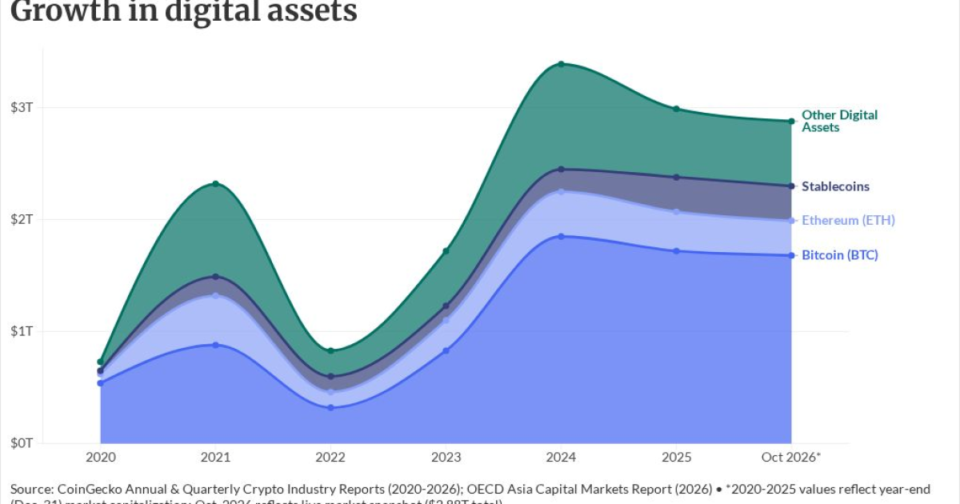
- Key insight: Digital assets and artificial intelligence-driven agents are going to transform financial services, and the change is going to happen in a hurry. The industry can take some key steps to weather the transition.
- What’s at stake: Both AI agents and digital assets are transformative technologies on their own, but coming together as they are now, they will bring an accelerated level of change that neither technology could have achieved on its own.
- Forward look: The whole ecosystem of players must lean in and collaborate to ensure legal, regulatory and compliance safeguards are in place, and that the potential of the new technology is fully achieved to benefit our clients and industry.
It is becoming increasingly clear that
Processing Content
As a
In all my years working with clients I have not felt this level of optimism for what we can finally deliver to clients in terms of breadth of solutions, sophistication of capabilities, ease of access, degree of availability and removal of friction. However, living up to that promise will require the financial services industry to be both ambitious and thoughtful, driven and collaborative, visionary and pragmatic. Most importantly, we will need to remain focused on the client and how new innovations will best meet their needs and goals.
In a three-part series, I explore how digital assets may reshape financial services. I recognize it is early in the journey, and things may play out in numerous ways. However, I believe structural shifts that will shape our industry are already emerging.
Here are five ways that things may play out for the financial services industry, summarized here and further explored in the next two parts of the series.
Digital assets are fundamentally reshaping banking and financial services at a faster pace and to a greater degree than we expect because of the combination of agentic AI and tokenization. Both AI agents and digital assets are transformative technologies on their own, but coming together as they are now, they will bring an accelerated level of change that neither technology could have achieved on its own. The growth of agentic AI will drive transaction paths that are programmable, always-on and frictionless. In parallel, the promise of tokenization of both money and real-world assets require end-to-end processes that are fully tokenized, which, in turn, will create pressure to innovate faster. The combination of these two market forces creates a double flywheel effect, which will generate urgency and incentives for financial transactions that are simpler, faster, cheaper, always-on and frictionless.
Read more:
Clients may not specifically ask their banks for digital assets products, but they do want simple, programmable, and intelligent ways to manage money and real-world assets. Once clients see what’s possible, there will be no putting the genie back in the bottle. These capabilities will increasingly become the standard and shape client expectations and needs. The role of product management is not to react to client asks and self-diagnoses, but rather to understand current and future client goals in order to deliver solutions the client hasn’t even considered. The institutions that can translate new technology into meaningful client value, before the client even asks for it, will be best positioned to win.
Digital assets are both a product and a rail, but this is not (just) about infrastructure, it is a paradigm shift in how financial services will be delivered, managed and consumed. Tokenization will shift business and revenue models, drive changes in client behavior and expectations, and redefine key concepts in financial services such as trust and money. The transformation occurring in the industry is not only reshaping the infrastructure, it is also reshaping the client experience. Thinking about tokenization in terms of improved products or rails limits us in our ability to imagine a future that is vastly different from what we have now. While it may be relatively easy to understand immediate and visible benefits of new technology, it is nearly impossible to imagine what it will be in the future after multiple compounded innovation hops. If history is any guide, we cannot fully anticipate how profoundly tokenization will reshape the industry.
It is risky for the incumbents to take a “do nothing” or “wait and see” approach. At the same time, the industry needs to ensure it is embracing the new technology and business models in a way that keeps the client and their needs at the center of everything we do. Previous waves of innovation have shown that incumbent institutions are often best positioned to succeed, provided they are willing to disrupt themselves before clients or competitors force them to do so. But there is also a risk that we get too enamored with the technology and forget to articulate the problems we are solving for clients — and why solving them is important. Collaboration is also critical to innovation, including participation in industry consortia and initiatives. Key to success for the incumbents will be the willingness to be an early mover, an unwavering focus on clients, and the ability to operationalize partnerships and networks. Those who do that will have disproportionate gains.
The financial services industry will need to get two things right in order to enable client adoption at scale and achieve the full benefits: (i) a minimum viable ecosystem of banks, fintechs, counterparties, infrastructure providers, and systems; and (ii) the legal, ethical and regulatory frameworks to address failures, disputes, and unintended consequences. Mass adoption will only happen if we have distribution and reach without added friction and fragmentation and frameworks to address consumer protection, identity management, proof of intent, liability, and accountability. While the technology is important, perhaps more important is the ability to overcome the innovation challenges that are not related to technology. Success will require focus on collaboration and a willingness to create a shared ecosystem, as well as the ability to create a financial service system that is fair, transparent, explainable, predictable and consistent.
Ultimately, while the details and nuances may evolve differently from what I have laid out, I believe that digital assets are reshaping financial services at a greater pace and magnitude than many of us expected just a year or two ago. The whole ecosystem of players must lean in and collaborate to ensure legal, regulatory and compliance safeguards are in place, and that the potential of the new technology is fully achieved to benefit our clients and industry. At stake is our ability to deliver financial services to clients in a way that is simpler, more accessible and more effective.