

Ethereum (ETHUSD) is down 1.00% at Jun 28 02:15(ET), now at $1563.16, with a 7-day down of 9.05%.
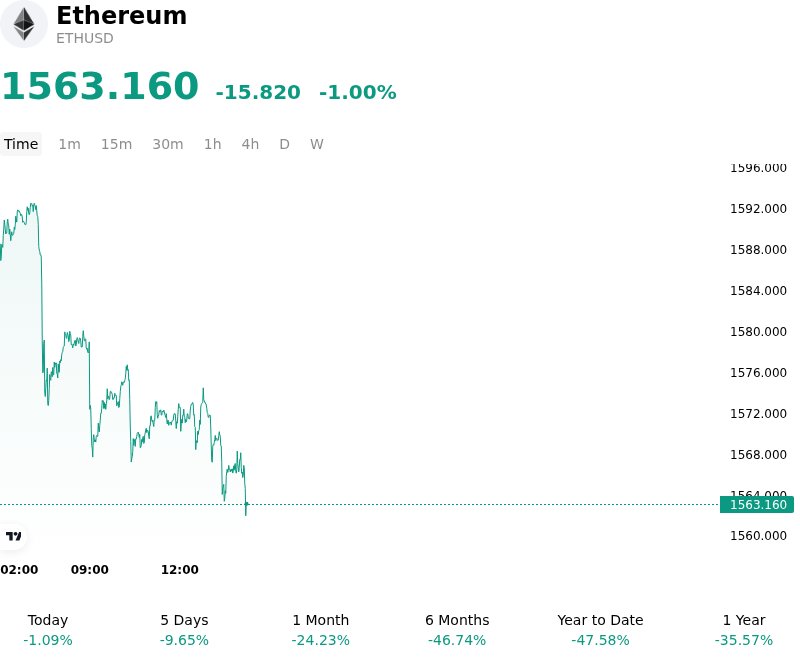
The recent downward pressure and volatility in Ethereum can be primarily attributed to a combination of persistent institutional capital outflows, a hawkish macroeconomic backdrop, and delayed protocol-level catalysts.
The institutional channel, which was expected to serve as a reliable source of support for Ethereum, has instead acted as a persistent source of market supply. US spot Ethereum exchange-traded funds (ETFs) recently experienced several consecutive days of net outflows, capping off a week of heavy capital withdrawals. This trend was led by substantial redemptions from major institutional products, including BlackRock’s ETF, which significantly cooled investor sentiment. The ongoing liquidations from these investment vehicles demonstrate that institutional appetite remains highly sensitive to broader market conditions and macro headwinds.
Compounding this structural selling pressure is a challenging macroeconomic environment. A firm US dollar, trading near cycle highs, and elevated US Treasury yields continue to weigh heavily on risk assets, including digital assets. Investor expectations have been significantly reshaped by a hawkish Federal Reserve posture. With market expectations for near-term interest rate cuts virtually extinguished, global liquidity conditions have remained tight. This environment naturally favors yield-bearing traditional assets over non-yielding speculative assets, prompting a broader risk-off rotation that has disproportionately affected high-beta digital assets like Ethereum.
Additionally, near-term fundamental catalysts have failed to materialize, further dampening buyer conviction. The much-anticipated Glamsterdam upgrade, which aims to improve parallel execution, proposer-builder separation, and layer-one network scaling, was rescheduled from the first half of 2026 to the second half of the year. This delay has removed a critical fundamental driver that many traders had relied on to justify a premium valuation, leaving Ethereum exposed to technical and liquidity-driven selloffs in the interim.
From a technical and derivatives perspective, the weakness was exacerbated by broader market correlation and positioning. As Bitcoin broke down below key psychological and technical support levels, Ethereum followed suit, magnifying the downward move due to its higher relative beta. This technical deterioration triggered leverage shakeouts and put-option hedging activity. Market makers, faced with short-gamma positioning near key support levels, were forced to sell spot and futures contracts to manage their exposure, accelerating the intraday slide. Consequently, the combination of sluggish ETF flows, delayed network upgrades, tight global liquidity, and derivative-fueled selling pressure continues to keep Ethereum on a defensive footing.
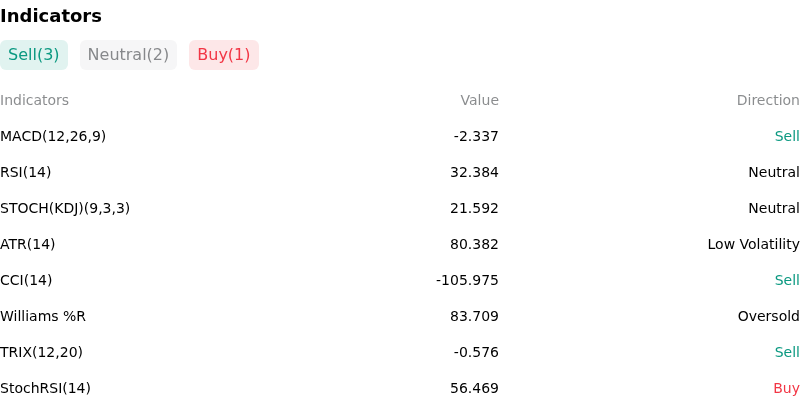
Technically, Ethereum (ETHUSD) shows a MACD (12,26,9) value of -2.337, indicating a sell signal. The RSI at 32.384 suggests neutral condition and the Williams %R at 83.709 suggests oversold condition. Please monitor closely.
This article may include AI-generated content that is human-reviewed, which is for reference and general information purposes only and does not constitute investment advice.