
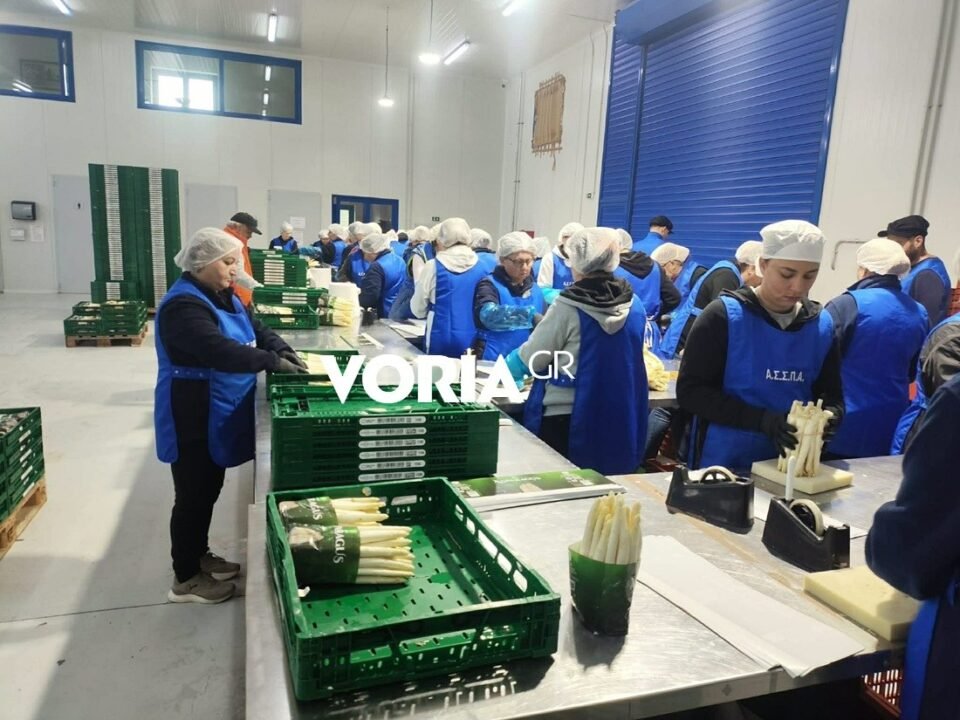
In the rural district of Almopia in the northern Greek region of Pella, the day begins early at this time of year for the area’s farming community. Before 7 am, pickup trucks filled with workers leave the villages, and shortly afterwards they begin harvesting the area’s “white gold”, white asparagus, from a total of 5,500 stremmas of cultivated land.
A few hours later, the first vehicles return loaded with the crop to cooperative warehouses, where the day’s initial harvest is unloaded. Almost all of it is destined for export. Germany, the Netherlands, Belgium, France, and Italy account for up to 99% of Almopia’s white asparagi production.
“It is its early harvest and the sun of Greece that make our asparagus sought after in Europe,” Yiannis Trypkos, one of the region’s longest-serving asparagus producers and a member of the ASSPA cooperative, told Voria.gr.
The Agricultural Cooperative “Synergasia Almopias” (ASSPA), although relatively new, is presented as an example of how a collective farming effort can develop. Founded eight years ago with six members, it now has its own certified sorting and packaging facility, employs more than 80 staff and has grown to 78 members. During the current harvest period, workers at the cooperative’s facilities operate in two shifts to process and package around 10 tonnes of white asparagi per day.
“Even some bulbs that are thinner or have some deformation compared to others and are not marketable are separated and sold for animal feed. We utilise everything, we throw nothing away,” said Yiannis Antoniou, president of ASSPA, speaking to Voria.gr. He added that the cooperative operates as a vertically integrated unit, handling not only asparagi but also plums grown in the area. The asparagi is then transported by large trucks to markets across northern and central Europe, before reaching the kitchens of high-end restaurants.
Of the region’s total production, expected to exceed 3,500 tonnes this year, only about 1% will remain in the domestic market. While asparagi is in strong demand abroad, it is rarely found on restaurant menus within Greece.