
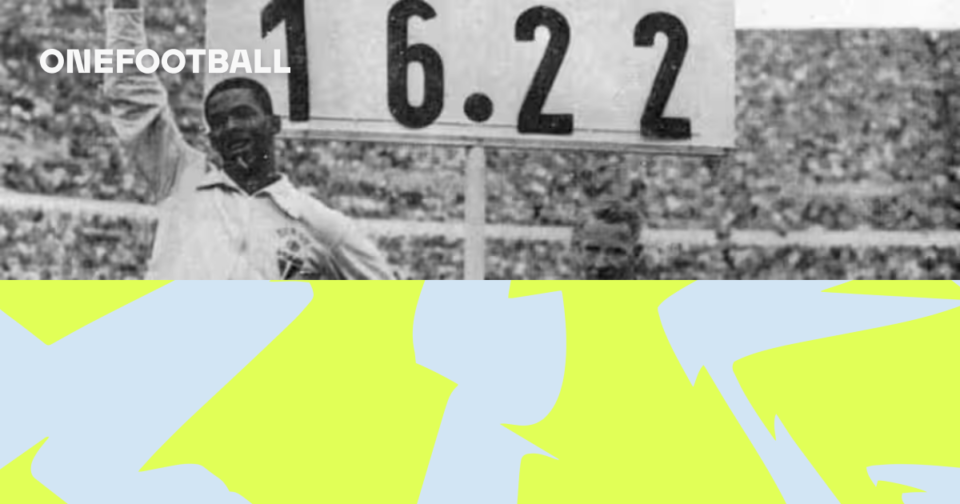
Seventy-four years ago, on July 23, 1952, Adhemar Ferreira da Silva made history in Brazilian sports by breaking the world record in the triple jump and winning the gold medal at the Olympic Games in Helsinki, Finland.
To better explain the importance of Adhemar’s achievement, we need to go back a bit in time and recount the beginning of his journey in sports.
An only child, Adhemar Ferreira da Silva was born in the Casa Verde neighborhood, in the north side of São Paulo, on September 29, 1927. His father, Antônio Ferreira da Silva, was a railroad worker, and his mother, Augusta Nóbrega da Silva, was a domestic worker. He never got to know his grandparents, but he always heard from his family that his grandfather came from a noble lineage in Africa, where he may even have been a king.


Statue of Adhemar Ferreira da Silva in the Casa Verde neighborhood, in São Paulo
Adhemar used to play in the street. Playing soccer was his favorite pastime. He even founded an amateur neighborhood team, Grêmio Esportivo Centenário, also from Casa Verde. On that team, he played as a defensive midfielder. But the athlete’s mother complained about this hobby: she thought it was dangerous to play on those bumpy fields or in tall grass. The idol’s soccer career did not last long.
He learned to read and write at a convent school. He studied at the School of Trade Apprentices, now a technical school, and graduated in Fine Arts. The future champion came close to becoming a sculptor. Everything changed in 1946. Adhemar was downtown with José Márcio Cato when a strong, slender young man walked by them. His friend said, “That’s Benedito Ribeiro, an athlete from São Paulo.” The word “athlete” made Adhemar feel that he wanted to be one.
Since his friend trained at the club, he offered to take him to Canindé, the home of Tricolor at the time. There he met his first coach: Dietrich Gerner. Adhemar warmed up, did gymnastics, went through a series of runs… He did a little bit of everything, without knowing exactly what he wanted to do. He tried a series of 100-, 200-, and 1,000-meter races, long jump, high jump, and a relay race. That same year, he took part in countless friendly competitions, without standing out in any of them. It was not a good start. “If there was someone in last place, I always finished after that last person.”
In 1947, Adhemar made the first triple jump of his life. He had seen someone practicing the event and wanted to do the same. He saw that he would need to get a run-up, sprint, reach the white board marking the jump, plant his foot there, launch his body, land on the same leg, jump again, switch legs, and reach the sandpit. “I thought it was interesting and asked the guy to explain everything again, because I hadn’t understood a thing.”
Even so, he managed to catch the coach’s attention, who told him to repeat the jump. He reached 12.8 m. Athletics books record that beginners rarely got to 11 m. Improving with each meet, he became São Paulo state champion with 13.89 m that same year. He would soon also become Brazilian and South American champion.
He then set out to achieve the Olympic qualifying mark. The qualifying standard set at the Olympic Trials in Rio de Janeiro was 14.80 m, and his teammates said only he was capable of earning the spot. “I just wanted to see Rio, and they were talking about London!” After overcoming the financial difficulties of traveling to the Marvelous City, he faced and defeated the biggest names of the time: Geraldo de Oliveira, the “Brazilian Kangaroo,” and Hélio Coutinho da Silva. He jumped 15.03 m and qualified for the Games.
When competition time came, at the famous Wembley Stadium and in front of 120,000 people, he was undone by inexperience. He lost focus and did not warm up properly. “The judge would call me, I’d jump, and look at the crowd, thinking there was going to be a soccer match.”
In 1949, coach Gerner worked with Adhemar to surpass the São Paulo state record of 15.13 m, held by the aforementioned Geraldo de Oliveira. On the very first attempt he reached 15.51 m and also broke the South American record, which had belonged to the Argentine Luis Ankel Brunetto since the 1924 Olympic Games. From then on, a succession of records and victories began in the great world of athletics, and he even surpassed the world record by jumping 16.01 m in 1951, although the feat was not officially recognized for several years. The exploits of the São Paulo athlete, however, drew attention all over the world.

Dietrich Gerner and Adhemar Ferreira da Silva
Qualified for the 1952 Olympic Games in Helsinki, Finland, Adhemar, ever studious, quickly made a point of meeting the interpreters for the Finns who had come to Brazil to compete in the São Silvestre road race in 1951, the Lehtos. Upon arriving in the Finnish capital, Adhemar set out to test his knowledge of the local language. And he did well with the expressions he had learned. The next day, the newspapers said: “Da Silva from Brazil arrives saying ‘terve, terve’ and singing ‘Niin mina neitonen sinulle laulan’.” Warm and charming, he went out into the streets and people wished him success in the competition.
Fully prepared, both socially and physically, Adhemar Ferreira da Silva, on July 23, 1952, broke the triple jump world record, then held by Japan’s Naoto Tajima, by jumping 16.05 meters in the qualifying round.
As if that were not enough, on the same day Adhemar broke his own world record three more times, jumping 16.09 m, 16.12 m, and 16.22 meters. In fact, he was the only one among the 35 competitors to jump beyond 16 meters. And all the jumps were measured and validated by no fewer than ten judges. It was all absolutely unprecedented and overwhelming.
He claimed the world record. He claimed the Olympic record. He claimed the gold medal.
“I only jumped what I could. I did not expect to do any of this… I dedicate my triumph to the Brazilian people.” To the press he also thanked the work and support of coach Dietrich Gerner at São Paulo. In turn, the Tricolor coach said that “Adhemar truly is an extraordinary athlete. No one is more suited than he is for great deeds. He always followed my instructions to the letter.”
On the podium, Adhemar cried and, acclaimed by the 70,000 fans shouting his name, thanked everyone by taking a lap around the track: it was the first Olympic lap of honor by a Brazilian. To top it off, the athlete displayed the São Paulo emblem in the official photo of the world record, which became immortalized in history.

Tricolor returned to honoring the idol. “Our admiration and pride for Adhemar Ferreira da Silva, even before he set a new world record in the triple jump, were enormous. But now, they are extraordinary,” said president Cícero Pompeu de Toledo, going even further: “A star on the São Paulo flag will symbolize the feat of Adhemar Ferreira da Silva.”
This idea had been circulating among the club’s directors and council members since the São Paulo athlete jumped 16.01 m in 1951. Officially, in the club statutes, however, the measure was only formalized in the version dated September 12, 1953. Nothing prevented the proper public tributes, of course. After the official ceremonies in the nation’s capital, with politicians and the like, Adhemar and his family finally returned to São Paulo at 10:30 a.m. on August 10, where he was welcomed by a crowd of fans at Congonhas Airport. “With flowers, smiles, and tears, São Paulo welcomed its champion,” read the Última Hora headline.
Then, at 3:30 p.m., the world record holder was already at Pacaembu to be honored once again, minutes before kickoff of a São Paulo vs. Vasco da Gama match, by a huge crowd of grateful Brazilians who spared no applause. The Rio club also offered a gift: the São Paulo flag with the promised golden star in honor of Adhemar’s achievement.
In 1955, at the Pan American Games in Mexico City, he once again broke the world record by reaching 16.56 meters. In tribute to these two extraordinary feats, that same year, 1955, the club decided to honor him by placing two golden stars on its flag (today also displayed on the crest and jersey).
Already with Vasco da Gama, in 1956, he won another Olympic gold medal, this time by jumping 16.35 meters. Only Adhemar, Robert Scheidt (1996 and 2004), and Rebeca Andrade (2020 and 2024) have two individual Olympic gold medals representing Brazil.
ADHEMAR FERREIRA DA SILVA

This article was translated into English by Artificial Intelligence. You can read the original version in 🇧🇷 here.
 Ver detalles de la publicación