
Alkane Resources Ltd (ASX:ALK, OTC:ALKEF) extended high-grade gold and antimony mineralisation at the Brunswick South deposit, strengthening its potential to become a major production source for the Costerfield operation in central Victoria.
Results from 91 additional extension and infill drill holes have confirmed continuity between the deposit’s deeper gold-dominant zone and historical near-surface workings, while identifying further mineralisation along strike and at depth.
Brunswick South sits about 200 metres from planned underground access, allowing Alkane to advance the deposit without extensive new development.
Regional map of the Costerfield Project in GDA2020 grid showing Alkane tenements and the main corridors of mineralisation identified, highlighting the location of the Brunswick South deposit.
High-grade drilling highlights
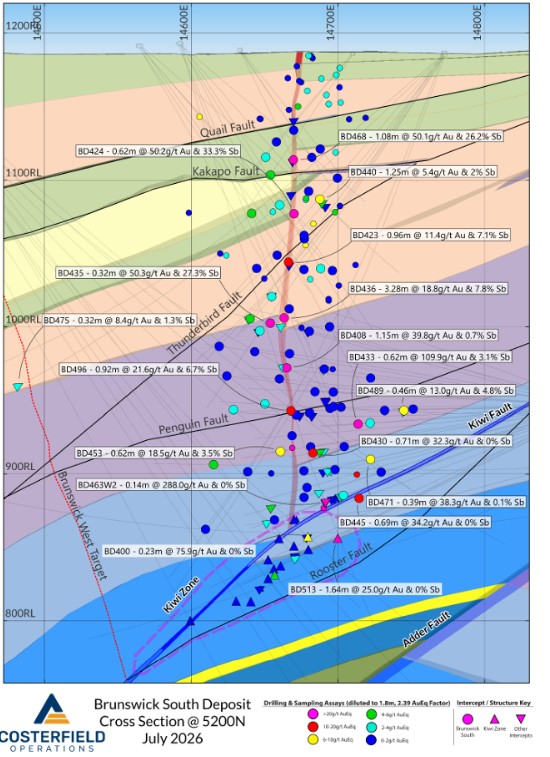
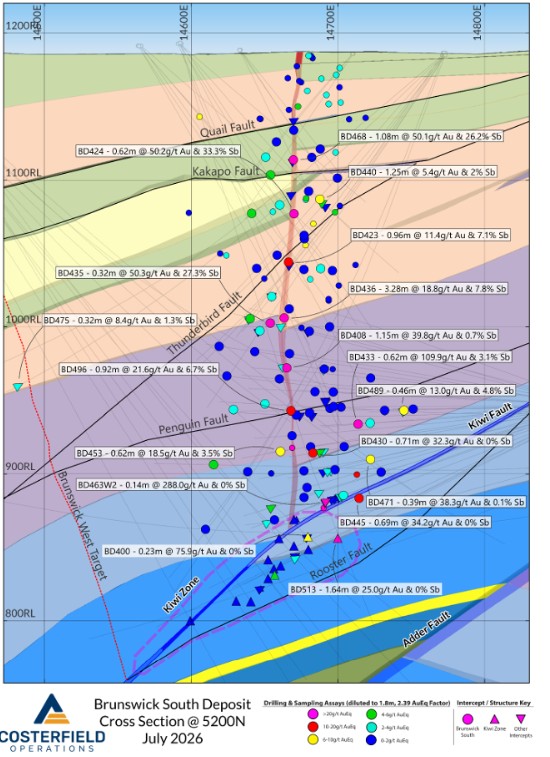
Standout results from the Brunswick South vein included:
- 50.1 g/t gold and 26.2% antimony over 2.17 metres;
- 109.9 g/t gold and 3.1% antimony over 0.65 metres;
- 50.2 g/t gold and 33.3% antimony over 0.86 metres;
- 39.8 g/t gold and 0.7% antimony over 1.3 metres; and
- 21.6 g/t gold and 6.7% antimony over 1.65 metres.
Drilling also returned 25 g/t gold over 1.7 metres from the deeper Kiwi zone, which is emerging as a gold-dominant area with geological characteristics comparable to the high-grade Youle deposit currently being mined at Costerfield.
The latest campaign comprised 28,421 metres of diamond drilling. Ten intercepts returned grades above 10 g/t gold equivalent when diluted to a 1.8-metre mining width, supporting the economic potential and continuity of the mineralised system.
Two mineralised zones defined
Alkane has identified two principal economic areas within Brunswick South.
The first is an upper, high-grade antimony-gold shoot extending from about 80 metres to 280 metres below surface, providing a mineralised panel height of around 200 metres.
The second is a lower, gold-dominant panel below the Penguin Fault and extending into the Kiwi Fault zone, with a strike length approaching 400 metres.
The deposit shows a transition from antimony-rich mineralisation in the upper levels to increasingly gold-dominant mineralisation at depth, a pattern also observed within the Youle-Shepherd system.
A separate parallel structure, known as Brunswick West, has also been identified about 200 metres west of the main deposit. The best result from this target was 8.4 g/t gold and 1.3% antimony over 0.32 metres, with follow-up drilling planned.
Positioned close to existing development
Managing director and chief executive officer Nic Earner said the results demonstrated Brunswick South’s potential to provide both high-grade gold and strategically important antimony.
“Focused extension and infill drilling at Brunswick South over the previous year has produced highly encouraging results. This newly defined deposit not only contains pockets of high gold endowment, but critically a significant quantity of antimony,” Earner said.
“Excitingly Brunswick South can be brought online without extensive access requirements as it is situated 200m from existing development. We are commencing development towards Brunswick South in the current quarter and are looking to establish it as a primary production source for Costerfield.”
What’s ahead
Capital development to access Brunswick South is scheduled to begin in the third quarter of 2026 and has already been incorporated into the Costerfield mine schedule.
Further drilling will test the Kiwi Fault at depth, the gap between Brunswick and Brunswick South, southern extensions of the mineralised system and the newly identified western structure.
Alkane expects to release an updated Mineral Resource Estimate and an initial Ore Reserve for Brunswick South later this year as part of its broader Resource and Reserves Statement.