
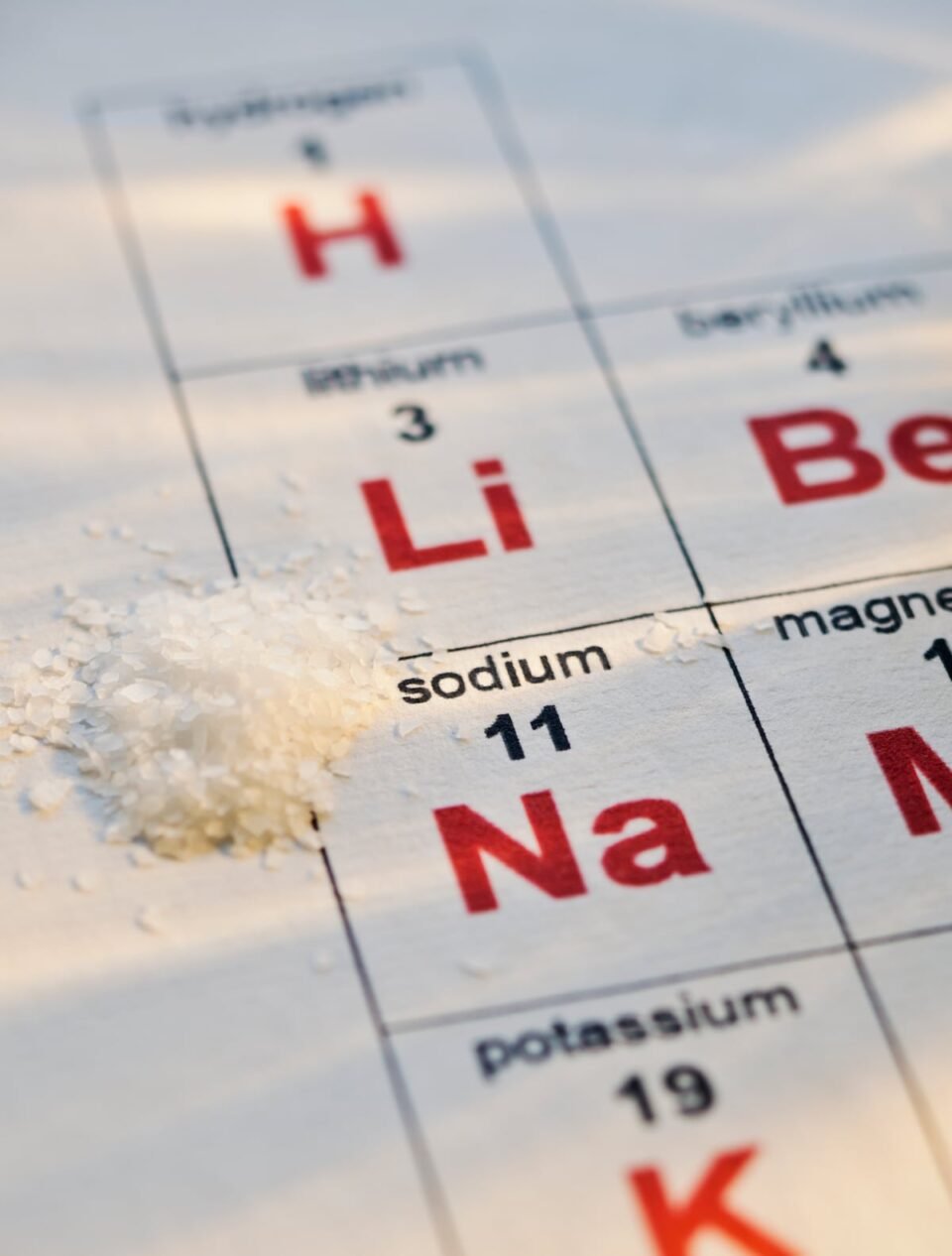
For decades, lithium has been the most coveted element in energy storage. It has been called “white gold,” a label that has brought major problems, including soaring prices, fragile supply chains and a geopolitical dependence that worries both governments and industry. Enter sodium: abundant, cheap and a major promise for a more sustainable energy revolution.
There is no doubt the initial gap is overwhelming: sodium makes up about 2.8% of the Earth’s crust while lithium barely reaches 0.002%. “The optimism is justified because it has a lot of potential, but it’s true there are aspects that still haven’t been proven, such as competitiveness and the cost sodium will have once a market scale is reached. Still, the prospects are good,” cautions Jon Ajuria, head of Sodium Technologies Research at CIC energiGUNE, an energy storage research center in Spain’s northern Basque Country region.
Beyond their abundance, sodium batteries have other advantages over lithium ones. Marcos Lafoz, a researcher at Spain’s Center for Energy, Environmental and Technological Research (CIEMAT), lists them: “Fast charge and discharge capability, the possibility of full discharge to facilitate transportation and handling, an apparently higher number of cycles and greater intrinsic safety, a wider operating temperature range without losing capacity, no dependence on critical elements, and a lower projected cost per unit of energy once economies of scale are achieved.”
Lithium nevertheless has two important advantages. First, three decades of optimization of materials, factories, quality controls, electronics, suppliers and recycling. Second, a physical attribute. “Lithium is light and small, and allows for high-voltage, high-energy-density batteries,” notes José Luis Tirado, professor of inorganic chemistry at the University of Córdoba (UCO).
Coexisting innovations
In other words, sodium batteries are heavier than lithium batteries for the same amount of stored energy. That makes their main market niche stationary applications such as renewable storage in homes or industrial facilities, especially data centers. “It’s an application where space may not be so critical and sodium batteries can offer a very solid alternative because they perform better at low temperatures, have better cyclability and lower cost,” Ajuria emphasizes.
However, all experts consulted agree that one technology will not replace the other; they will coexist. “Today there are applications that use lithium batteries whose performance is likely excessive for the task, but it’s the technology that’s available. When there is a sufficiently mature, cheaper alternative that does not require such demanding technical performance, it will undoubtedly be used as a substitute,” says Lafoz, who does not see, for example, sodium being used in mid- and high-range electric vehicles where maximum range and power capacity are sought. The same applies in other areas such as aviation, drones or smartphones, where battery size and weight are critical.
Map of energy power
Another relevant issue is geopolitical. China dominates the battery manufacturing market and, although it is also investing heavily in sodium — according to the International Energy Agency, it accounts for more than 95% of installed or announced sodium capacity for 2030 — the abundance of this element means more countries can produce it and reduce the vulnerability of their supply chains. “It’s not clear which countries will become leaders in these technologies. What is clear is that those where energy storage markets are more developed have a stronger position and greater motivation for these developments,” reasons Lafoz.
As for the other raw materials a battery needs, sodium again has an additional advantage: the materials used in the electrodes. While lithium batteries use graphite in the anode and cobalt-containing oxides in the cathode, sodium batteries can use more sustainable alternatives. “Carbons obtained from pyrolysis of agricultural waste are very suitable. This is a major advantage because it’s accessible and cheaper, and it also uses a waste product, supporting the circular economy,” says María Bernechea, senior scientist at the CSIC’s Institute of Nanoscience and Materials of Aragon.
Regarding cathodes, the research group José Luis Tirado is part of is already working on more sustainable and cheaper electrode options. “Cathodes with lower nickel or vanadium content, while maintaining or even improving electrochemical performance.” That said, Bernechea predicts materials based on manganese or nickel, used in both lithium and sodium batteries, will gain importance, and warns: “Manganese is relatively abundant, but not so much in Europe.”
The recyclability factor
When we talk about more sustainable batteries it’s important to ask how their recycling works. “[Sodium batteries] are much easier to recycle, but also much less interesting from an economic perspective,” says Jon Ajuria of CIC energiGUNE. They typically contain fewer high-value metals, so technologically there is less need to recover materials for second use. Paradoxically, that also means recovering less money from recycling. “This makes it especially important to design batteries from the outset to be easy to disassemble and recycle,” says Professor José Luis Tirado, although Ajuria says policies that truly promote recycling will be essential.
Sign up for our weekly newsletter to get more English-language news coverage from EL PAÍS USA Edition