
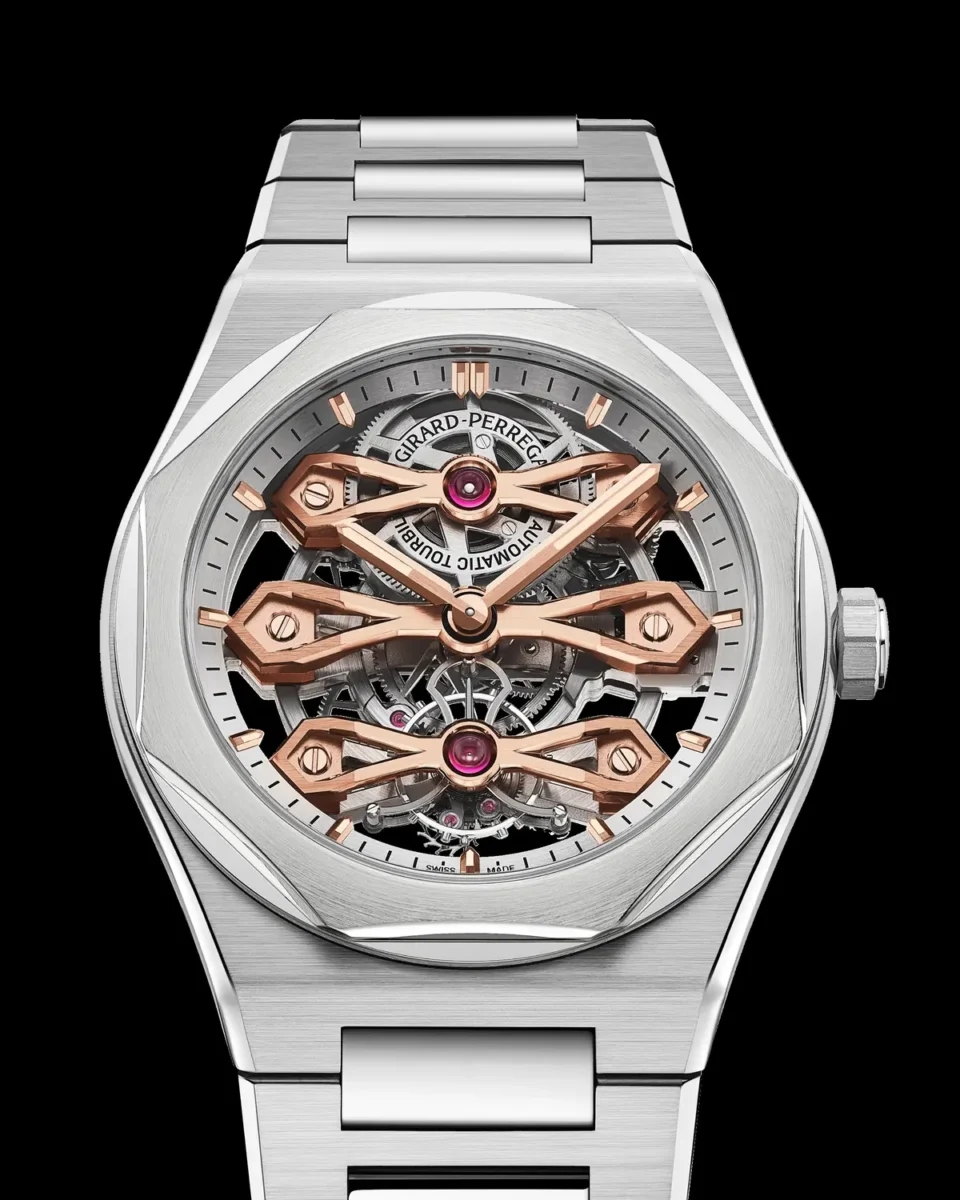
Girard-Perregaux has unveiled the Laureato Fifty Three Gold Bridges, a skeletonized tourbillon that brings the maison’s signature three-bridge architecture to its integrated-bracelet sports watch. Announced on October 27, the Ref. 99112-58-3619-1CM pairs a 41mm stainless steel case and white gold octagonal bezel with the new Caliber GP9620, a self-winding movement developed exclusively for this model and this size.
The Haute Minute
Girard-Perregaux has unveiled the Laureato Fifty Three Gold Bridges, a 41mm steel tourbillon with a white gold bezel. Its new Caliber GP9620 features three rose gold bridges, a platinum micro-rotor, and 418 hand-polished angles, with each watch assembled by one master watchmaker. It is priced at $182,000.
The timing matters for the brand. Girard-Perregaux is approaching the 160th anniversary of the Three Bridges design, which Constant Girard first conceived in 1867, and the Laureato itself has anchored the catalog since 1975. The GP9620 is also the last of four new Manufacture calibers the maison introduced between October 2025 and September 2026, following the GP9530, GP4800, and GP8410.
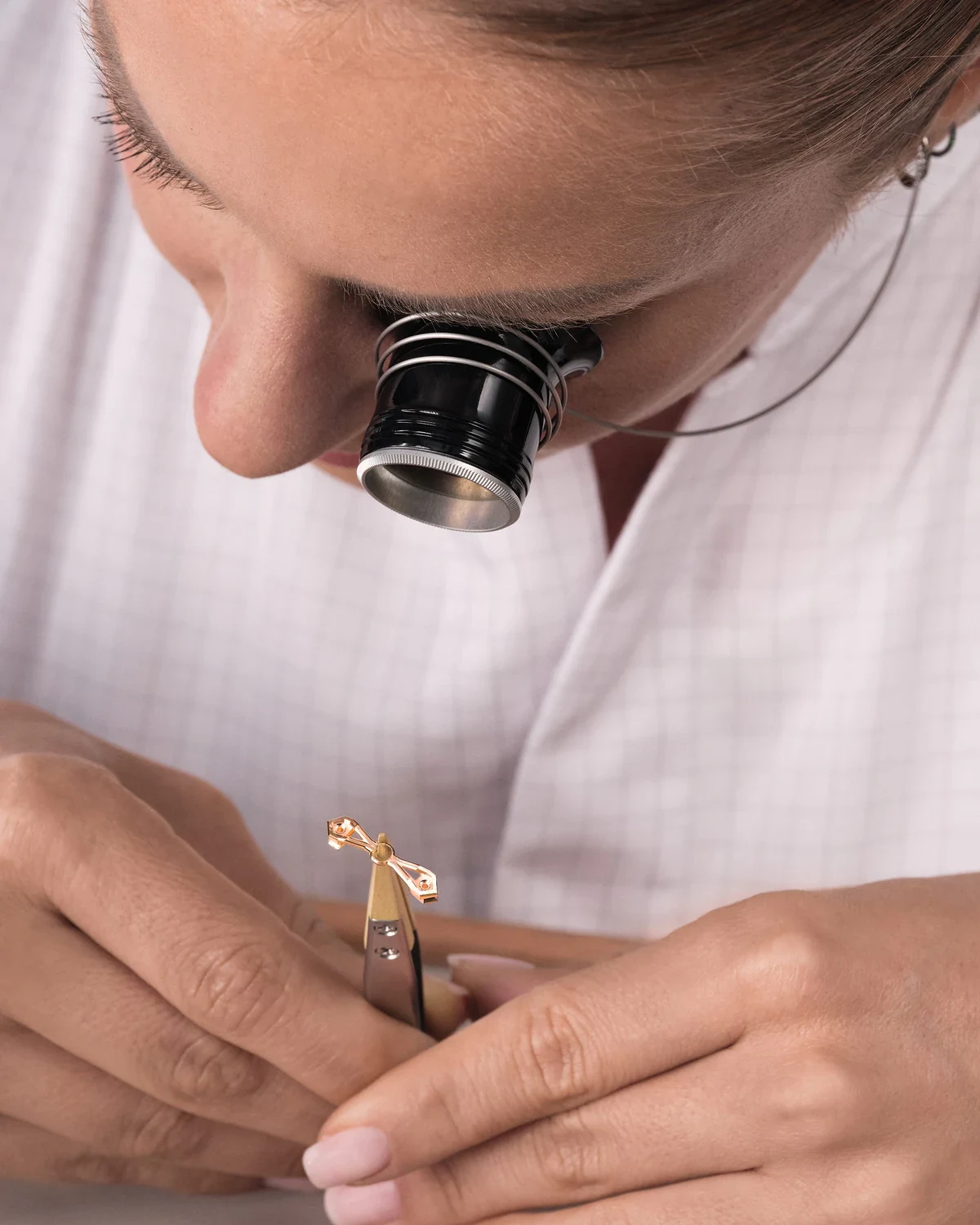
Photo Credit: Girard-Perregaux
Inside the Girard-Perregaux Laureato Fifty Three Gold Bridges
The press materials frame the watch around a single idea—beauty from within—and the movement backs it up. Three openworked bridges in rose gold span the dial side, holding the gear train in plain view. The tourbillon sits beneath the lower bridge in a lyre-shaped titanium cage, while a patented platinum micro-rotor tucked behind the barrel winds the watch without blocking the view the way a full rotor would.
Measuring 32mm across, the GP9620 is built from 303 components and 33 jewels, beats at 3 Hz (21,600 vibrations per hour), and delivers a power reserve of at least 55 hours. The finishing is where the numbers get serious: the movement carries 418 hand-polished angles, 362 of them inward angles, which cannot be produced by machine and demand hours of work at the bench. I think that inward-angle count is the most telling figure on the spec sheet, because it shows where the time and skill actually went.
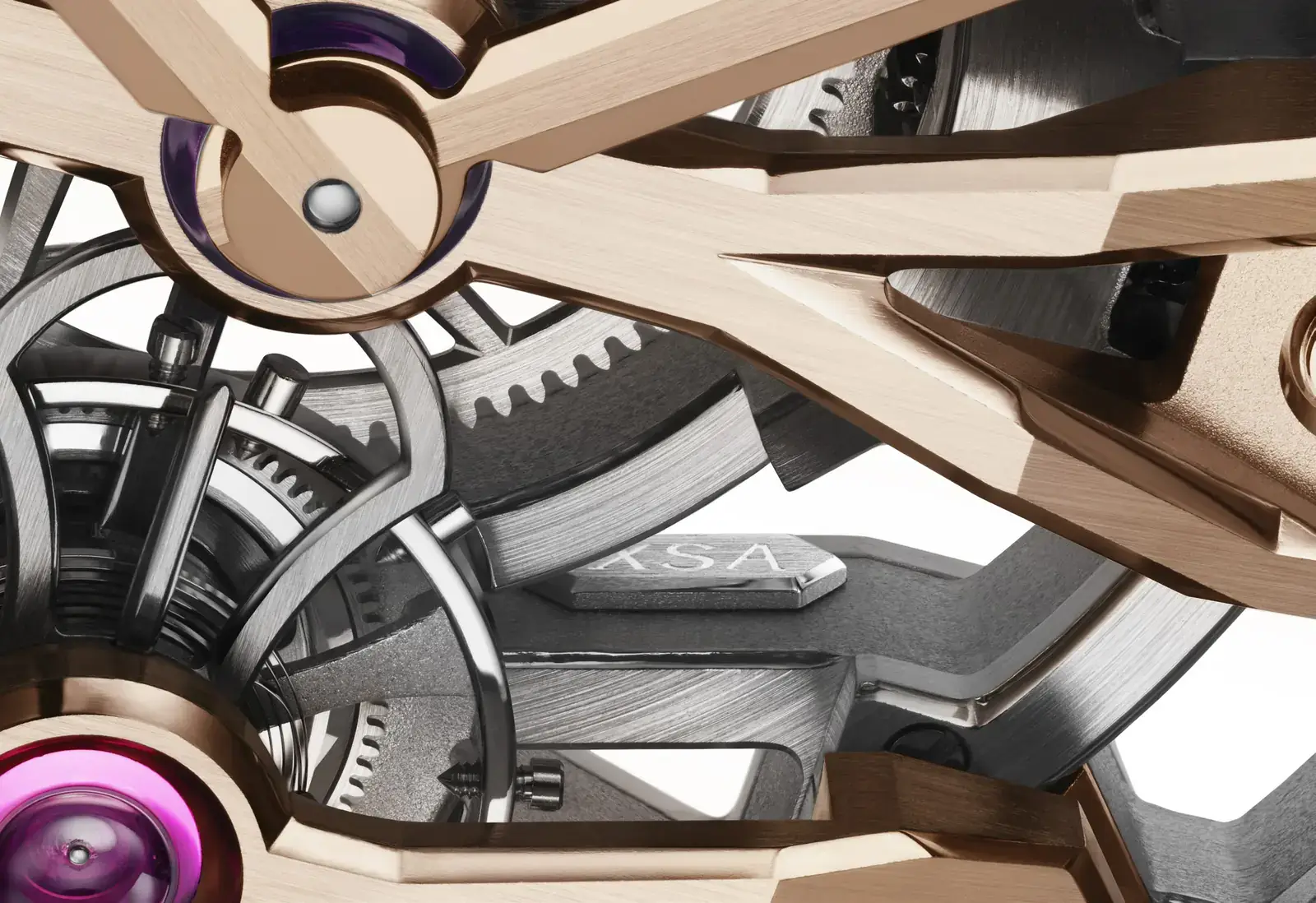
Photo Credit: Girard-Perregaux
Every piece also carries a personal signature. Each watch is assembled from start to finish by a single master watchmaker, whose initials appear on a small arrow-shaped plate on the movement. The arrow shape echoes the bridges themselves, and it turns an industrial process into something closer to a signed work.
To keep the focus on the movement, the dial is reduced to a ring with suspended indexes. The pink gold indexes and baton hands are filled with luminescent material that glows blue in the dark, a practical touch on a watch that otherwise reads as pure display. The warm pink gold also ties the time-telling elements to the rose gold bridges below.
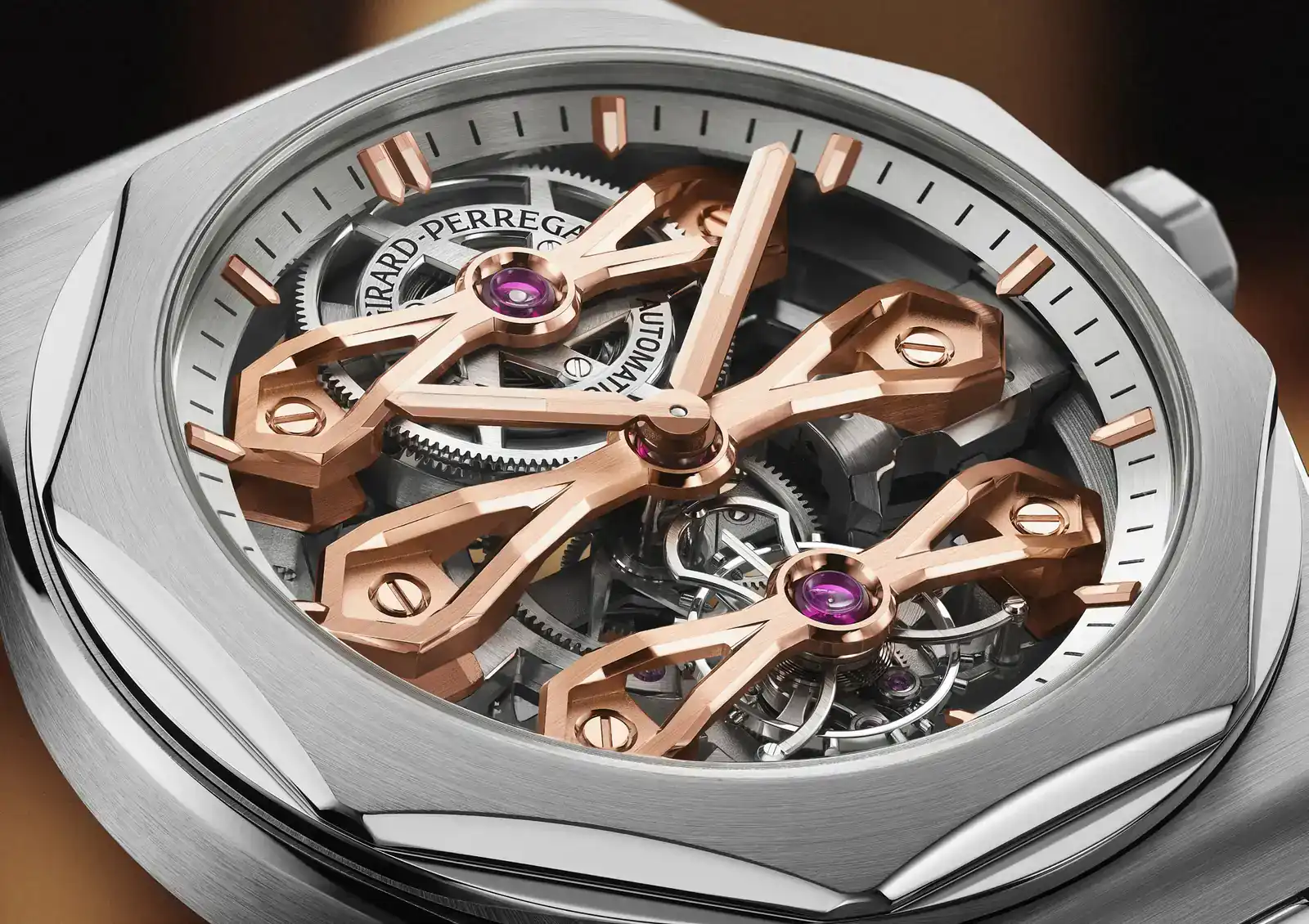
Photo Credit: Girard-Perregaux
Case, Bracelet, and Wearability
The 41mm case stands 10.85mm tall, a slim profile for a tourbillon with an automatic winding system, and it is fitted with antireflective sapphire crystal on both sides. Water resistance is rated to 50 meters. The white gold octagonal bezel sets up a quiet contrast with the brushed and polished steel, a mixed-metal approach that keeps the Laureato’s 1970s sports watch roots intact while signaling the haute horlogerie inside.
The integrated stainless steel bracelet closes with a triple folding clasp that offers up to 4mm of tool-free fine adjustment, useful for anyone whose wrist size shifts through the day. Turn the watch over and the sapphire caseback reveals the micro-rotor and the reverse side of the openworked movement.
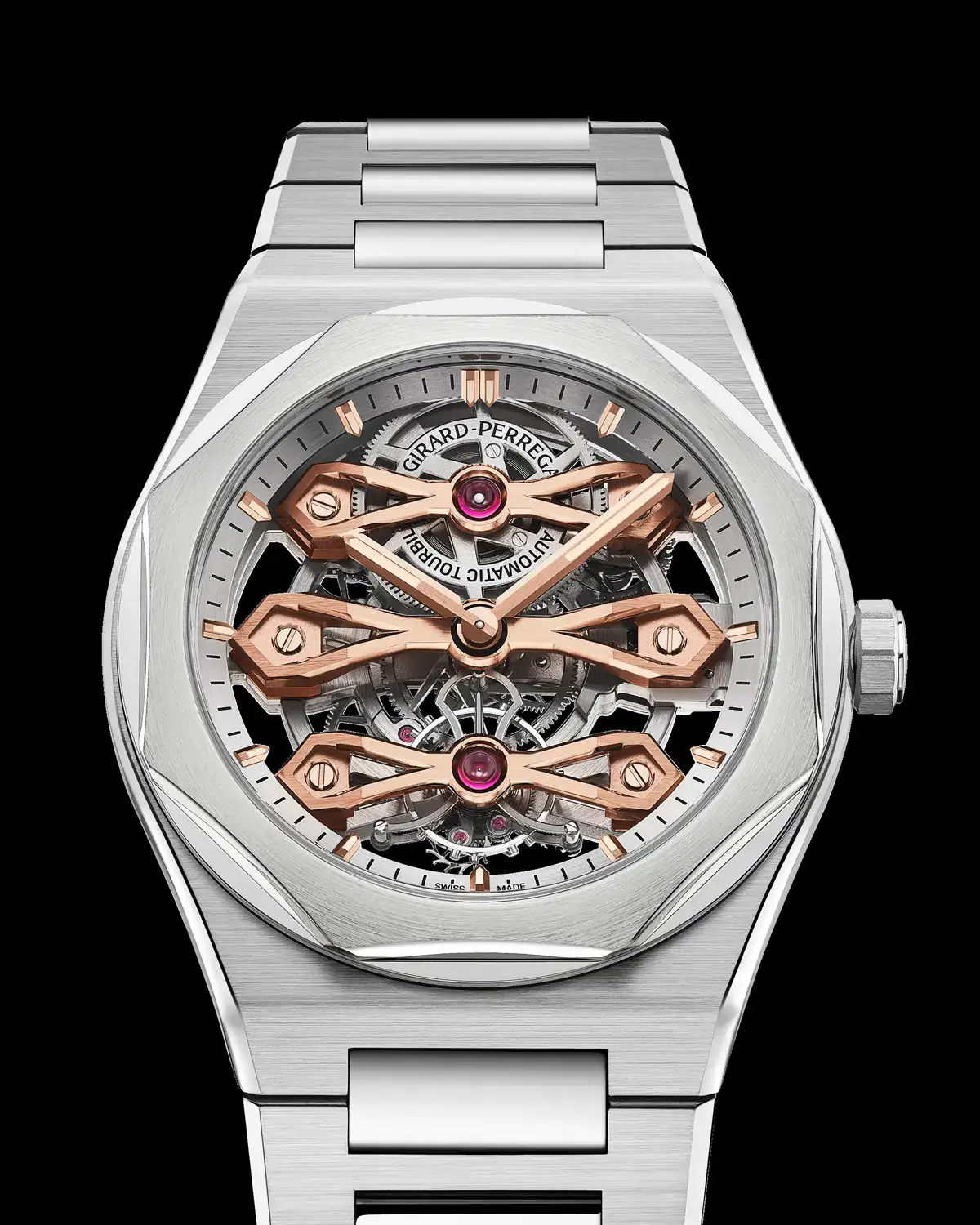
Photo Credit: Girard-Perregaux
Steel tourbillons on integrated bracelets are no longer rare, but few carry a design lineage that stretches back to 1867. By building a dedicated caliber around the Three Bridges rather than adapting an existing one, Girard-Perregaux has given the Laureato a skeletonized flagship that feels native to the collection. The Laureato Fifty Three Gold Bridges is priced at $182,000, and more details are on the Girard-Perregaux website.
| Specification | Details |
|---|---|
| Reference | 99112-58-3619-1CM |
| Case | Stainless steel, white gold octagonal bezel |
| Diameter | 41mm |
| Thickness | 10.85mm |
| Crystal | Antireflective sapphire; sapphire caseback |
| Water Resistance | 50m (5 ATM) |
| Dial | Ring with suspended pink gold indexes, blue-emission lume |
| Hands | Pink gold baton hands with lume |
| Movement | Caliber GP9620, self-winding skeletonized tourbillon |
| Movement Diameter | 32mm |
| Components / Jewels | 303 / 33 |
| Frequency | 3 Hz (21,600 vph) |
| Power Reserve | At least 55 hours |
| Bracelet | Integrated stainless steel, triple folding clasp with up to 4mm tool-free adjustment |
Timely FAQs
What movement powers the Girard-Perregaux Laureato Fifty Three Gold Bridges?
It uses the Caliber GP9620, a self-winding skeletonized tourbillon with three rose gold bridges, a platinum micro-rotor, 303 components, and a power reserve of at least 55 hours.
How big is the Laureato Fifty Three Gold Bridges?
The stainless steel case measures 41mm in diameter and 10.85mm thick, with water resistance to 50 meters.
How much does the Laureato Fifty Three Gold Bridges cost?
The official US price is $182,000.
Who assembles each watch?
Each watch is assembled from start to finish by a single master watchmaker, whose initials appear on an arrow-shaped plate on the movement.

Adrienne Faurote
Editor in Chief · Haute Time
As a former New Yorker, now a “Miamian,” Adrienne Faurote joined Haute Living in August of 2021. She currently serves as the Haute Media Group Editor-in-Chief, overseeing all editorial platforms within the Haute Media Group while also maintaining her role as Fashion, Jewelry & Watch Director. Prior to her position at Haute Living, Faurote was the Market Editor at Marie Claire Magazine US, amassing over ten years in the industry, becoming an authoritative voice in all things fashion, jewelry, and watches.