
On the morning of the 16th, the gold price rebounded slightly from the more-than-one-year low hit last Monday. Spot gold once climbed back above $3900 per ounce, but then turned downward, touching $3832.23 per ounce at one point during the session, refreshing the year-to-date low. As of press time, London spot gold was quoted at $3836.91 per ounce, down 1.21%.
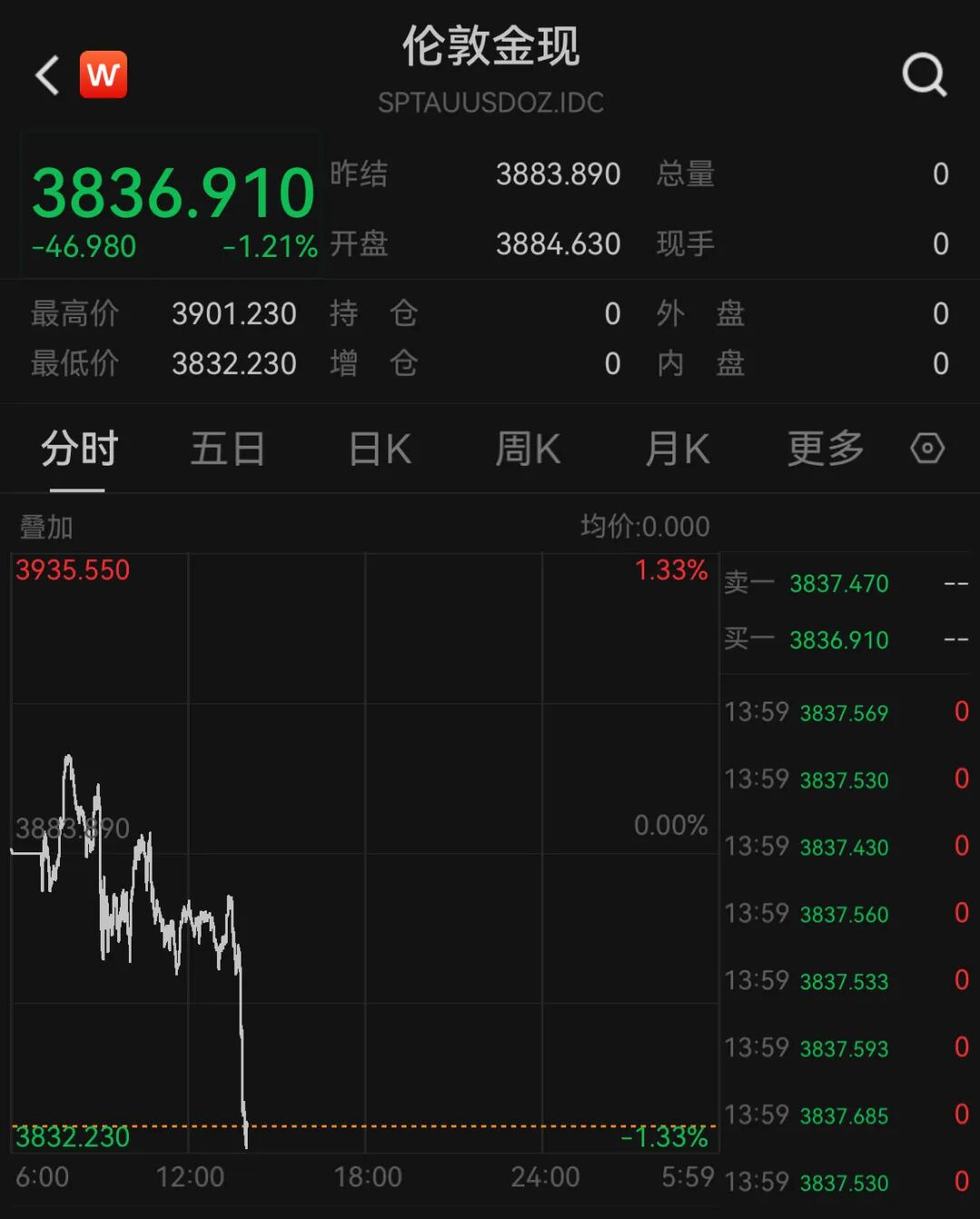
Screenshot from Wind
Multiple institutions warn that the core contradiction driving the fall of precious metals — the expectation of the Federal Reserve’s interest rate hike and the strengthening of the US dollar and US Treasury yields — has not fundamentally changed. The traditional inflation-hedging and risk-aversion attributes of gold and silver have failed collectively in this round of market movement.
“Buy the dip in the Asian market, sell the rally in the US market”
A report released on the 16th local time by David Scutt, market analyst at US financial services firm StoneX, shows that since September, gold has risen by a cumulative 2.7% during the Asian trading session, while plummeting by 12.2% during the US trading session. Since the start of 2026, the gold price has posted a cumulative gain of 3.4% in the Asian session, while the cumulative decline in the US session is as high as 28.1%.
In simple terms, Asian capital continues to take over during pullbacks, but as soon as the US session opens, selling pressure surges in concentratedly, and rebounds are often quickly erased.
Scutt reminded investors that although this pattern is not consistent every month, gold traders should pay close attention to the selling pressure during the US trading session.
Previous research from StoneX shows that gold’s sensitivity to US dollar movements has soared to near historically extreme levels. The gold/US Dollar Index (DXY) beta coefficient over the past 252 trading days is -2.47, ranking in the 99th percentile of history, which means that even a small rise in the US dollar may exert huge selling pressure on the precious metal gold.
Scutt pointed out that after incorporating short-end US Treasury yields, this geographical trading divergence becomes even clearer. Since September, the vast majority of the increase in short-end US Treasury yields has occurred in the early New York morning, with a cumulative rise of 67.7 basis points; the yield fell by 28.7 basis points in the Asian session, and rose only slightly by 15.9 basis points in the European session. Meanwhile, the yield rally in the early New York morning usually fades in the late New York afternoon, with yields falling by a cumulative 9.9 basis points during this period.
“The period when upward pressure on US Treasury yields is the strongest is exactly the period when gold is under the heaviest pressure. For precious metals that are denominated in US dollars and do not generate interest themselves, the current macro environment is extremely unfavorable,” Scutt said.
According to a Market Watch report on the 15th local time, Michael Kramer, founder of US investment advisory firm Mott Capital, pointed out that gold and silver can be regarded as inflation hedging tools and even safe-haven assets during periods of market volatility and geopolitical tensions. However, they have failed to play this role at present, as the market is reassessing the monetary policy path and reacting to higher inflation rates.
“In addition, the US dollar is strengthening as the market expects the Federal Reserve to tighten monetary policy, and the policy path divergence between the Fed and other central banks seems to favor further monetary policy tightening by the Fed. Therefore, at least for now, their safe-haven status does not work,” Kramer said.
What key levels should be focused on in the market outlook?
Scutt pointed out that from the 4-hour chart, the support at $3870.24 has held for the time being, the gold price has entered a short-term range-bound movement, with resistance at $3920 on the upside. The current gold price is in the middle of the range, and if risk appetite continues to pick up, there is still room for the gold price to rise again.
But he reminded that even if there are two-way trading opportunities in the short term, from a longer-term perspective, the magnitude of the previous sharp decline determines that the general direction of gold is still to sell on rallies.
Kramer pointed out that although it is difficult to judge the specific support level from the technical side, there is a recognizable support zone between $3900 and $4000. If this zone is broken below, the gold price may fall further, even to around $3600.
“Unless the relationship between gold and the US dollar changes, economic data that continuously points to a hawkish stance of the Federal Reserve (which will lead to higher interest rates and a stronger US dollar) may mean that the gold price will continue to fall, and the technical support level in the $3900 to $4000 range may be difficult to hold,” Kramer said.
The views in this article are for reference only and do not constitute investment advice. Investment is risky, please be cautious when entering the market.
This article is from the WeChat Official Account “China News Finance” (ID: jwview), written by Luo Kun, published with authorization from 36Kr.