
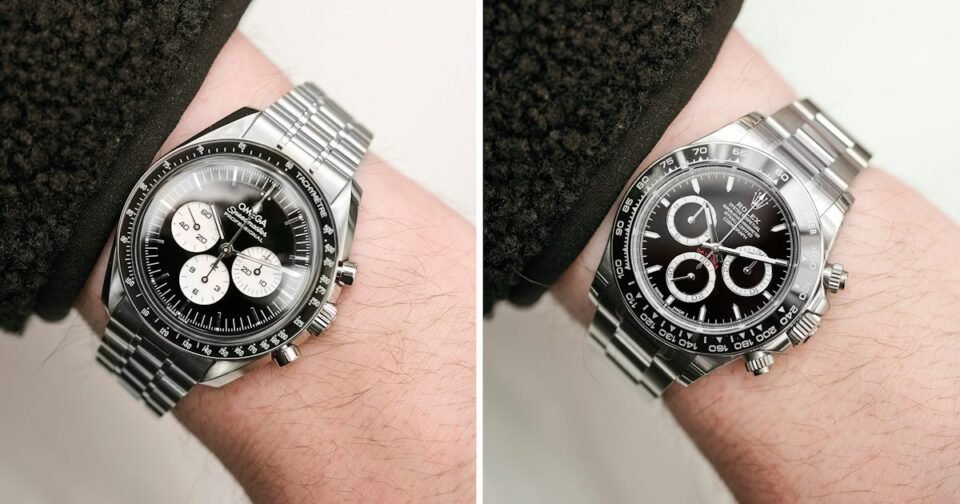
The Omega 3861 movement is a great one, with the Co-axial escapement and a silicon balance spring which allows for less wear and friction on the movement, less (necessarily) lubrication (although they still do lubricate the escapement), and the silicon components help contribute to the METAS certification up to 15,000 Gauss (so less magnetization like I’m currently dealing with on a watch right now). However, Rolex’s Caliber 4131 more than holds its own, using the brand’s Chronergy escapement, a highly efficient evolution of the traditional Swiss lever escapement made out of a largely antimagnetic nickel-phosphorus alloy—15% more efficient than a standard Swiss lever, the brand says. It also uses Parachrom (a niobium alloy) for the escapement material, which resists magnetism but not as much as silicon. Rolex, however, doesn’t publish Gauss ratings.
While the Omega quotes its Master Chronometer 3861 at -0/+5 seconds per day, certified first as a chronometer by COSC and then run through a battery of test by independent body METAS. Rolex keeps a slightly tighter range of -2/+2 seconds, certified first by the independent COSC and then subjected to stricter in-house testing, but it’s self-certified and not independent. Rolex also offers 22 hours more power reserve (72 versus 50 in the Omega) and a longer suggested service interval of 10 years (to Omega’s 5 to 8 years). One other thing to note is that the 3861 runs at 3Hz, whereas the Rolex 4131 runs at 4Hz. Generally, that means the watch is more shock-resistant. In a vacuum, with all other things being equal, it would also result in a lower power reserve and more wear on the movement, but we’ve seen that’s not the case with Rolex.