
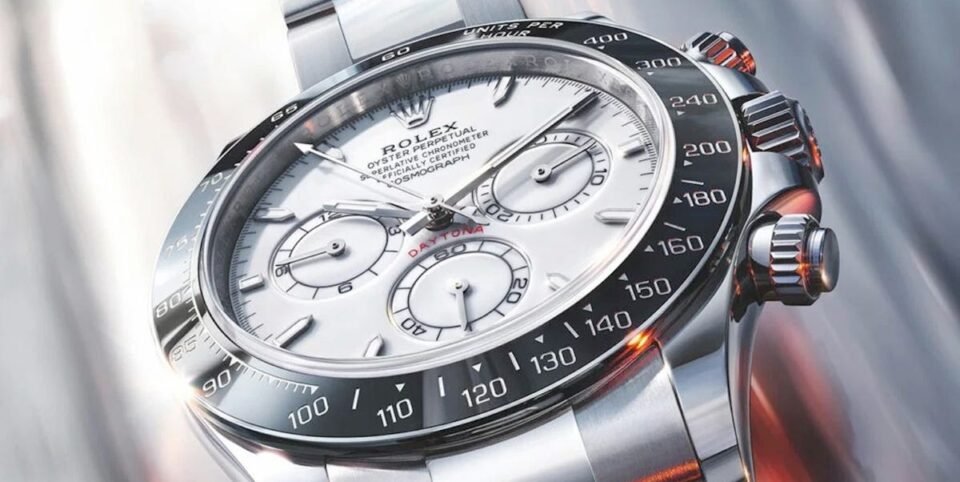
Rolex has created a remarkable contradiction of a watch with the latest Daytona. Seeing the description – to say nothing of the price – you might be tempted to bracket it under ‘stealth wealth’, because although it looks superficially similar to a regular stainless-steel model, it is, in fact, a combination of steel and platinum. But a Rolex Daytona is one of the best-known status symbols in the world, regardless of what it’s made of. And then you learn that the use of platinum extends only to the bezel ring, part of the caseback and the powder used to fill in the numerals on the ceramic bezel itself. So, despite being mostly steel, it costs more than the same watch in gold. Head-spinning stuff.
The contradictions don’t end there. The newest model – which goes by the official reference number 126502 and was unveiled at Watches & Wonders in Geneva this past April – is technically ‘off-catalogue’, or as Rolex now likes to say, one of its “Exceptional Watches”.

These normally don’t make it anywhere near the press, let alone the wider public, either via display case or Instagram feed. But this has been one of the most widely discussed releases for Rolex this year, even going some way towards overshadowing its centenary-edition Oyster Perpetual models.
“Off-catalogue pieces were once kept out of sight of prying eyes, but even Rolex knows that maintaining its position means parading the crown jewels every now and again,” says specialist watch author and cohost of The Luxury Society Podcast, Robin Swithinbank. “That’s why we’re seeing the Ref 126502, and it’s also why Rolex is charging into the left field with pieces like the Celebration and Jubilee dials. To give Rolex credit, despite its unchallenged position as Switzerland’s final boss watch brand, it’s not resting on its laurels.”

The Daytona’s star has been in the ascendant for so long, few people remember a time when it wasn’t popular. But some of the most collectible vintage models are desirable precisely because they weren’t a success when they launched. Today, the hype for rare vintage references and the demand for new Daytonas marches in lockstep; the right dial details, patina and provenance can still bring a seven-figure result at auction, while even the standard-issue steel Daytona ranks as one of the least available Rolexes at retail. Lately, Rolex has stoked enthusiasm even higher with a steady drip feed of extremely exclusive variations.
In 2023, it surprised the world with a special edition Daytona in white gold to mark 100 years of the 24 Hours of Le Mans endurance race (which coincided with the 60th anniversary of the Daytona itself). From a brand that practically never produces commemorative editions, this rapidly became one of the hottest watches on the planet. Fun fact: the Daytona was originally going to be called the Le Mans until Rolex’s sponsorship of the US race took priority as it pushed into the American market. Rolex has sponsored the modern incarnation of the 24 hours of Le Mans since 2001 and awards an engraved (steel) Daytona to every winner.
The white gold Le Mans Daytona, distinguishable by its red ‘100’ on the tachymeter bezel, simple ‘reverse panda’-style white-on-black chronograph subdials and display caseback, was not officially limited or numbered, but was discontinued after about a year. It was replaced by reference 126528LN: the same watch in yellow gold. This, unlike the white gold, was another ‘off-catalogue’ model and quickly found its way into the collections of the world’s best-connected A-listers, including LeBron James, David Beckham, Kevin Hart and Ed Sheeran.
This latest addition isn’t quite as stratospherically rare but is arguably much more unusual. It debuts a handful of new features and design details, including one that proved surprisingly controversial. We have a new ceramic bezel in anthracite grey – not black – that has been “enriched with tungsten carbide”, in Rolex’s words, for “a particularly striking metallic gleam”. The numerals on the bezel, which enable you to time your speed over a known distance, are horizontal rather than radial: that’s a call-back to the very earliest models. It has a display caseback, something very rarely seen on a Rolex prior to 2023 with the launch of the 1908, and never before included on a (mostly) stainless steel model.
But the most unusual – and, for watch geeks, most debatable – feature is the dial. Rolex, continuing its contradictory streak, refers to it as “grand feu enamel”; contradictory because, in all other realms, the company likes nothing better than coining its own language (Rolesium for the combination of steel and platinum, for example; Everose for its rose gold alloy) and if it had done so for this dial, it would have avoided the nerdiest controversy of the year so far.
Enamel dials are highly prized by watch collectors for several reasons – their glossy, milky appearance among them – but part of the appeal is that it’s an ancient handcraft, requiring great skill and susceptible to failure. Rolex’s Daytona dial appeared to have sidestepped many of the production difficulties in using a ceramic, rather than metal, base: a typically ingenious and efficient step, but one that, according to experts, renders use of the phrase grand feu incorrect and misleading.

Lewis Heath, founder of Scottish independent watchmaker anOrdain, which specialises in traditional enamel dials, explains: “Enamel is the fusion of a silica-based mixture to metal, and if it’s fused to ceramic, it’s a ceramic glaze. The one aspect which differentiates enamel from ceramics is the layer of metal.” Traditional enamelling requires firing the dials at temperatures of 800°C, and the problems arise because the enamel and metal cool at different rates, which can cause the enamel to crack – in which case, it’s back to square one. With its three chronograph subdials and main surrounding dial, Rolex’s Daytona has four separate enamel elements to each watch, which must match perfectly and survive the firing process (not to mention then having holes lasered in them for the hands, a process for which Rolex holds a separate patent).
The wealth of unusual details, the subtle baiting of the watch-geek community and the sheer surprise of its existence at all, combined with its hefty price tag of make this Daytona one of the most intriguing Rolex releases in years. For Swithinbank, its unorthodox nature is the entire point – describing it as “bait” intended to both sustain Rolex’s brand image and fuel sales of more readily available references. At the same time, the price is no accident. Swithinbank points out that Rolex has an interest in closing the gap between its retail prices and the inflated sums that its rarest watches command in the secondary market, especially since launching its own certified pre-owned program, which was recently estimated to be worth US$600 million annually.
According to Paul Altieri, CEO of pre-owned Rolex dealership Bob’s Watches, it has already had the desired effect. “The secondary market reaction has been immediate because Rolex effectively repositioned the entire modern Daytona platform upwards,” he says. “As a result, the stainless steel 126500 model now almost feels like relatively good value within the Daytona lineup, despite already trading well above retail. We’ve already started to see sentiment strengthen, and I wouldn’t be surprised to see prices continue trending upwards from here.”
Where things go from here, we can only speculate. Rolex is not in the habit of one-hit wonders, so it is a fair bet that we could see enamel used more widely (however it’s made) in the future, as well as potential price rises for the core Daytona collection. And like the Le Mans, the Rolesium Daytona is unlikely to stick around for long. The unpredictability of it all is, of course, part of the show. “Creating desirability is an art as much as a science,” says Swithinbank, “and Rolex’s position proves it’s better at this than all the rest.”