
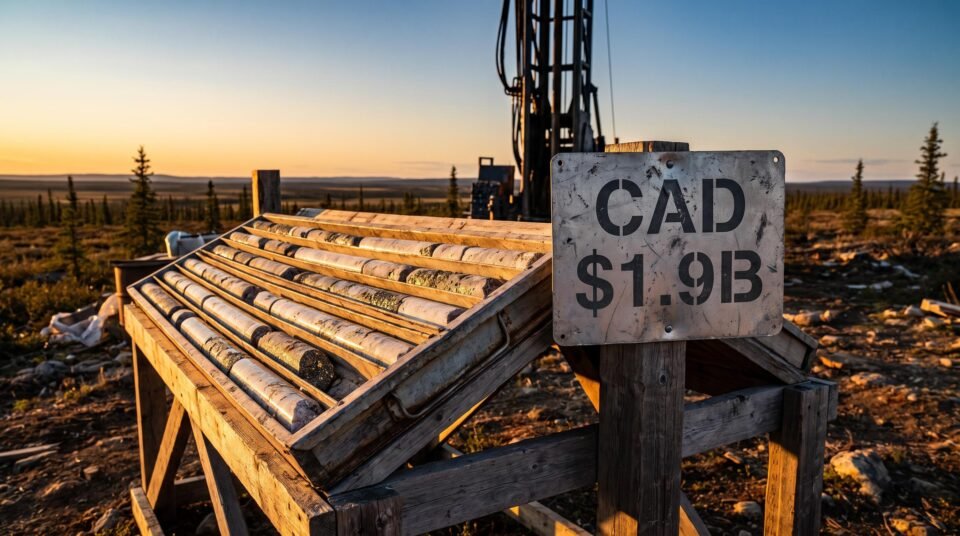
A junior gold explorer just published a preliminary economic assessment carrying a CAD $1.9 billion after-tax net present value. The deposit behind that number was outlined with roughly 90,000 metres of drilling, and the project sits at the earliest formal study stage, well short of feasibility. The scale of the claim arrives before the reader has any obvious reason to trust it.
That gap between headline and stage is exactly why this moment matters for anyone weighing White Gold Corp stock. The August 2026 PEA has just landed, the northern access road serving the neighbouring Coffee project received its critical permit on 31 August 2026, and the company is deploying its largest drill campaign to date. Three separate catalysts are converging in a single field season rather than unfolding across years.
Here is what the data actually tells you about whether the investment case holds up beneath the headline figures, and the specific variables worth tracking before drawing any conclusion.
What the CAD $1.9B PEA actually tells you (and what it deliberately does not)
Start with the number that does the marketing, then check what sits underneath it. The August 2026 preliminary economic assessment, presented by White Gold geologist Dylan Langille at the Beaver Creek Precious Metals Summit, puts the after-tax value of the project at roughly CAD $1.9 billion.
August 2026 PEA headline economics After-tax NPV: approximately CAD $1.9 billion. Internal rate of return: 38-41%. Projected mine life: approximately 9.4 years. Total resource base: approximately 3 million ounces across four deposits.
A preliminary economic assessment, or PEA, is the first formal study that tests whether a deposit could work as a mine, using early assumptions rather than detailed engineering. Management has been explicit that this one is a proof-of-concept starting point, not a signal of advanced development.
A preliminary economic assessment is the first formal study that tests whether a deposit could work as a mine, using early assumptions rather than detailed engineering, and the gap between a PEA and a full feasibility study is where most junior project valuations carry the greatest uncertainty.
The figure worth interrogating is the gold price assumption. The PEA runs its economics at US$3,600 per ounce. A Kitco News survey of analysts published on 23 September 2026 put the 2027 consensus at US$4,610 per ounce, itself revised down from US$5,100 in the prior poll.
That roughly US$1,000 per ounce gap is not simply reassuring headroom. It tells you that even after consensus was cut sharply in one cycle, the published economics still sit in what would be a conservative scenario. That changes how seriously to weigh the IRR: the return figure is not resting on an aggressive price bet.

The resource itself was built on a limited base. Mining News North’s coverage cites 35.2 Mt indicated at 1.53 g/t (1.73 Moz) and 32.2 Mt inferred at 1.22 g/t (1.27 Moz) at Golden Saddle and Arc, though that resource detail is unverified in the source materials.
The analytical question, then, shifts. It stops being “is CAD $1.9 billion real?” and becomes “how much does the resource need to grow before this advances?” The 15,000-20,000 metre 2026 drill program, described as the largest in company history, is management’s answer to that question.
When big ASX news breaks, our subscribers know first
The Coffee road permit and what it means for exploration economics in the White Gold District
Understand the mechanism before the magnitude. In remote Yukon terrain without road access, exploration leans on helicopters to move drill rigs, fuel, personnel, and core samples in and out. Every one of those flights adds to the cost of each metre drilled, and short weather windows compress the usable field season.
That cost structure is what the Coffee road permit is set to change. On 31 August 2026, Talamore Mining, the successor operator of the Coffee project, announced receipt of the Primary Resource Road Permit for the northern access route, which it described as the critical permit for completing the road.
The permit authorises roughly 29 km of new road segments plus upgrades to about 5 km of existing road. The corridor runs from the Coffee deposit toward Dawson City, passing along the western boundary of several White Gold properties. Coffee sits approximately 25-33 km south of the White Gold district.

How road access changes the arithmetic of Yukon drilling
Ground access rewrites the cost-per-metre equation. The specific operational shifts are concrete rather than abstract:
- Truck and tracked equipment access replaces helicopter mobilisation, cutting fuel and transport costs on every metre drilled.
- Larger, more powerful drill rigs become deployable by road, lifting penetration rates and lowering cost per metre across long programs.
- Extended field seasons open up, because ground-based access can run through shoulder periods when helicopter flying is uneconomic or grounded.
The practical effect is that the same drill budget stretches to more holes and better geological data. Yukon exploration geologists weigh road proximity heavily when prioritising targets, and Talamore’s own framing of this permit as the single critical milestone shows how central road access is to the entire development lifecycle, not just mine construction.
For White Gold, that matters right now because of the 15,000-20,000 metre program in the field. A structural cut to district exploration costs lets that capital reach further. The catch is timing: the road is permitted but not complete, and no public completion date appears in the source materials. Infrastructure catalysts are notoriously hard to price before they are operational, which means the full cost reduction is not yet baked into consensus assumptions for the district.
District-scale value creation depends on the infrastructure catalyst arriving before the capital markets price it in, and the sequence the Coffee road establishes, permitted access enabling lower-cost drilling across multiple operators, follows a pattern that has historically unlocked district premiums well ahead of individual project feasibility.
District scale as an investment thesis: what the Coffee and Great Bear precedents actually validate
White Gold controls roughly 305,102 hectares across 21 properties and 15,364 quartz claims, about 40% of the emerging White Gold District. The question is what that land position is actually worth, and two precedents answer it in sequence.
Start with Coffee, because it is the same district and the same road. Kaminak Gold assembled Coffee as a multi-deposit, district-scale camp, and the combination of resource scale, a credible development concept, and early road planning supported Goldcorp’s acquisition of the company. Coffee later folded into Newmont’s portfolio. The asset whose road Talamore is now advancing is the same one that established the district’s development precedent.
The second precedent is more personal to White Gold. Great Bear Resources built a large, high-grade land position in Ontario’s Red Lake district and was acquired by Kinross in a multi-stage deal combining upfront cash and shares with contingent payments tied to resource and project milestones. Dylan Langille logged the Great Bear discovery borehole in January 2019, stayed with the project through 2025, then joined White Gold Corp.
Both deals point to the same structural lesson. Majors pay cash and shares for demonstrated value while retaining upside to further discovery through contingent payments and royalties. The valuation triggers are consistent: crossing the 2-3 Moz resource range with room to grow, delivering robust economics under conservative pricing, and securing critical infrastructure permits.
For an investor in White Gold Corp stock, that reframes the land package. The 300,000-hectare position is a multiplier on a strong core asset, not a substitute for one. District scale attracts major interest only once the flagship crosses a de-risking threshold, which means the 2026 drill results will move valuation more than the headline land size ever could. The current 3 million ounce base and August PEA represent a plausible early point on that trajectory, not a finished one.
The next major ASX story will hit our subscribers first
Where the investment case is genuinely fragile: the risks that the PEA headline obscures
The risks that matter most are not the ones generically attached to junior miners. They are the specific hurdles that threaten White Gold’s development sequence, and the order they clear in is itself the risk.
- Permitting timelines. Yukon open-pit projects face multi-stage environmental and socio-economic assessments that can run for years, with no guaranteed schedule. No specific permitting timeline is confirmed in the source materials, which is itself a source of uncertainty.
- Community and First Nations consultation. Projects advance within settled and unsettled land claims, where durable relationships and impact-benefit agreements are genuine project risk, not a compliance formality. A breakdown can alter scope or timing even after a positive PEA.
- Capital market access. Juniors depend on equity, strategic backing, and occasionally royalty deals. A reported $23 million placement and Agnico Eagle strategic backing help here, though both are flagged as unverified and neither is a permanent solution to financing risk.
- Gold price sensitivity. PEA economics move sharply with the gold price, and the 2027 consensus has already been cut in a single cycle.
- Technical de-risking. Moving from PEA to feasibility across four deposits demands geotechnical data, detailed metallurgy, and mine design that could surface surprises on recoveries or pit slope stability.
Consensus can move fast The 2027 gold consensus was revised from US$5,100/oz to US$4,610/oz in a single Kitco polling cycle (23 September 2026). The PEA’s US$3,600/oz floor still sits below that, but the direction of travel is the point.
The most consequential risk here is sequential rather than geological. Permitting, consultation, and financing must each clear in the right order before feasibility capital becomes available, and a delay in any one compresses the others. The CAD $1.9 billion NPV is a real number under its stated assumptions, but reaching the point where a feasibility study tests it means clearing a chain of non-technical hurdles the PEA stage does not de-risk. Knowing which hurdle sits on the critical path is what separates informed positioning from headline-chasing.
Execution risk in junior developers is frequently treated as a single undifferentiated category, but permitting timelines, community consultation outcomes, and capital access are sequentially dependent hurdles, each one’s failure compressing the others in ways that a headline NPV cannot capture.
Past performance does not guarantee future results. Financial projections are subject to market conditions and various risk factors, and these forward-looking statements are speculative and subject to change based on market developments and company performance.
Three variables that will define the White Gold Corp investment case through 2027
The investment case at this stage is real but contingent. Rather than waiting for a verdict, an investor can track three specific variables, each connected to a thread developed above.
- 2026 drill results and resource growth. The 15,000-20,000 metre program is fully funded and is the primary near-term signal on whether the PEA’s conservative economics get leveraged by a bigger resource. A meaningful addition above the current 3 million ounce base strengthens the thesis; a flat result leaves the NPV resting on today’s tonnes.
- Coffee road construction progress. The 29 km road is permitted but carries no confirmed completion date. Visible construction toward operational ground access accelerates the district-wide cost-structure improvement; a stall delays the exact catalyst that stretches exploration budgets further.
- Gold price trajectory. The gap between the US$3,600/oz PEA floor and the US$4,610/oz 2027 consensus is the macro lever. Prices holding near consensus widen the economic headroom already visible; a slide toward the floor narrows it and puts the IRR under pressure.
Gold price trajectory is the macro lever that sits beneath every IRR figure in the current environment, and with institutional targets spanning a wide range, the difference between a conservative and consensus scenario can shift a project’s after-tax NPV by hundreds of millions of dollars.
Tracking all three at once is not speculation. It is monitoring whether the conditions that make the CAD $1.9 billion NPV achievable are converging or diverging, which is a materially different posture from betting on the headline. These are the specific pieces of evidence to collect before the thesis is confirmed or revised.
This article is for informational purposes only and should not be considered financial advice. Investors should conduct their own research and consult with financial professionals before making investment decisions.