
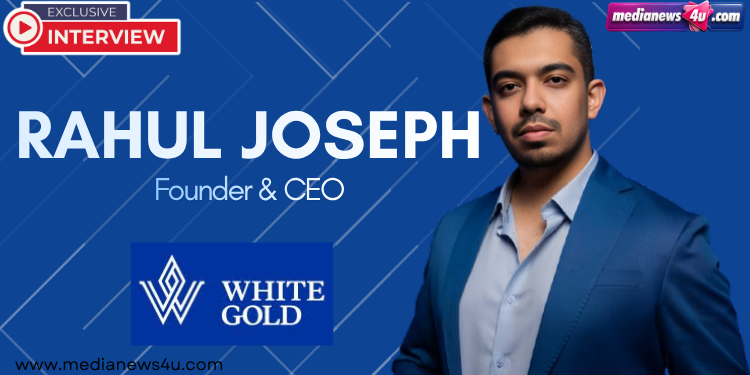
White Gold Money’s bold decision to bid for the Title Sponsorship of Bigg Boss Telugu, Bigg Boss Kannada and Bigg Boss Malayalam has created considerable buzz in the media market. At a time when brands are increasingly scrutinising media investments for both scale and effectiveness, taking a title sponsorship across three Bigg Boss franchises represents an unusually ambitious bet on mass entertainment.
Very few brands have taken such a broad and aggressive approach to media investment across the three South Indian markets, making White Gold Money’s move particularly noteworthy. More importantly, the investment reflects a strategic shift for the organised gold-buying company—from using media primarily to drive customer acquisition towards using large-scale properties to build long-term brand equity.
For Rahul Joseph, Founder & CEO, White Gold Money, the rationale is rooted in the nature of the category itself. Gold selling is an occasional, high-value decision where the consumer needs to trust the brand before the moment of transaction arrives. The company’s challenge, therefore, is to ensure that White Gold is already familiar and credible when that moment comes.
The Bigg Boss association is the latest expression of that strategy, but the thinking behind it begins with a broader transformation taking place in the organised gold-buying market.
Organised Gold Buying: Making Transparency Visible
The organised gold-buying category is undergoing a behavioural shift, with consumers increasingly questioning how their gold is tested, valued and whether the transaction is transparent and properly recorded.
“For decades, people went to a local jeweller or pawnbroker because it was convenient and had nothing to do with valuation. What’s changing today is that consumers, especially in urban and semi-urban South India, are starting to ask questions,” Joseph says.
For White Gold Money, the response has been to make transparency visible through live rate displays, tamper-proof testing in front of customers, digital receipts and the elimination of back-room valuation.
“Our job is to make transparency visible,” Joseph says, pointing to the company’s focus on delivering these practices consistently and at scale.
But in a high-value category, transparency needs to be supported by brand reputation. Consumers may be handing over jewellery that has been in their families for generations, making trust a crucial part of the decision.
“Branding and reputation building are not optional in this category. They are foundational,” Joseph says.
With gold selling being an occasional decision, the challenge is to build familiarity well before the need arises. “Honestly, this is the hardest part of our job. Nobody wakes up thinking about selling gold,” Joseph points out.
For White Gold, therefore, the objective is to remain visible and relevant so that when the need eventually arises, the brand is already associated with safety, credibility and transparency.
That need for sustained familiarity is also influencing how the company is approaching its media investments.
From Acquisition to Brand Equity: The Evolution of White Gold’s Media Strategy
White Gold Money’s media strategy has evolved from being predominantly acquisition-led in its early years to placing greater emphasis on brand equity as it has expanded across Karnataka, Kerala, Andhra Pradesh and Telangana.
“We are now investing meaningfully in brand equity,” Joseph explains, adding that the company does not view acquisition and brand building as separate objectives.
“A strong brand recall directly lowers the cost and increases the speed of acquisition,” he says.
The strategy is built around one consistent brand promise—fairness, transparency and respect for the customer—while adapting the way it is communicated to different markets.
“White Gold is one brand promise, expressed in many languages,” Joseph says.
Creative execution, casting, language and tone are consequently localised to reflect individual markets.
Media, correspondingly, has a multi-layered role. Regional television continues to occupy a central position in the company’s reach and credibility strategy, with Joseph highlighting the legitimacy that comes from being consistently present in family viewing.
“Appearing consistently on a screen where a family watches together still carries a legitimacy that’s hard to replicate elsewhere,” he says.
Digital and social media complement television by allowing White Gold to focus on consumer education—explaining gold valuation, addressing questions from first-time sellers and communicating how gold can help consumers manage financial needs and future plans.
Large entertainment properties add another dimension, combining television-scale reach with sustained engagement and cultural relevance. This thinking has played a significant role in White Gold Money’s decision to associate with Bigg Boss across three South Indian language markets.
Bigg Boss: From Sponsorship to Sustained Brand Presence
The scale of White Gold Money’s Bigg Boss investment is significant not merely because it involves a high-profile entertainment property, but because the company has chosen to make the bet across three major South Indian language markets simultaneously.
The decision represents a marked escalation from conventional media buying and demonstrates the company’s confidence in the role of large entertainment properties in building consumer brands.
For Joseph, however, the attraction of Bigg Boss goes beyond headline reach.
“Bigg Boss isn’t just a show in these markets—it’s continuous viewing, conversations, and often controversies, all at once, for months at a time,” he says.
That combination of scale, frequency and cultural relevance is particularly suited to a category where the consumer may not be actively considering a transaction when they encounter the advertising.
“For a category like ours, where we need people to trust us before they need us, that sustained, high-involvement viewership was exactly the environment we wanted to be a part of,” Joseph says.
The company’s strategy is based on the belief that trust cannot be built through short bursts of communication.
“Gold-selling decisions aren’t made on impulse from a 30-second ad. They are made when a need arises and the customer reaches for a name they already trust,” Joseph explains.
Bigg Boss therefore offers something that conventional spot advertising may find difficult to replicate: repeated exposure embedded within a viewing habit that continues for months.
For White Gold, the objective is to move beyond being an advertiser around the programme and become part of the consumer’s recurring entertainment experience.
The company has also sought to ensure that the association does not stop with title branding and logo visibility.
“We were clear from the start that we didn’t want to just put our logo on a screen and call it done,” Joseph says.
White Gold has explored integrations, consumer contests, meet-and-greets and associations with culturally relevant sporting institutions, including Bengaluru FC (BFC) and Kerala Blasters FC (KBFC).
The strategy is designed to create a broader ecosystem of consumer engagement around the brand.
The three-market Bigg Boss investment also builds on White Gold Money’s earlier experience with regional entertainment properties including Sa Re Ga Ma Pa, Dance Kannada Dance on Zee Kannada, Star Singer on Asianet and Aadivaram on Star Maa.
Those associations, according to Joseph, reinforced two important lessons: reach alone is not sufficient, and consistency matters more than a short-lived spike.
The Bigg Boss move is therefore not simply a case of the brand “going bigger”. It is an attempt to go deeper—with greater integration, localisation and sustained presence.
“It was a natural evolution rather than a leap,” Joseph says.
White Gold will evaluate the association across multiple layers. Reach and awareness form the first layer, followed by consideration and trust—whether consumers increasingly view the company as a safe and credible option when selling gold. At the business level, the company will look at footfalls and transaction volumes in the markets where the shows are active.
The timing is also significant given White Gold’s entry into Andhra Pradesh and Telangana, where the Bigg Boss association provides an opportunity to accelerate awareness as the company establishes itself in newer markets.
The Next Phase: Building a South India-Wide Consumer Brand
The Bigg Boss investment comes against the backdrop of an ambitious physical expansion strategy. White Gold Money is looking to move from around 80 cities towards 100 cities, increasing its physical presence across South India.
As the company enters newer markets, large-scale brand-building properties are expected to remain an important part of the media strategy.
However, the company does not envisage a mass-media-only approach. In markets where White Gold is already established, the focus is expected to increasingly shift towards targeted, performance-led activity designed to convert awareness into actual footfalls.
Digital, on-ground initiatives and community-level engagement will therefore become increasingly important.
The emerging strategy is a differentiated media mix: brand building in newer markets and performance-led activity in established markets.
But behind the geographic and media expansion lies a larger ambition.
“Trust is our business and that will remain our priority,” Joseph says.
Over the next three to five years, White Gold Money wants to become the first name that comes to mind for organised gold buying across South India.Achieving that ambition will require the company to expand its physical network while maintaining the same standards of transparency and customer experience across every new location.
White Gold’s ambition, Joseph says, is not simply to become a larger chain of gold-buying centres. It wants to become a genuine consumer brand—one that South Indian households associate with fairness, transparency and respect.
In that context, the company’s three-way Bigg Boss title sponsorship is more than a media investment. It is a statement about how White Gold Money intends to compete in the next phase of the organised gold-buying market: by making the brand familiar long before the consumer needs it, and by turning familiarity into trust when the moment of transaction arrives.