

To add to the assortment of scary things going on in the world at the moment, here we are with our annual set of spooky charts. From consumption and the price of diesel to the housing market, credit spreads, the capex boom and the recent repricing in France, we hope you agree that some of these are worth keeping a close eye on. Viewer discretion advised.
Source: M&G, Bloomberg. October 2026.
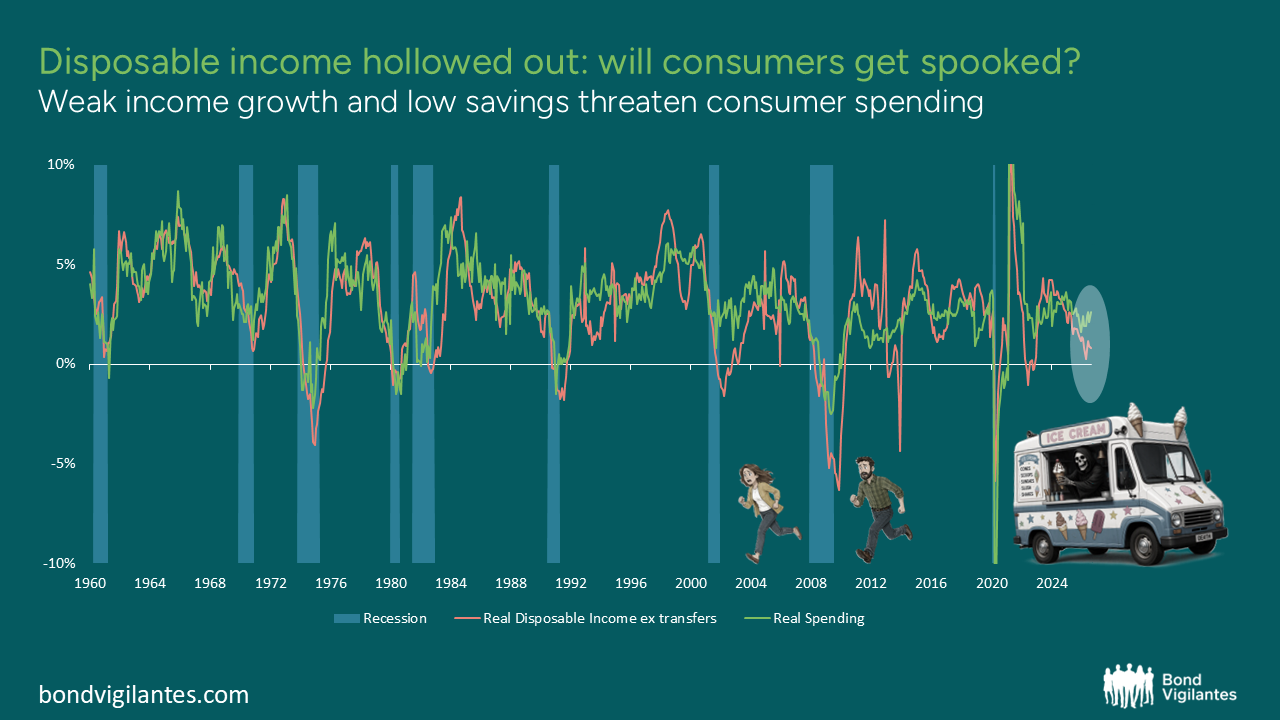
A gap has surfaced between income and spending, with consumption increasingly being supported by savings rather than income growth. Real spending grew 2.6% over the year on the most recent print, while real personal income excluding transfers only increased by 0.8%. Spending has outgrown income in all months since the middle of 2024, and that gap has to be paid for somehow… increasingly, savings. However savings are finite, and the longer income growth stays below spending growth, the less protection there is left when the skeletons come out of the closet. Income ex transfers hasn’t turned negative yet, but when it has in the past it has often been in or around a recession. That isn’t necessarily proof of anything, but it isn’t a reassuring takeaway either.
Source: M&G, Bloomberg. October 2026.
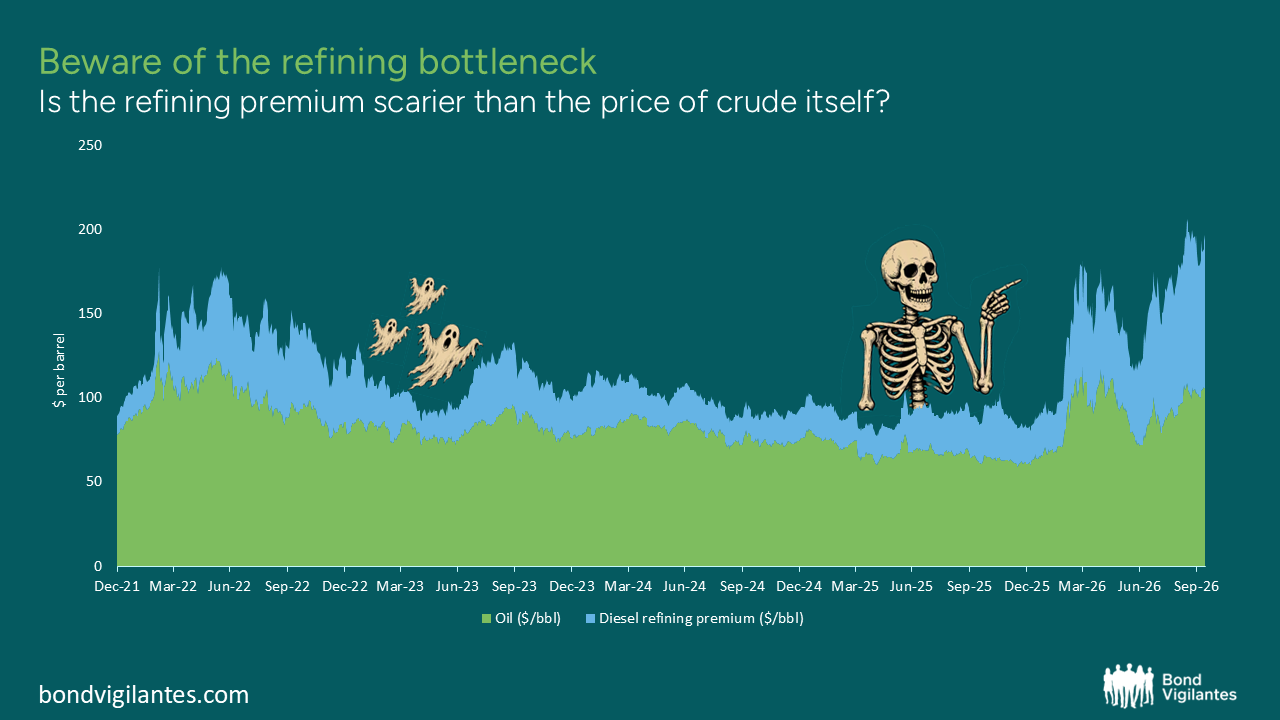
This chart splits the price of a barrel of US diesel into two parts: the crude oil that goes into it, and what refiners charge to turn that crude into diesel. Together, they make up the price at the pump before tax and distribution. Oil supply concerns have been top of mind for investors throughout most of this year, but the bottleneck in refining capacity may be of deeper concern when thinking about possible solutions to the current strain. The refining premium has roughly quadrupled this year, and sits well above the period when Russia first invaded Ukraine. The cost has been felt by the consumer, with pump prices passing $6 per gallon – which brings both economic and political difficulties. Diesel is what moves goods and runs farms and machinery, so this could matter more for inflation than the oil price alone suggests. Even if a resolution to global conflicts brings with it a lower oil price, might a persistently higher refining cost become a more entrenched concern for inflation and the broader economy?
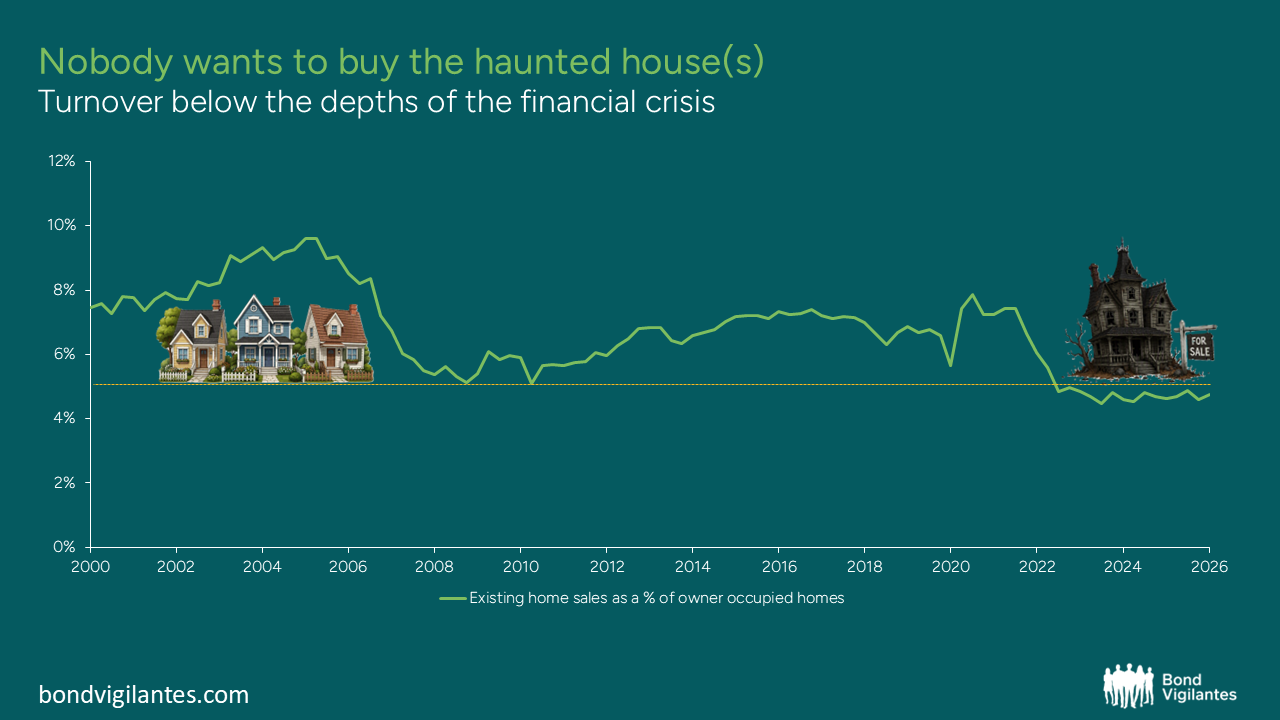
Source: M&G, Bloomberg, St Louis Fed. October 2026. US NAR Total Homes Sales SAAR as a % of Owner Occupied Housing Units in the United States
The US housing market has become a bit of a ghost town. Existing home sales as a percentage of owner occupied homes are running at 4.75%, below the post crisis low of 5.1% in 2010 and about half the 9.6% reached in 2005. This is a story of limited appetite to move, as most mortgaged homeowners are paying well below today’s interest rates. Moving would mean taking on a mortgage at a much higher rate, ultimately limiting turnover across the board. The housing market appears to be stuck in a bit of a rut, and this has a feedthrough into fewer dollars being spent on anything from solicitors to sofas. Scary stuff for those associated with the sector or optimistic on broad based economic growth.
Source: M&G, Bloomberg. ICE BofA US Corporate Index (C0A0). September 2026.
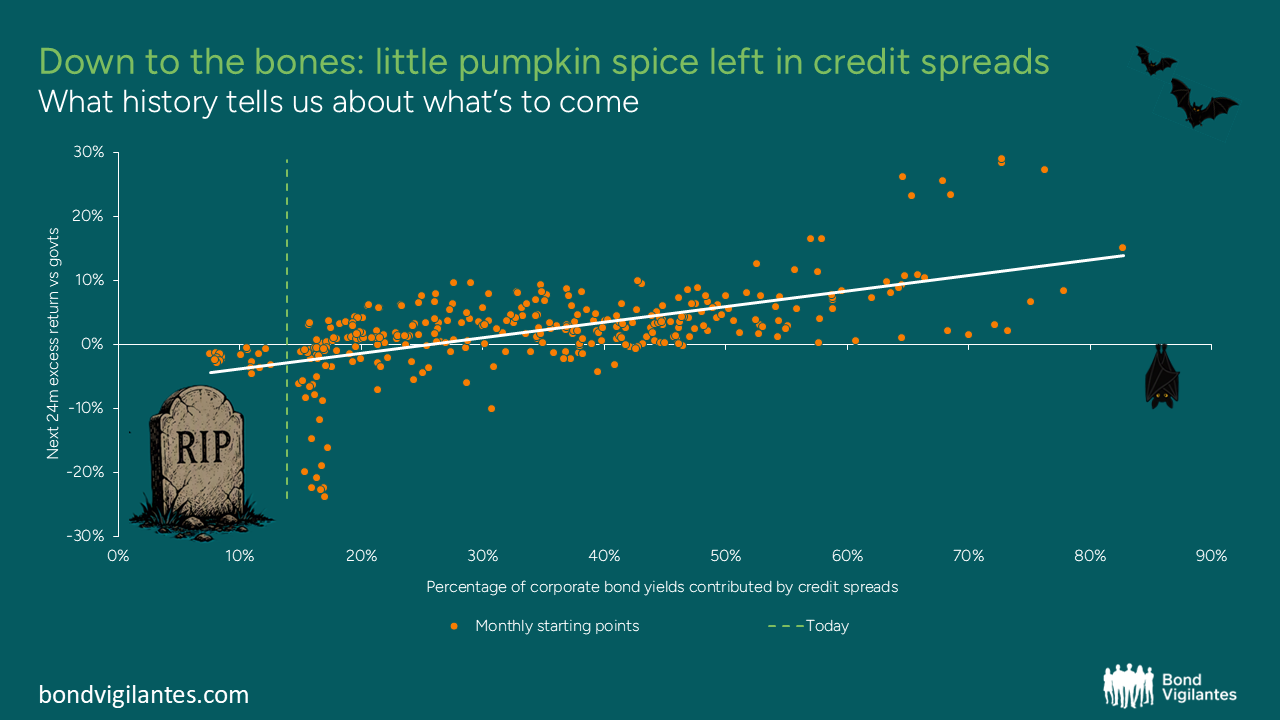
The following sentence is not my most groundbreaking: credit spreads are pretty tight. The reasons for that are well debated, but it is interesting to look at the realised excess return for credit (vs governments) at a similar period in the past where the credit spread contributed so little to the overall corporate bond yield. For the US investment grade index, the credit spread now makes up about 14% of the yield, the lowest proportion since 1998. Starting points like this have historically been followed by weak excess returns. It will not necessarily be the same story this time around, but there isn’t much pumpkin spice left to scrape off the top…
Source: M&G, Bloomberg. October 2026. Hyperscalers defined as the main cloud and data centre operators: Microsoft, Amazon, Alphabet, Meta and Oracle. Analysis based on Q2 2026 reporting period.
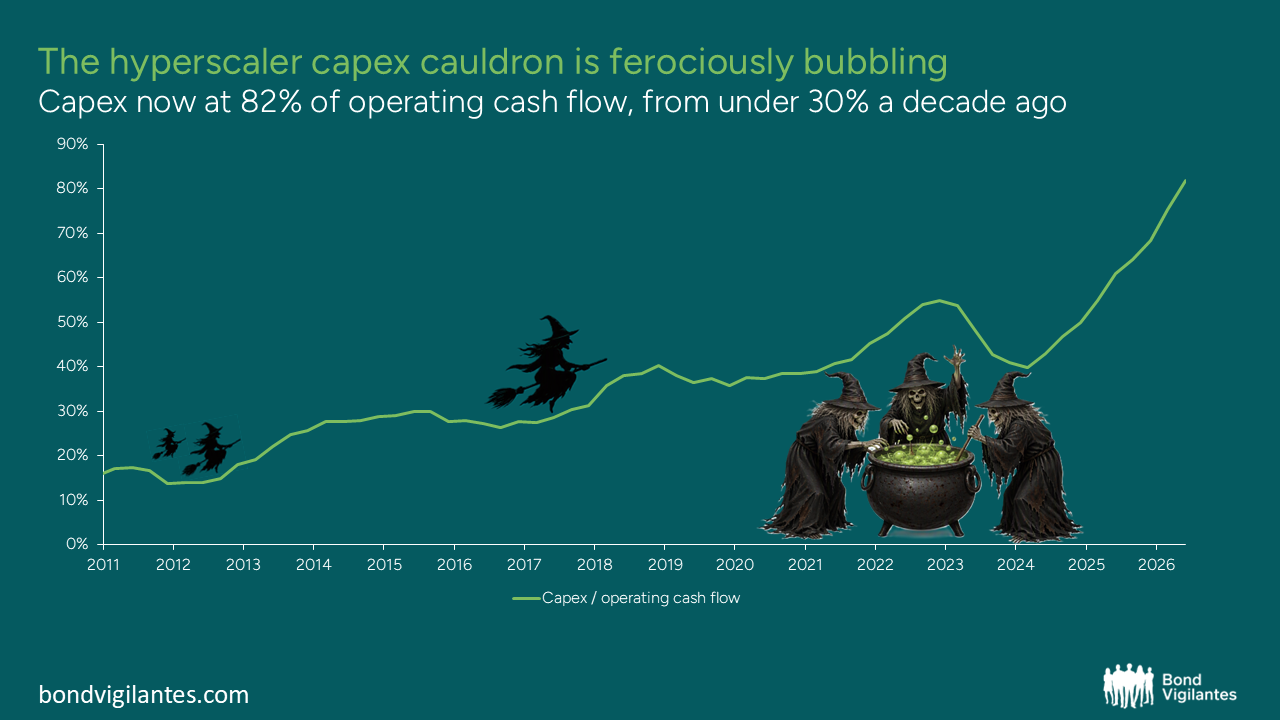
The hyperscalers, by which we mean here the companies actually building and running the data centres (Microsoft, Amazon, Alphabet, Meta and Oracle), are now spending 82% of their combined operating cash flow on capex based on end of Q2 reporting, up from 27% a decade ago and ‘just’ 40% as recently as early 2024. Company guidance points to this spending increasing into next year as the capex boom continues. These are some of the strongest balance sheets in the world, but once buybacks and dividends are added on top of capex there isn’t much cash flow left over, so more of that spending is likely to be funded through the bond market, and there have already been some very large deals this year (not to mention the leases and private credit vehicles that keep some of it off balance sheet altogether). The cauldron is hotting up, and the bond market looks set to play a bigger part in keeping it bubbling…
Source: M&G, Bloomberg. 20 October 2026.
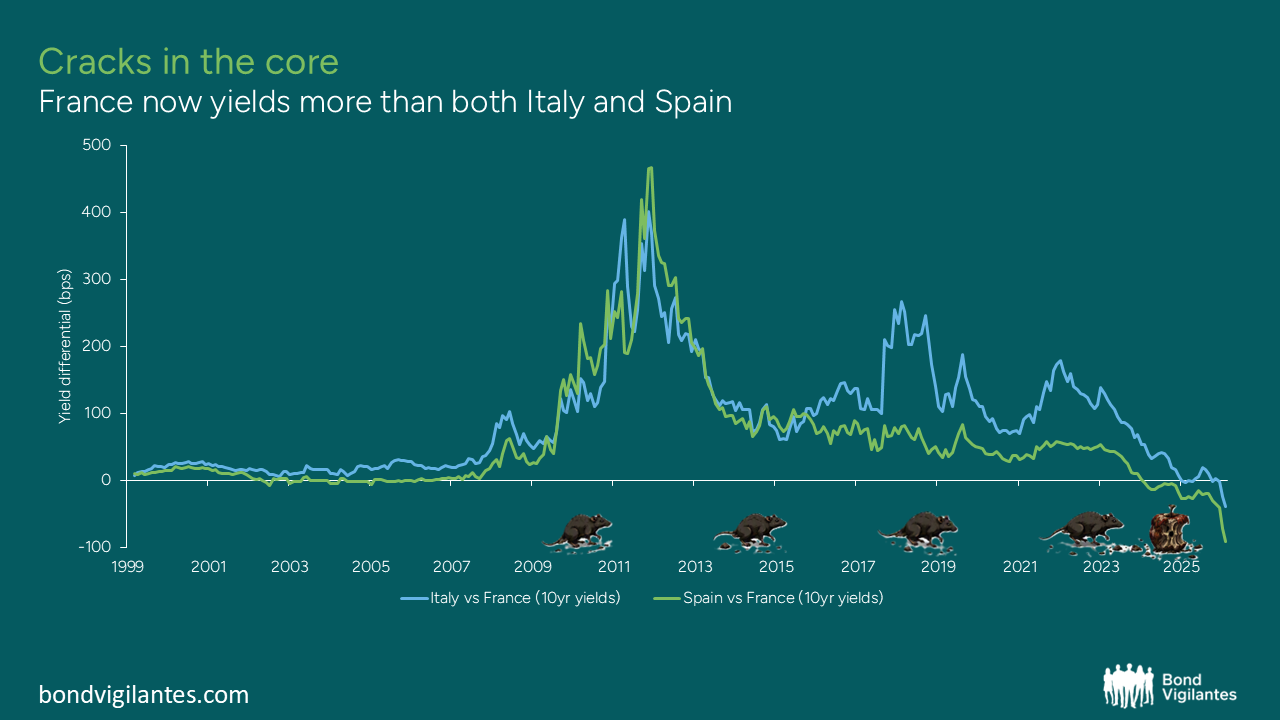
For most of the last 25 years France has been part of the euro area core, priced somewhere between Germany and the periphery. After recent political developments and concerns over government borrowing, France’s 10 year yield is now above Italy’s and significantly above Spain’s. Three years ago Italy yielded 138bp more than France, and at the height of the sovereign debt crisis Spain yielded almost 470bp more. Some of this is Italy and Spain making progress on their finances, and some of it is French politics struggling to achieve the same. Italy was back above France as recently as March, so the crossover hasn’t been entirely one way, but the September move in particular was large.
So there it is: consumption increasingly propped up by savings, inflation at risk of being fed through the refinery rather than the oil well, a housing market in a rut, credit spreads with little left to give, just as a capex boom is set to lean further on the bond market, and a euro area core that looks less core by the month.
Happy Halloween to all.