
By Agecroft Partners
Artificial intelligence could be one of the most significant developments in hedge fund investing since the emergence of quantitative trading.
What makes the current AI revolution different is that it is no longer limited to quantitative hedge funds employing teams of PhDs and programmers. Generative AI and increasingly sophisticated machine-learning tools are making advanced investment research capabilities accessible to discretionary fundamental managers, credit specialists, macro traders, and even relatively small hedge funds. The biggest change is that AI can dramatically increase the amount of information an investment professional can analyze, while reducing the time and cost required to do it. There are six major areas where AI is transforming the investment process.
1. Fundamental investment research
Traditionally, an equity analyst might spend days reviewing annual reports, quarterly earnings releases, conference call transcripts, industry publications, and competitor filings before forming even a preliminary view on a company. Much of that time is spent locating, extracting, and organizing information rather than analyzing it. AI can now accelerate many of these tasks dramatically.
For example, an analyst researching a publicly traded industrial company could use AI to:
A. Analyze 10 years of SEC filings and earnings transcripts, extracting key financial data, segment results, and management guidance into a structured format in minutes rather than days.
B. Identify changes in management’s language regarding demand, pricing, and margins. Subtle shifts in tone, such as moving from “strong demand” to “stable demand,” or a sudden increase in hedging language, can be early signals that fundamentals are changing before it shows up in reported numbers.
C. Compare financial metrics with 20 competitors, including growth rates, margins, return on capital, working capital trends, and capital allocation decisions, to see whether a company’s performance reflects company-specific strengths or simply industry-wide conditions.
D. Identify inconsistencies between management commentary and reported financial results, such as optimistic statements about pricing power while gross margins are declining, or claims of strong demand alongside rising inventories and receivables.
E. Build preliminary financial models and sensitivity analyses, showing how earnings and valuation respond to changes in key assumptions such as volume, pricing, input costs, and interest rates.
F. Highlight potential investment catalysts and risks, including upcoming product launches, contract renewals, regulatory changes, debt maturities, litigation, and shifts in customer or supplier concentration.
AI can also extend research beyond a single company, mapping supply chain relationships, summarizing expert network and industry interview notes, and flagging developments at customers or suppliers that may affect the company being analyzed. This allows an analyst to cover more companies with greater depth, or to go much deeper on a concentrated set of positions. It also reduces language barriers. An analyst can have AI read annual reports, filings, and earnings releases in Japanese, German, or Spanish and report back in English, allowing investment teams to look across a wider range of markets.
A research project that historically required several days of preliminary work may now be substantially accelerated. However, data validation and investment judgment remain essential. AI tools can misread tables, misattribute figures, draw on outdated information, or present a confident answer that is simply wrong. Analysts must verify key data against source documents, and firms need clear policies on data security, the handling of material non-public information, and documentation of how AI-generated analysis is used in the investment process. These governance requirements apply to every use of AI discussed in this paper.
The investment implication is that analysts can spend less time collecting and organizing information and more time developing differentiated investment insights. Because these tools are becoming widely available, simply having access to AI will not be a lasting competitive advantage. The edge will increasingly come from how a firm integrates AI into its research process, the quality of its proprietary data and judgment, and its ability to identify insights the rest of the market has not yet recognized.
2. Alternative data analysis
Hedge funds have long used alternative data, but AI greatly expands the types of information that can be analyzed, and allows it to be processed far more quickly and economically. Examples include satellite imagery, credit card transaction data, shipping activity, job postings, consumer reviews, web traffic, app downloads, and social media.
Much of this data is unstructured, meaning it comes in the form of images, text, or raw activity logs rather than neat tables of numbers. Historically, turning it into something usable required teams of data scientists and engineers. AI can now handle much of that work: counting cars in parking lots from satellite images, reading millions of product reviews to measure shifts in customer satisfaction, mapping job postings to specific companies and roles, and cleaning and aligning datasets from different vendors so they can be analyzed together.
Consider a hedge fund analyzing a retailer. AI could combine credit card transaction trends, online pricing and promotional activity, hiring patterns, consumer sentiment, web and app traffic, and inventory indicators to develop a view of revenue growth before quarterly earnings are released. It could also reveal why sales are changing, for example whether growth is coming from new customers or higher spending by existing ones, whether discounting is driving volume at the expense of margins, or whether a competitor is gaining share in a particular region or product category.
The competitive advantage increasingly comes from combining multiple datasets and extracting useful signals rather than simply purchasing access to the data. A single dataset viewed in isolation can be misleading. Credit card panels may over-represent certain demographics, web traffic may not translate into purchases, and satellite data can be distorted by weather or seasonality. Cross-checking several independent sources helps confirm whether a signal is real.
Alternative data also carries specific risks. Many datasets have short histories, making it difficult to test how reliable they are across different market environments. Data quality and vendor methodology can change without notice. Legal considerations include consumer privacy rules and the terms under which data was collected or scraped. Strong vendor due diligence and documented compliance procedures are becoming essential.
The investment implication is that AI may make alternative data more accessible to smaller managers while increasing competition for previously proprietary signals. As more managers buy the same data and apply similar tools, the insights it produces are likely to be priced into markets faster and decay sooner.
3. Quantitative investment strategies
AI is expanding the tools available to systematic hedge funds. Traditional quantitative models often depend on predefined statistical relationships, such as linear factor models built on value, momentum, quality, or carry, where the researcher specifies in advance which variables matter and how they relate to returns. More advanced machine-learning models can detect nonlinear relationships and interactions across many variables. A signal that works only when volatility is low and credit spreads are tightening, for example, may be invisible to a linear model but identifiable by a machine-learning approach. Natural language processing also allows systematic funds to convert text from earnings calls, news, regulatory filings, and social media into quantifiable signals, alongside the alternative datasets described above.
Potential applications include:
A. Identifying changing market regimes, such as shifts between risk-on and risk-off environments or between inflationary and disinflationary periods, so models can adjust when historical relationships stop working.
B. Forecasting volatility more accurately, improving position sizing and risk budgeting.
C. Refining trading signals by combining large numbers of weak signals into a stronger composite and identifying when individual signals are decaying.
D. Dynamically adjusting risk exposures as correlations, volatility, and factor crowding change.
However, this is also one of the areas where AI can be most dangerous. Financial markets have a low signal-to-noise ratio, and the relationships within them change over time as market structure, regulation, and investor behavior evolve. Complex models may fit historical noise rather than discover durable relationships. The more variables and parameters a model has, the easier it is to produce an impressive backtest that fails in live trading. Other risks include look-ahead bias, data errors, models that are difficult to interpret, and crowding, as multiple managers using similar data and techniques arrive at the same trades and face the same losses when they unwind.
The winners will not necessarily be managers with the most sophisticated AI models, but those with the strongest data, research discipline, and out-of-sample validation. That means requiring an economic rationale for why a signal should work, testing on data the model has never seen, accounting realistically for transaction costs and capacity, and monitoring live performance against expectations so decaying signals are identified early.
4. Portfolio construction and risk management
AI can help managers understand risks that traditional portfolio models may overlook. Conventional risk systems typically measure exposure through sectors, countries, market capitalization, and standard factors such as value, momentum, and size. These are useful, but they can miss the economic relationships that actually drive returns.
For example, a portfolio containing 50 different securities may appear diversified, but many positions could be exposed to the same underlying economic driver. A portfolio holding a semiconductor maker, a utility, an electrical equipment manufacturer, a commercial real estate developer, and a copper miner spans five different sectors, yet all five may be heavily dependent on continued spending on AI data centers. If that spending slows, positions that looked unrelated could decline together.
AI can help identify these common exposures by analyzing company fundamentals, news, supply chains, earnings sensitivity, and trading behavior. It can map customer and supplier relationships, measure how each company’s revenues and earnings respond to changes in interest rates, commodity prices, currencies, or consumer spending, and group securities based on how they actually trade together rather than how they are classified.
Other applications include:
A. Stress testing, including hypothetical scenarios that have no direct historical precedent, such as an escalation in tariffs, a sharp move in a specific currency, or the failure of a major counterparty, with AI helping to trace how the shock would ripple through each position.
B. Liquidity forecasting, estimating how long positions would take to exit under normal and stressed market conditions, and how that compares with the fund’s redemption terms.
C. Correlation analysis, recognizing that correlations are not stable and often rise sharply during market stress, when diversification is needed most.
D. Scenario modeling, quickly evaluating how the portfolio would perform across a range of economic, policy, and market outcomes.
E. Crowding analysis, identifying positions widely held by other hedge funds that could face forced selling if those managers reduce risk at the same time.
AI may improve portfolio efficiency and risk monitoring, particularly for complex multi-strategy funds. These firms may run dozens of independent investment teams, each managing its own book. AI can aggregate exposures across all teams in close to real time, revealing when multiple portfolio managers have unknowingly built similar positions or exposures to the same theme, and helping the central risk function reallocate capital more effectively.
AI should support rather than replace risk judgment. Models built on historical data may underestimate the impact of events without precedent, and risk outputs that cannot be explained are difficult for a risk committee to act on.
5. Trade execution and transaction costs
AI is being used to improve the timing and execution of trades. Transaction costs extend well beyond commissions. They include bid-ask spreads, market impact (the extent to which a fund’s own buying or selling moves prices against it), and opportunity cost when an order is delayed or only partially filled. These costs are often invisible in a fund’s reported expenses, but they reduce returns directly. For larger hedge funds trading substantial volumes, even modest improvements in execution can have a meaningful impact on performance.
Applications include:
A. Predicting liquidity, forecasting intraday volume and depth of the order book for each security so orders can be sized and timed appropriately.
B. Selecting execution algorithms and brokers, learning from the fund’s own trading history which algorithms, brokers, and trading venues have delivered the best results for different types of orders and market conditions.
C. Estimating market impact before a trade is placed, helping portfolio managers judge whether the expected return on an idea justifies the cost of implementing it.
D. Determining when to execute orders, deciding whether to trade aggressively to capture a short-lived opportunity or patiently to minimize impact, and adjusting in real time as conditions change.
E. Reducing information leakage, detecting when other market participants appear to be trading ahead of a fund’s orders, and changing execution patterns in response.
These tools are not limited to equities. In fixed income, credit, and other less liquid markets, where many securities trade infrequently and prices are less transparent, AI can help estimate fair value, identify likely counterparties, and improve the pricing of requests for quotes.
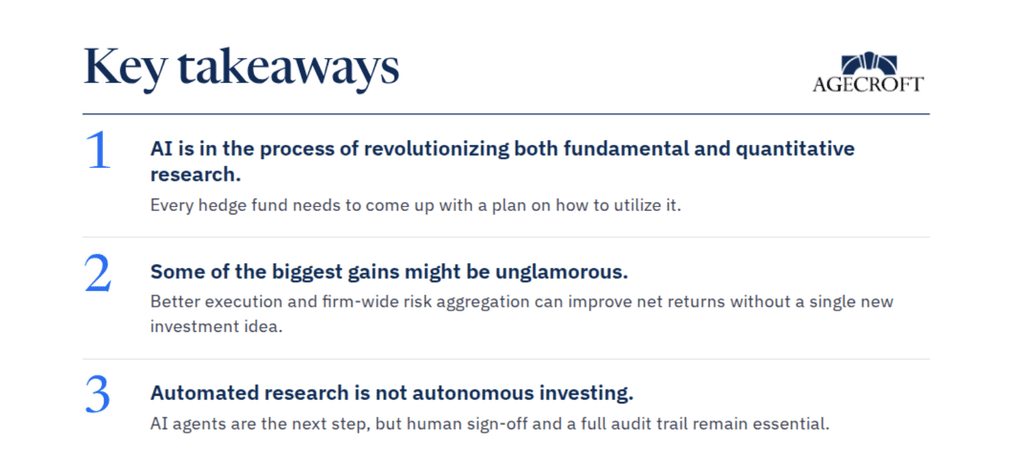
For example, a manager purchasing $500 million of securities might use AI-driven execution models to reduce market impact by several basis points. A hypothetical five-basis-point saving would represent $250,000 in reduced transaction costs. The benefit compounds with turnover. For a hypothetical $5 billion fund that trades $15 billion of securities a year, the same five-basis-point improvement would save approximately $7.5 million annually, or roughly 15 basis points of additional return for investors. AI can improve net returns even when it does not generate a single new investment idea.
The benefits are not evenly distributed. Managers with large assets, high turnover, or less liquid strategies stand to gain the most, while smaller firms will largely rely on tools provided by brokers and technology vendors. As adoption spreads, execution is also becoming an arms race in which yesterday’s advantage quickly becomes today’s standard.
6. AI investment agents and automated research workflows
This may be the most transformative development over the next three to five years. Instead of simply asking AI questions, investment firms are beginning to develop AI agents capable of executing multistep research workflows.
The difference is significant. A conventional AI tool answers one question at a time, and the analyst decides what to ask next. An AI agent is given an objective and works toward it on its own: breaking the task into steps, retrieving filings and data, running analyses, checking its results, and deciding what to investigate next based on what it finds. Rather than functioning as a faster search engine, it begins to resemble a junior research analyst that can work through a full assignment.
Illustrative AI investment research workflow:
Stage 1: Investment hypothesis. The analyst or portfolio manager defines the idea, such as rising electricity demand from data centers benefiting certain utilities and equipment suppliers.
Stage 2: Agent-driven research. The AI agent identifies the companies most exposed to the opportunity, analyzes their filings and earnings transcripts, evaluates competitors, processes relevant alternative data, and builds financial scenarios showing how earnings and valuations might respond under different assumptions.
Stage 3: AI-generated investment research package. The agent delivers a structured report with sources, financial models, key risks, and potential catalysts, with each conclusion linked back to the underlying documents and data so it can be verified.
Stage 4: Portfolio manager review and decision. Humans validate the work, apply investment judgment, and approve any position within the firm’s risk limits.
Agents can also be used for ongoing monitoring. Once a position is in the portfolio, an agent can track every new filing, earnings release, news story, management change, and relevant data point, and alert the investment team when something challenges the original thesis.
A human analyst could supervise several such workflows simultaneously. The important distinction is that automated research does not mean autonomous, unsupervised investing. Because each step builds on the one before, an early mistake, such as a misread figure or an incorrect assumption, can carry through to the final conclusion. Firms adopting these tools need clear limits on what agents are permitted to do, a complete audit trail of the sources and steps behind each conclusion, and human sign-off before any research influences a portfolio decision.
The productivity of a small investment team could increase substantially, and it may change how hedge funds build their teams, with fewer analysts devoted to gathering and organizing information and more focused on judgment, insight, and supervising AI-driven research. There is also a risk that if many firms rely on similar agents analyzing the same information, their conclusions will begin to converge, making genuinely independent thinking more valuable than ever.
What this means for fund managers: AI could change the competitive balance between large and small hedge funds
Historically, large hedge funds enjoyed substantial advantages in research staffing, technology budgets, alternative data, and analytical infrastructure. A multi-billion-dollar firm could employ dozens of analysts, data scientists, and engineers, purchase expensive datasets, and build proprietary systems that smaller managers simply could not afford.
AI could reduce some of these advantages by making advanced analytical capabilities available at much lower costs. Powerful AI models, cloud computing, and specialized vendor tools can now be accessed on a subscription basis, without the need to build infrastructure from scratch. A five-person investment team may eventually be able to perform research tasks that previously required a much larger team.
The impact extends beyond investment research. AI can also streamline many of the non-investment functions that weigh heavily on smaller firms, such as compliance monitoring, investor reporting, responding to due diligence questionnaires, and preparing marketing materials. Lowering these costs could reduce the level of assets a manager needs to run a sustainable business, making it more viable for emerging managers to launch and grow.
Smaller managers may also have structural advantages in adopting AI. They can often move faster, with fewer layers of approval and less legacy technology to replace. And as AI makes widely followed signals and large, liquid markets more efficient, the remaining opportunities may increasingly lie in niche or capacity-constrained strategies where smaller managers are better positioned to invest.
However, the largest firms may still retain significant advantages in proprietary data, computing infrastructure, specialized AI talent, and the ability to build customized systems. If widely available AI tools allow everyone to analyze public information equally well, the value of data that others cannot access will rise, and large firms are best positioned to secure exclusive datasets and data partnerships. They can also afford to compete for scarce AI and machine-learning talent, invest in experiments that may not pay off, and benefit from the vast amounts of data generated by their own trading activity. Large multi-strategy platforms, in particular, may use AI to further strengthen their ability to allocate capital, manage risk, and attract talent across many investment teams.
The competitive outcome is not predetermined. AI is likely to narrow the gap in some areas while widening it in others. Smaller managers that use AI effectively may be able to compete on research quality and operating efficiency in ways that were not previously possible, while the largest firms may extend their lead in the most data- and technology-intensive strategies.
What this means for allocators: evaluating managers’ AI implementation in due diligence
For investors, AI adds a new dimension to manager due diligence. Because these tools are becoming widely available, the key question is not whether a manager uses AI, but whether it is genuinely enhancing the investment process and whether the risks are properly controlled. Firm size alone may also become a less reliable indicator of a manager’s research capabilities, making it important to evaluate how effectively a manager uses AI relative to its resources and strategy.
Useful questions include how AI is integrated into research and decision-making, and what controls govern its use, including data validation, the handling of material non-public information, limits on AI agents, and human accountability for final decisions. Allocators should ask which alternative datasets a manager relies on, how they are validated, and what the manager does with that data that competitors are not. For systematic managers, the focus should be on how the firm guards against overfitting, how live results compare with backtests, and whether the team can explain why its models make the decisions they do. On risk management and execution, allocators should understand how a manager identifies concentrated economic exposures, how its stress tests are designed and influence portfolio decisions, and how it measures and improves transaction costs.
AI also offers allocators an opportunity to apply the same analytical tools to their own portfolios, identifying hidden overlap in economic exposures and crowded positions across the hedge funds they invest in.
Conclusion
Across the hedge fund industry, artificial intelligence is making information cheaper to gather and analyze. Signals built on public data will be priced in faster, and backtests and scenario analysis will be easier to produce. Research that once took an analyst a week can now be compiled in a day.
Implementing AI is a balancing act. Firms that do nothing could find themselves left behind on productivity and insights, while others that move too quickly could end up trading on a hallucination or implementing a flawed strategy from an overfit backtest. What will separate managers is what AI cannot supply: the discipline to validate the research that these tools produce, data that others cannot access, and the judgment to act on only the best insights.
Firm size will tell allocators less than it once did, and the quality of a manager’s process will tell them more as smaller firms become capable of research that used to require a large team. Allocators must understand how their current and prospective fund managers are using AI to create a more efficient and differentiated investment process, and what controls exist to mitigate the additional risks that come with it.