
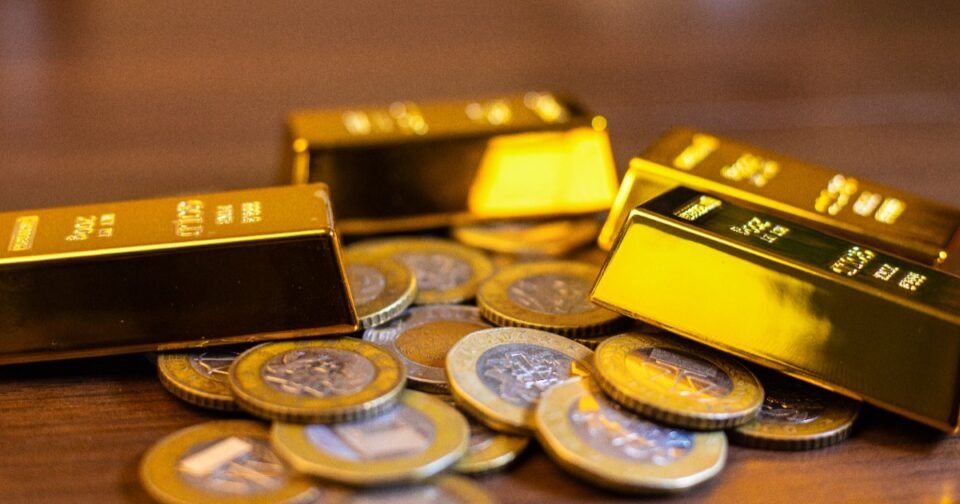
Gold surged this week, supported by optimism that the United States and Iran could be nearing a peace agreement to end their ongoing conflict, which began on February 28.
This contributed to a broader rally in the precious metals market, with gold reaching as high as $4,750 per ounce earlier this week.
As of 15:45 p.m. West Africa Time, May 8, 2026, spot gold is trading at $4,723.11 per ounce, reflecting a 0.77% increase, according to real-time data from Investing.com.
The precious metal is on track for a 2.3% weekly gain, its strongest performance since late March.
Despite initial pressure from rising oil prices, concerns over higher interest rates, and profit-taking by investors, analysts remain confident that the broader bullish trend for gold is intact.
The rally has also been fueled by softer U.S. Treasury yields and a weaker dollar. Additionally, ongoing tensions in the Middle East, Eastern Europe, and parts of Africa have further boosted demand for gold as a safe-haven asset.
“The market is already pricing in a U.S.-Iran peace agreement, which is yet to be signed or settled upon, so we’re seeing some confidence in the precious metals market,” said Ross Norman, chief executive officer of precious metals platform Metals Daily.
Africa Strengthens Its Position in the Gold Market
According to the Africa Finance Corporation’s latest State of Africa’s Infrastructure Report, the continent’s total central bank reserves rose to $530 billion in 2025 from $480 billion in 2024, driven largely by rising gold prices and increased bullion purchases across the continent.
Gold now accounts for about 17% of Africa’s reserves, up from less than 10% in 2022 and 2023. Physical gold holdings have increased from 663 tonnes in 2022 to an estimated 738 tonnes in 2025.
Farmonaut, a research platform, also confirmed that Canada and Africa together produced more than 850 tonnes of gold in 2023, accounting for nearly 21% of global output.
In 2025, Africa’s gold production surpassed 700 tonnes, with major contributions from Ghana, South Africa, and Burkina Faso.
Global Miners Deepen African Expansion
The surge in gold prices is also driving international mining companies to deepen their investments across Africa, eager to secure access to the continent’s rich gold reserves despite rising taxes, stricter regulations, and growing state intervention.
Major international miners operating across Africa include Barrick Gold in Mali and Tanzania, AngloGold Ashanti in Ghana, Tanzania, and Egypt, Newmont Corporation in Ghana, Endeavour Mining across West Africa, Gold Fields in Ghana and South Africa, and B2Gold in Mali and Namibia.
Other companies such as Sibanye-Stillwater, Harmony Gold Mining, Iamgold, and Resolute Mining are expanding their operations across Southern and West Africa, leveraging rising bullion prices.
As the industry grows, miners are increasingly adopting satellite-based technologies and digital systems to improve exploration efficiency, extraction, and environmental compliance.
African Governments Demand Greater Control
African governments are increasingly leveraging the gold rally to negotiate tougher mining terms after decades of exporting raw minerals with limited local value addition.
Countries are demanding higher state ownership stakes, stricter local content requirements, and increased royalties.
In Burkina Faso, the military-led government headed by Captain Ibrahim Traoré, recently announced plans to increase the state’s stake in the Kiaka gold mine from 15% to 40%, affecting Australia-listed West African Resources.
While it remains uncertain if the company will agree to these terms, the miner is forecasting annual gold production of between 430,000 and 490,000 ounces, driven by its operations in Burkina Faso.
In Mali, international mining companies continue to expand despite higher taxes and increased state equity requirements under the revised mining code, with elevated bullion prices outweighing political and regulatory concerns.
Meanwhile, Morocco’s Managem Group committed $750 million to increase gold production by 134% across its African operations by 2030.
The Future of Gold: Projections and Forecasts
As gold production continues to rise, J.P. Morgan remains bullish, forecasting gold prices to reach $6,300 per ounce by the end of 2026, with a long-term forecast adjusted to $4,500 per ounce. Meanwhile, Morgan Stanley predicts gold prices will hit $5,700 by year-end 2026.
With global demand for safe-haven assets on the rise, Africa is set to play an increasingly influential role in the precious metals sector in the coming years.