
The Greenfield Advantage: How Process Design Is Reshaping PGM Project Economics
Commodity markets have long punished single-product mining operations during price downturns. When a mine’s entire revenue base is anchored to one metal, a sustained price correction can compress margins, erode cash flow, and in extreme cases, threaten viability. The PGM sector has lived through precisely this scenario over recent years, with platinum and palladium market dynamics enduring a prolonged compression cycle that tested the resilience of producers across South Africa’s Bushveld Complex.
Against this backdrop, a quieter evolution has been underway in how new PGM projects are conceived and engineered. Rather than accepting the traditional processing hierarchy where platinum group metals sit at the top and chrome is managed as an afterthought, project developers are increasingly rethinking the metallurgical architecture of their operations from first principles. The financial logic is straightforward: chrome prices demonstrated relative resilience through the same period that PGM prices struggled, providing a natural hedge for operations capable of extracting meaningful chrome volumes alongside their primary PGM basket.
This is precisely the economic equation that underpins the latest metallurgical test results from the Bengwenyama project, where Southern Palladium Bengwenyama chrome recovery improvements through a revised processing approach have produced results that could fundamentally reframe the project’s risk and return profile ahead of its definitive feasibility study completion.
Disclaimer: This article contains forward-looking statements, financial projections, and analysis based on publicly available information. It does not constitute financial advice. Readers should conduct independent research before making any investment decisions.
When big ASX news breaks, our subscribers know first
Why the UG2 Reef at Bengwenyama Is Structurally Suited to Chrome Optimisation
Not every PGM ore body lends itself to chrome co-product design. The UG2 reef on the Bushveld Complex is among the relatively few globally where chromite concentration is high enough to make it economically meaningful as a production target in its own right.
Bengwenyama sits on the Eastern Limb of the Bushveld Complex, immediately adjacent to the Modikwa Mine operated as a joint venture between Valterra and African Rainbow Minerals. This location provides an instructive reference point: Modikwa is an established UG2 producer with decades of operational data, offering a degree of geological and infrastructural comparability to Bengwenyama’s development scenario.
The project hosts a total mineral resource of 40.25 million ounces across both the UG2 and Merensky reefs. Southern Palladium has elected to prioritise the UG2 reef for initial development based on three converging characteristics:
- Higher 7E PGM grades relative to the Merensky reef at this deposit, with UG2 grades confirmed at 7.35 g/t on a 3E basis
- Superior rhodium contribution, which is strategically valuable given rhodium’s premium position within the PGM basket
- Elevated chromitite content, with the UG2 reef carrying a chromite oxide grade of 29.71% Cr₂O₃, providing the raw material base to justify a chrome-optimised processing approach
On a 3E elemental split, the platinum contribution sits at 49.9%, palladium at 48.6%, and gold at 1.5%. While the platinum-palladium balance is relatively even, the additional rhodium and chrome dimensions of the UG2 ore body create revenue diversification opportunities that extend well beyond the headline 3E grade.
It is worth understanding the geochemical reality underlying the chrome-ruthenium relationship within UG2 ore. Chromite and ruthenium are intimately associated at the mineralogical level within the UG2 reef structure. This means that any processing decision affecting chromite liberation will inherently influence ruthenium recovery. This is not a flaw in the system but rather a physical characteristic of the ore body that must be explicitly managed through quantitative economic optimisation.
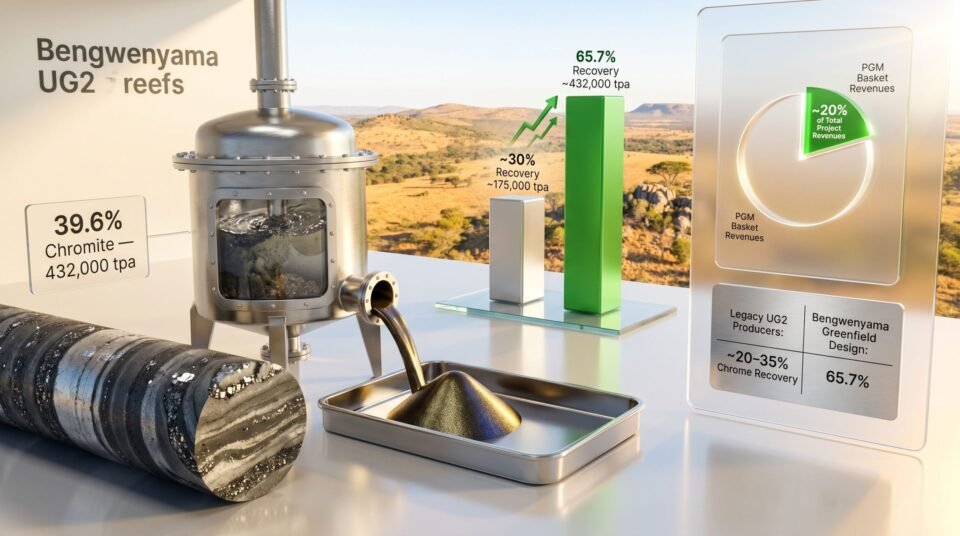
The numbers emerging from Southern Palladium’s latest metallurgical test work represent a step-change rather than an incremental improvement. Where the original prefeasibility study assumed a chromite recovery rate of approximately 30% using conventional fine grinding, the revised methodology has demonstrated recovery rates of 65.7% through a fundamentally different processing sequence.
To appreciate why this matters, it is useful to understand what actually changes between the two approaches.
How Conventional Fine Grinding Falls Short
In a conventional UG2 processing plant, the ore is fed directly into a fine grinding circuit designed to liberate PGM minerals from the surrounding rock matrix. While this achieves adequate PGM liberation, it simultaneously over-grinds chromite particles. Chromite that has been reduced to fine particle sizes becomes progressively harder to recover through gravity or density separation techniques. Much of it reports to the flotation tailings or is lost as fine waste, limiting total recovery to the range of 20% to 35% that characterises most legacy Bushveld operations.
The Dense Media Separation Pivot
The revised approach inverts this sequence. Dense Media Separation (DMS) is introduced as a pre-concentration step before primary milling. DMS exploits the density differential between chromite-bearing material (which is denser) and lighter gangue minerals. By separating these components upstream of the grinding circuit, the process achieves two critical outcomes simultaneously:
- Chromite-rich material is extracted at coarser particle sizes, before fine grinding destroys the physical integrity of chromite grains
- The remaining feed to the primary milling and flotation circuit carries a lower mass burden and higher effective PGM grade
The resulting chromite liberation at coarser particle sizes is the technical mechanism that drives the recovery improvement from approximately 30% to 65.7%. This is not a marginal tuning of process parameters but a structural redesign of the processing sequence.
What the Numbers Look Like in Practice
The practical production implications of this shift are substantial:
| Processing Scenario | Chromite Recovery Rate | Chrome Concentrate Output (per 100,000 tpm ore feed) |
|---|---|---|
| Original PFS (conventional fine grind) | ~30% | ~175,000 tpa |
| Revised DFS methodology (coarser grind post-DMS) | 65.7% | ~432,000 tpa |
| Increase | +119% | +147% |
Expressed differently, from the same volume of ore processed each month, the revised methodology recovers approximately 2.5 times more chrome concentrate than the original design assumption. The resulting concentrate carries a grade of approximately 39.6% chromite, which is suitable for direct sale to ferrochrome producers without further upgrading.
An additional technical benefit that is less immediately obvious is the capacity to produce both fine and coarse chrome product streams simultaneously. This dual-stream capability is commercially significant because different customer categories within the ferrochrome supply chain have distinct product specifications and price points, potentially broadening the pool of available offtake partners and reducing concentration risk on the chrome revenue side.
The test work programme was conducted by RM Process Pty Ltd, with results verified by MAK Analytical. Independent verification of metallurgical test results is standard practice at the DFS stage, providing a basis for integrating the findings into financial modelling with greater confidence than preliminary in-house assessments would allow.
How Higher Southern Palladium Bengwenyama Chrome Recovery Reshapes Project Revenue
The financial architecture implications of this metallurgical shift deserve careful analysis. Under the original prefeasibility assumptions, chrome was projected to contribute approximately 12% of total project revenue. At that level, chrome is broadly consistent with by-product classification: meaningful but not structurally significant in the context of overall project economics.
The revised recovery methodology changes this calculus materially. Based on current spot prices, chrome is projected to contribute approximately 20% of total mine revenues under the DFS processing design. Furthermore, this crossing of a threshold is not merely symbolic.
A revenue contribution of 20% from a secondary commodity is generally sufficient to reclassify that commodity as a genuine co-product in project economics modelling. This distinction matters not only for financial reporting but for how project risk is assessed by lenders and equity investors evaluating the project’s income diversification profile.
For project financing purposes, a more diversified revenue base reduces the effective single-commodity risk exposure that debt providers must price. PGM project financings have historically attracted conservative lending terms given the sector’s price volatility, a challenge well documented across PGM market challenges. A project that generates one dollar in every five from a commodity with different price cycle characteristics than PGMs presents a structurally different risk profile from an operationally comparable project entirely dependent on the PGM basket.
The Ruthenium Trade-Off: Quantifying the Price Threshold
The economic logic underpinning the chrome-first approach is not unconditional. Johan Odendaal, Managing Director of Southern Palladium, has confirmed that a quantifiable trade-off exists. Because ruthenium is geochemically associated with chromite within the UG2 reef, maximising chrome recovery makes ruthenium progressively harder to liberate in the subsequent PGM flotation circuit. Higher chromite extraction therefore comes at the cost of some ruthenium recovery.
The critical question is whether the chrome revenue gained exceeds the ruthenium revenue sacrificed. At current ruthenium pricing of approximately $1,800 per ounce, the chrome economics are clearly favourable. The mathematics only reverse if ruthenium were to appreciate to approximately $5,000 per ounce, a level that represents more than 2.7 times current spot pricing.
| Ruthenium Price Scenario | Economic Preference |
|---|---|
| Current (~$1,800/oz) | Maximise chrome recovery via coarser grind |
| $1,800/oz to $5,000/oz | Chrome optimisation remains preferred |
| Above $5,000/oz | Reassess grind parameters to prioritise ruthenium liberation |
This explicit quantification of the decision threshold is an important feature of the project’s technical design. Rather than presenting chrome optimisation as an unconditional improvement, it establishes a clear price trigger that would prompt a process design review. For investors and project analysts, this kind of scenario-defined decision point provides a transparent framework for monitoring the economic assumptions underlying the processing strategy.
Five Cascading Benefits Beyond the Revenue Line
The financial case for Southern Palladium Bengwenyama chrome recovery optimisation extends well beyond the direct revenue contribution improvement. The processing redesign generates a chain of operational and cost improvements that compound the primary revenue gain:
-
Reduced secondary circuit capital requirements — extracting chromite upstream via DMS means the flotation and secondary milling circuit handles a lower-mass, higher-grade feed. This creates potential for a smaller physical plant footprint and may reduce the capital expenditure estimate when the DFS cost modelling is finalised.
-
Improved PGM head grades to flotation — with bulk chromite extracted before the flotation circuit, the remaining feed carries higher effective PGM grades. This improves the quality of the PGM concentrate and the overall efficiency of the flotation process.
-
Lower external refinery penalty charges — chrome content in PGM concentrate is subject to penalty deductions by external refiners. Extracting chrome upstream reduces the quantity reporting to the PGM concentrate stream, directly lowering this cost burden.
-
Reduced tailings infrastructure requirements — when chrome is extracted as a saleable product rather than reporting to the tailings facility, the total mass of material directed to dry-stacked tailings storage decreases. This reduces both the capital cost of tailings infrastructure and the ongoing operational footprint of waste management.
-
Quantifiable environmental risk reduction — lower chromite content in tailings diminishes the long-term risk of chromium leaching into groundwater systems. This represents a measurable improvement in the project’s environmental risk profile, which is increasingly scrutinised during both regulatory approvals and institutional investment screening processes.
The environmental dimension is worth emphasising. Reduced chromite in tailings is not merely a cost efficiency metric. It represents a genuine reduction in long-term environmental liability that aligns with the ESG frameworks increasingly applied to mining sustainability transformation assessments by institutional capital.
The Greenfield Advantage: A Structural Edge Legacy Producers Cannot Replicate
One of the less-discussed dimensions of Bengwenyama’s chrome recovery opportunity is its structural origin: the project is a greenfield development currently in DFS. This seemingly procedural fact has profound engineering implications.
The majority of established UG2 producers on the Bushveld Complex were designed and commissioned under processing paradigms that treated chrome as a secondary consideration. The financial assumptions embedded in their original capital structures, the physical layout of their plants, and the contractual arrangements with external refiners all reflect a world where PGMs dominated the revenue logic and chrome was managed rather than maximised.
Retrofitting these operations to achieve the kind of chrome recovery rates that DMS-integrated greenfield design can deliver is a different proposition entirely. It would require capital expenditure on new infrastructure, potential disruption to existing processing circuits, renegotiation of operational contracts, and the acceptance of transition-period inefficiencies. The economics are often prohibitive.
| Factor | Legacy Bushveld UG2 Operations | Bengwenyama (Greenfield DFS Design) |
|---|---|---|
| Typical chrome recovery rate | 20% to 35% | Targeting 65.7% |
| Chrome revenue contribution | Generally below 12% of basket | Projected ~20% |
| Process design flexibility | Constrained by existing infrastructure | Full greenfield optimisation possible |
| Tailings chrome content | Comparatively higher | Materially reduced by design |
| Refinery penalty exposure | Ongoing structural cost | Reduced through upstream extraction |
Bengwenyama is in the privileged position of being able to integrate DMS and a coarser grind methodology into the original plant design without any retrofit cost or transitional disruption. This is a structural competitive advantage over legacy peers that simply cannot be replicated through operational optimisation alone.
The next major ASX story will hit our subscribers first
DFS Progress, Timelines, and Key Milestones to Watch
Southern Palladium is targeting completion of the Definitive Feasibility Study by the fourth quarter of 2026, with mining right approval anticipated within a similar timeframe. These two milestones are the critical near-term catalysts for the project’s advancement toward a potential final investment decision.
The project experienced approximately one month of drilling delays attributable to heavy rainfall in the Steelpoort area, a disruption that was manageable but illustrates the practical operational challenges of advancing exploration and development work in a region subject to seasonal rainfall events. Notably, the flooding also confirmed that the planned mining footprint itself was not affected, providing a degree of positive geological validation alongside the operational inconvenience.
Several workstreams remain to be resolved before the DFS can be finalised:
- Full integration of the revised chrome recovery methodology into the DFS financial model, incorporating current spot prices across the full commodity basket
- Completion of PGM flotation optimisation test work, ensuring that chrome and PGM recovery are co-optimised rather than treated as sequential problems
- Formal mining right approval from South African regulatory authorities
- Market offtake assessment for both the fine and coarse chrome product streams generated by the revised processing sequence
- Capital cost re-estimation reflecting the potential for a smaller secondary processing plant given the reduced mass feed to that circuit
Each of these represents a discrete risk factor that investors should monitor as the DFS advances. The integration of chrome recovery data into the financial model is particularly significant because it will determine whether the 20% revenue contribution estimate, currently based on spot price calculations, is formally reflected in the DFS’s net present value and internal rate of return outputs. The cut-off grade economics underlying these projections will consequently shape the project’s overall viability assessment.
Frequently Asked Questions: Bengwenyama Chrome Recovery and Project Fundamentals
What makes the Bengwenyama UG2 reef particularly suited to chrome co-product development?
The UG2 reef at Bengwenyama carries a chromite oxide content of 29.71% Cr₂O₃, which is high enough to support a meaningful chrome production stream when combined with the right processing methodology. Combined with the reef’s superior 7E PGM grades and elevated rhodium contribution, this chromite content makes the UG2 the preferred starting point for mine development and provides the geological foundation for chrome co-product economics.
Why does coarser grinding after DMS recover more chrome than conventional fine grinding?
Conventional fine grinding reduces chromite particles to sizes where gravity and density separation techniques become less effective, and much of the chromite reports to tailings. DMS pre-concentration extracts chromite-rich material at coarser particle sizes before fine grinding occurs, preserving the physical characteristics that allow effective chromite recovery. This sequencing is the technical foundation of the improvement from approximately 30% to 65.7% recovery.
Does maximising chrome recovery reduce PGM output?
There is a specific trade-off with ruthenium, which is geochemically associated with chromite in the UG2 reef. Higher chromite extraction makes ruthenium harder to liberate in the downstream flotation circuit. However, at current ruthenium prices of approximately $1,800 per ounce, the additional chrome revenue generated under the revised methodology more than compensates for the ruthenium recovery foregone. This optimisation would only reverse if ruthenium pricing were to exceed approximately $5,000 per ounce.
When is the DFS expected to be completed?
Southern Palladium is targeting DFS completion in the fourth quarter of 2026, with mining right approval anticipated in a similar timeframe according to statements made by Managing Director Johan Odendaal as reported by MiningMX in April 2026.
Why can Bengwenyama achieve higher chrome recovery rates than most established Bushveld producers?
Most legacy Bushveld UG2 operations were designed under processing paradigms that prioritised PGMs, treating chrome as ancillary. Retrofitting these plants to maximise chrome recovery is constrained by existing infrastructure, capital requirements, and operational complexity. As a greenfield project in DFS, Bengwenyama can integrate DMS and coarser grinding directly into its original plant design without any of these constraints, achieving a structural processing advantage that existing operations cannot easily replicate.
Key Metrics Summary: Before and After the Processing Redesign
| Metric | Original PFS Assumption | Revised DFS Projection |
|---|---|---|
| Chromite recovery rate | ~30% | 65.7% |
| Chrome concentrate output | ~175,000 tpa | ~432,000 tpa |
| Chrome as % of total revenue | ~12% | ~20% |
| Chrome concentrate grade | Not specified | ~39.6% chromite |
| Processing method | Conventional fine grind | Coarser grind following DMS |
| Ruthenium trade-off threshold | Not quantified | ~$5,000/oz ruthenium |
The trajectory of Southern Palladium Bengwenyama chrome recovery optimisation illustrates a broader principle that is gaining traction across the PGM development landscape: the most durable mining projects are those designed to generate resilient revenue across commodity price cycles, not merely optimised for peak returns from a single metal. The near-doubling of chrome recovery at Bengwenyama is not simply a processing improvement. It is, consequently, a deliberate architectural decision to build a more diversified, lower-risk revenue base into the mine’s fundamental design, at the stage when doing so costs the least and delivers the most.
Want to Track the Next Major Mineral Discovery Before the Broader Market Does?
Discovery Alert’s proprietary Discovery IQ model scans ASX announcements in real time, delivering instant alerts on significant mineral discoveries — from diversified PGM projects to emerging commodity plays — so subscribers can act on actionable opportunities ahead of the crowd. Explore historic discoveries and their returns to understand the scale of what early positioning can mean, then begin a 14-day free trial at Discovery Alert to gain your market-leading edge.