
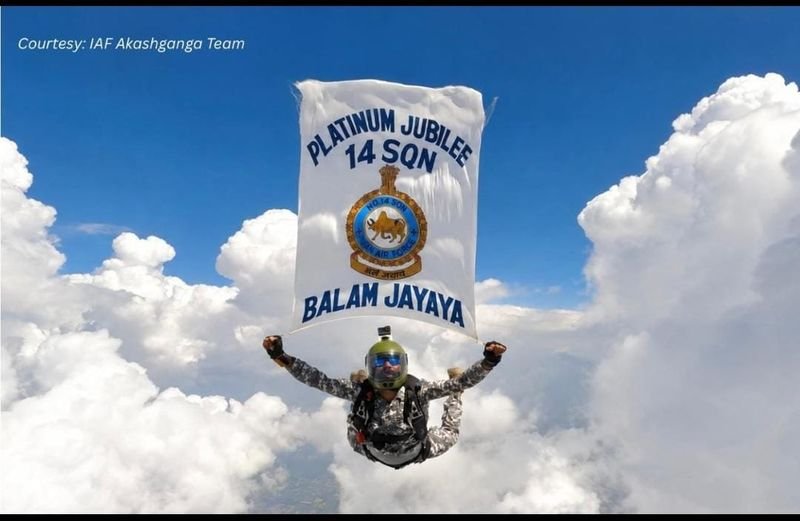
The No. 14 Squadron, the Indian Air Force’s first unit to be equipped with the Jaguar strike aircraft, commemorated its Platinum Jubilee at a forward airbase under the Western Air Command with a series of events.
Famously known as the ‘Bulls’, the squadron was raised in 1951 with the Spitfire aircraft, with Squadron Leader Leslie Richard Dickinson Blunt as its first commanding officer. Having traversed four generations of fighter aircraft, it has participated in two wars with Pakistan and several other operations.
The commemorative celebrations paid tribute to the squadron’s rich history and the supreme sacrifice of its martyrs. Flying operations and combat equipment were showcased on the occasion. Generations of serving and veteran Air Warriors associated with the squadron came together to celebrate its illustrious journey, according to information shared by the Western Air Command on Sunday.
Air Marshal George Thomas, Air Officer Commanding-in-Chief, Western Air Command; former Chiefs of the Air Staff; gallantry awardees; senior serving officers; and veterans of the squadron attended the celebrations. A special first-day cover on the squadron was also released on the occasion.
Starting with the Supermarine Spitfire, one of the most iconic Allied fighters of the Second World War, the squadron briefly operated the de Havilland Vampire from October 1957 to August 1959 before converting to the Hawker Hunter, which it flew for the next 20 years.
The squadron went to war in 1965 and 1971 with the Hunter. In September 1965, it was involved in one of the most decisive aerial battles over the subcontinent when, while operating in the eastern theatre, two of its pilots took on six enemy Sabre jets.
Flight Lieutenant Alfred Cooke engaged three aircraft, while his wingman, Flying Officer SC Mamgain, took on the other three, disintegrating the enemy formation over Kalaikunda. Interestingly, the enemy squadron to which the Sabres belonged was also No. 14 Squadron, based in erstwhile East Pakistan.
The Bulls were later led by Wing Commander Dennis A LaFontaine, who went on to become Chief of the Air Staff. Another former Air Chief, Shashindra Pal Tyagi, commanded the squadron from December 1982 to October 1985.
Cooke, who had travelled from Australia to attend his former squadron’s jubilee, died in Delhi at the age of 87 due to medical reasons just a day before the celebrations. He had been decorated with the Vir Chakra. In 2015, while commemorating the 50th anniversary of the battle, he presented his medal to the squadron at Ambala for posterity.
During the 1971 Bangladesh Liberation War, the squadron, then under the command of Wing Commander Ramanathan Sundaresan, undertook vital close air support and offensive strikes against Pakistani ground and infrastructure targets, communication lines and troop concentrations in the eastern theatre. It also operated briefly from the captured Pakistani airbase at Jessore to carry out strike missions.
In August 1979, the Bulls moved from Kalaikunda in the east to Ambala, where they were re-equipped with the SEPECAT Jaguar deep-penetration strike aircraft, which they continue to fly. Over the past 47 years, the Jaguars have undergone several upgrades.
During the Kargil conflict in 1999, the Bulls were among the two Jaguar squadrons—the other being No. 27 Squadron, the ‘Flaming Arrows’—deployed for operations under Operation Safed Sagar to undertake photo-reconnaissance and bombing missions along the Line of Control (LoC).