
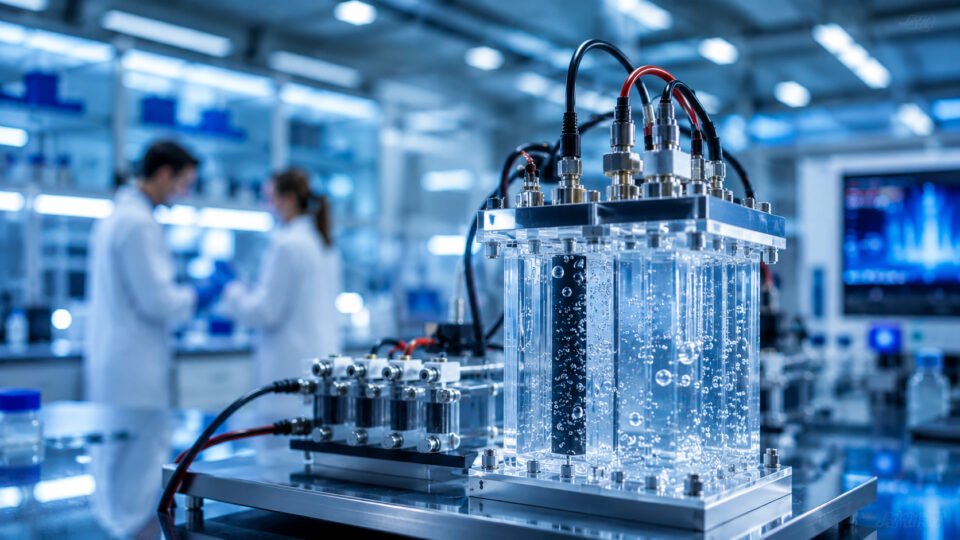
New catalyst created by scientists in the USA eliminates the use of platinum in water electrolysis and may accelerate the advancement of green hydrogen.
Researchers at Washington University in St. Louis have developed a new catalyst capable of enhancing the performance of water electrolysis without using platinum, one of the most expensive and rare metals currently employed in the production of green hydrogen.
The advancement caught the attention of the energy sector because the technology managed to operate for over 1,000 hours under conditions compatible with industrial applications. The result could accelerate large-scale clean fuel production and reduce operational costs considered one of the main obstacles to the global energy transition.
The research, published by Science Daily on May 18, 2026, was led by Professor Gang Wu from the McKelvey School of Engineering. According to the team, the system was specifically designed for anion exchange membrane water electrolyzers, a technology seen as one of the most promising for the future of clean energy.
How water electrolysis produces fuel without carbon emissions
Water electrolysis is a chemical process that uses electricity to separate water molecules into hydrogen and oxygen. When this electricity comes from renewable sources, such as solar, wind, or hydroelectric power, the generated fuel is called green hydrogen.
In recent years, this technology has gained traction in several countries due to the need to reduce greenhouse gas emissions. The problem is that many systems still depend on platinum to operate with high efficiency.
Platinum offers excellent chemical performance but has significant limitations:
- High cost in the international market
- Production concentrated in a few countries
- Complex and environmentally sensitive extraction
- Difficulty in large-scale expansion
It was precisely at this point that the US scientists focused their studies to create a new, more accessible and efficient catalyst.
New catalyst combines rhenium and molybdenum to replace platinum
The differential of the new catalyst lies in the combination of rhenium phosphide with molybdenum phosphide in a hybrid structure developed by the researchers.
According to the team from Washington University in St. Louis, each material has a specific function within water electrolysis. Rhenium helps in the fixation and release of hydrogen on the system’s surface, while molybdenum accelerates the breakdown of water molecules in the alkaline environment of the electrolyte.
This combination allowed for the creation of a highly efficient system without relying on platinum.
Tests showed that the new catalyst managed to outperform the performance of some modern cathodes based on noble metals, something considered extremely relevant for the advancement of green hydrogen.
U.S. Scientists Achieve Over 1,000 Hours of Continuous Operation
One of the most important results of the study was the system’s durability. The new catalyst operated for more than 1,000 hours while maintaining stability at current densities compatible with industrial standards.
This point is essential because water electrolysis requires equipment capable of functioning continuously under intense conditions without significant loss of efficiency.
Many alternative materials to platinum achieve good performance only in short operation periods. Over time, many of them suffer accelerated degradation or loss of chemical stability.
According to the U.S. scientists, the performance achieved places the technology among the most durable platinum-free cathodes ever developed for alkaline electrolyzers with anion exchange membrane.

Green Hydrogen Gains Importance in Hard-to-Decarbonize Sectors
The growth of green hydrogen is directly linked to international pressure for carbon emissions reduction. Governments and companies have been seeking alternatives capable of replacing fossil fuels in heavy industrial activities.
Some sectors have greater difficulty with direct electrification and may depend on hydrogen in the coming decades:
- Aviation
- Maritime transport
- Heavy trucks
- Steel production
- Chemical industry
- Industrial fertilizers
In this scenario, the new catalyst can help make green hydrogen more economically competitive compared to oil, coal, and natural gas.
Additionally, reducing the dependence on platinum can expand the global production of the technology and decrease risks related to the international supply chain.
The global green hydrogen market has been receiving billion-dollar investments in recent years. The United States, China, Germany, and Middle Eastern countries have announced projects aimed at large-scale renewable fuel production.
In Brazil, states like Ceará, Bahia, and Pernambuco are also attracting investments for the implementation of industrial hubs related to green hydrogen.
Experts point out that reducing the costs of water electrolysis will be decisive for increasing the competitiveness of this energy source in the international market.
Currently, one of the main challenges is still related precisely to the use of platinum, which increases the cost of equipment and limits the industrial expansion of the technology.
Therefore, the new catalyst developed by U.S. scientists is seen as a strategic advancement in the global race for sustainable energy solutions.
Upcoming tests may define the industrial viability of the new technology
Despite positive laboratory results, researchers still need to prove the commercial viability of the system on an industrial scale.
The next studies should evaluate factors such as:
- Manufacturing costs
- Scalability of production
- Resistance in continuous operations
- Energy efficiency in large industrial plants
Even so, the performance presented so far is already considered an important milestone for the energy sector.
The combination of greater durability, absence of platinum, and high efficiency can significantly accelerate the expansion of green hydrogen in different regions of the world.
The advancement that can accelerate the next generation of clean energy
The development of the new catalyst represents an important step towards making water electrolysis more efficient, accessible, and economically viable.
By eliminating the need for platinum, U.S. scientists have paved the way for cheaper and more durable systems, capable of driving the growth of green hydrogen in the coming years.
Although the technology is still in the laboratory phase, the results obtained in more than 1,000 hours of operation show that the research can directly contribute to accelerating the global energy transition and reducing dependence on fossil fuels in strategic sectors of the economy.
With information from Science Daily.
Source link