
A nuclear accident may become a serious hazard for humankind and exhibit long-lasting consequences for the environment. Decades ago, and especially in the aftermath of the Chernobyl nuclear accident, global networks of monitoring stations were established for atmospheric radioactivity surveillance. They now have the sensitivity and precision to identify atmospheric releases of even small amounts of anthropogenic radionuclides1. In September and October 2017, these monitoring stations detected a radioactive cloud over a wide swath of Europe containing the fission products 106Ru (T1/2 = 371.8 d) and traces of 103Ru (T1/2 = 39.2 d)2. The characteristics of the release (e.g., lack of concomitant radionuclides) suggested that the source was a spent nuclear fuel reprocessing facility. The source term of the release was estimated at 250 TBq 106Ru, and atmospheric modeling indicated that the cloud originated in the southern Urals in the Russian Federation2,3. This area hosts one of the largest nuclear facilities in the world, the Federal State Unitary Enterprise (FSUE) Production Association Mayak in Ozersk, Russia.
Currently, no country has assumed responsibility for this considerable release, which is likely the single-largest accidental release from civilian nuclear reprocessing4. Despite a large number of meteorological indications3,5,6,7,8, Russian authorities and institutions have repeatedly denied any involvement of the Mayak facility in the release9,10,11. In their official statement9, the Rosatom State Nuclear Energy Corporation emphasized that there were not any incidents at any of the Rosatom sites during the period of September–October 2017. The FSUE Production Association Mayak is a subsidiary of Rosatom. The Russian authority also referred to this statement in response to a query concerning the release of 106Ru from the International Atomic Energy Agency (IAEA) to its 43 member states in the region12. According to IAEA, none of the countries reported an event that could be the cause of the release of 106Ru in the fall of 201712. In an interview with Nuclear Engineering International Magazine, the deputy director of the Nuclear Safety Institute of the Russian Academy of Sciences (IBRAE) argued that “if the Mayak facility [were] the source, then we would have found concentrations hundreds of thousands of times the norm around it and in the soil10.” The IBRAE also set up an International Independent Scientific Commission for the investigation of the release of 106Ru. The Commission gathered two times, in January and April 201813,14. The Commission agreed on an estimated release source term of the event of ~100 TBq13. Science reported that a representative of the Russian nuclear regulator Rostechnadzor who inspected Mayak in November 2017 told the Commission that he saw no anomalies in the Mayak facility from a month earlier11. Early alternative attempts at explanation of the release, such as a release on Romanian territory9 or the burning of a satellite’s radionuclide battery containing 106Ru10 had been addressed previously2 and were essentially dispelled. While it is difficult to imagine that a private facility could routinely handle such considerable activities, it is clear that nuclear facilities (both private and state-run), including reprocessing facilities, must be operated under strict governmental regulatory control15 and report any events to the regulator.
Previous studies have focused on tracking the cloud across Europe and have provided chemical insights, suggesting that the release occurred at an advanced stage of the reprocessing, when the Ru species had been transformed from initially produced gaseous RuO4, at least in part, into one or more soluble compounds with medium volatility2. One of the released chemical species was identified as a polychlorinated Ru(III) form16. The release carried a 103Ru/106Ru signature of very young spent fuel (i.e., only 1.5 or 2 years after the end of neutron irradiation, assuming regular high-burnup fuel)2. Together with other indications, this suggests that the 106Ru release could have originated during the production of a highly radioactive 144Ce source commissioned for the European sterile neutrino project SOX-Borexino in the Gran Sasso National Laboratory (GSNL)2,11.
The degree of burnup of the reprocessed fuel is key for understanding the fuel’s past use prior to the release. High burnup would imply a civilian purpose of the spent fuel. Low burnup, by contrast, may indicate a military purpose, such as production of weapons-grade Pu or even utilization of low-burnup fissile material in a nuclear-powered missile17. With increasing burnup, nuclear fuel will increasingly accumulate 240Pu, which thwarts its applicability in nuclear warheads.
Any use of low-burnup fuel would also affect the model age of the released material. The above model age of 1.5–2 years after neutron irradiation applies only to high-burnup fuel. In particular, if low-burnup fuel had been used to produce the 144Ce source above mentioned, the measured ratio of 103Ru/106Ru would make the released material appear younger than its actual age. In other words, low burnup could also mean that the fuel that was used for the 144Ce source was in fact “older” than the suggested ≤2 years. This could mean that it underwent the established and safe reprocessing scheme with ~3 years of cooling. As outlined in ref. 18, the compact design of the 144Ce source required exceptionally high specific activity, which is only achievable either by reducing the minimum cooling time from 3 to 2 years (high-burnup scenario) or by reprocessing fuel that has undergone only approximately one-third of its nominal burnup (i.e., prior to reaching the end of its lifetime), while allowing 3 years of cooling (low-burnup scenario). In any case, since Mayak not only hosts a reprocessing facility but also has an explicit military history, it has until now not been possible to rule out a military context or another low-burnup scenario of the release.
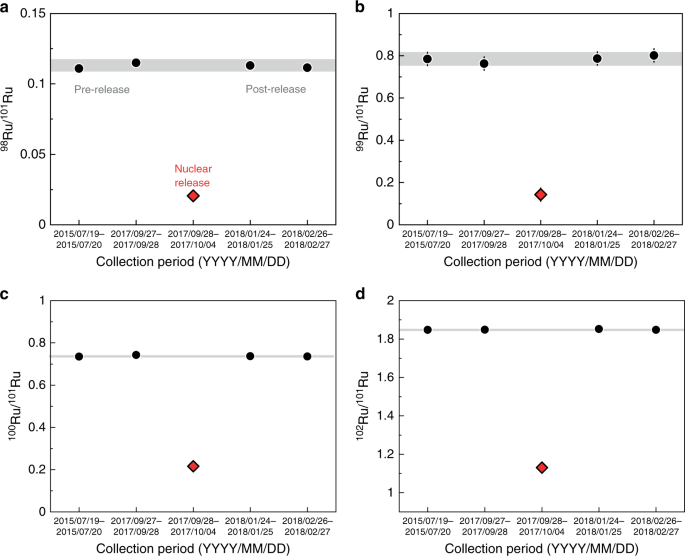
The circumstances of the incident cannot be assessed solely by analyzing the detected radioactive Ru isotopes, because the resulting 103Ru/106Ru ratio is a function of neutron flux, energy spectrum, fuel type that varies by reactor type and burnup, and decay time. Since none of these variables are known, the 103Ru/106Ru ratios do not allow the direct distinction of the provenance of the released material. The stable isotopic composition of fission-generated Ru also depends on the fuel type, hence, varies by reactor type and burnup, but not on radioactive decay. Therefore, precise measurements of the stable isotopic composition of fission-generated Ru can serve as an indicator of whether the released material was produced in a civilian reactor or during a low-burnup scenario, e.g., the production of weapons-grade Pu19,20,21.
Here, we show that precise stable isotope analyses of Ru in environmental samples can be used to constrain the provenance of nuclear material released into the atmosphere. We present the first high-precision measurements of stable Ru isotopic compositions of particulate matter collected in air filters including one sample that contains material from the 2017 Ru release. We conclude that the stable isotopic composition of the 2017 nuclear release is consistent with fission-generated Ru produced in regular, high-burnup spent fuel; hence, the nuclear release was most likely related to an accident during reprocessing of spent fuel used in civilian nuclear activities.