
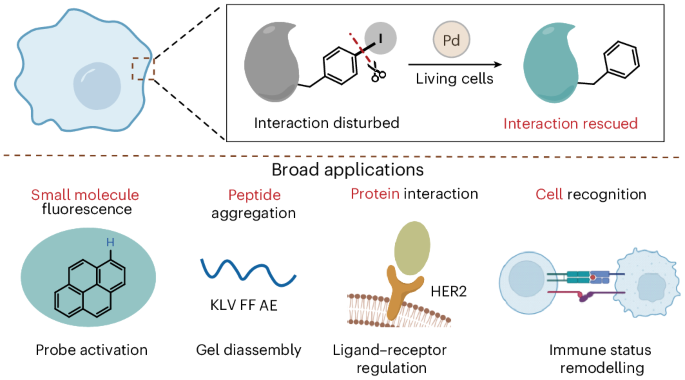
Kohlmeier, M. in Nutrigenetics (ed Kohlmeier, M.) 103–221 (Academic Press, 2013).
Young, L., Jernigan, R. L. & Covell, D. G. A role for surface hydrophobicity in protein–protein recognition. Protein Sci. 3, 717–729 (1994).
Obukhov, A. G., Xie, N.-Z., Du, Q.-S., Li, J.-X. & Huang, R.-B. Exploring strong interactions in proteins with quantum chemistry and examples of their applications in drug design. PLoS ONE 10, e0137113 (2015).
Buyong Ma, T. E., Wolfson, H. & Nussinov, R. Protein–protein interactions: structurally conserved residues distinguish between binding sites and exposed protein surfaces. Proc. Natl Acad. Sci. USA 100, 5772–5777 (2003).
Mayumi Genji, Y. Y., Hoshino, M. & Matsuzaki, K. Aromaticity of phenylalanine residues is essential for amyloid formation by Alzheimer’s amyloid β-peptide. Chem. Pharm. Bull. 65, 668–673 (2017).
Garstka, M. A. et al. The first step of peptide selection in antigen presentation by MHC class I molecules. Proc. Natl Acad. Sci. USA 112, 1505–1510 (2015).
Pataskar, A. et al. Tryptophan depletion results in tryptophan-to-phenylalanine substitutants. Nature 603, 721–727 (2022).
Shaikh, F. Y. et al. A critical phenylalanine residue in the respiratory syncytial virus fusion protein cytoplasmic tail mediates assembly of internal viral proteins into viral filaments and particles. mBio 3, e00270–00211 (2012).
Crouch, E. et al. Contributions of phenylalanine 335 to ligand recognition by human surfactant protein. J. Biol. Chem. 281, 18008–18014 (2006).
Li, H.-Z. et al. Identifying key residues and key interactions for the binding of LEAP2 to receptor GHSR1a. Biochem. J. 477, 3199–3217 (2020).
Pless, S. A. et al. A cation-π interaction in the binding site of the glycine receptor is mediated by a phenylalanine residue. J. Neurosci. 28, 10937–10942 (2008).
Merrill, B. M., Stone, K. L., Cobianchi, F., Wilson, S. H. & Williams, K. R. Phenylalanines that are conserved among several RNA-binding proteins form part of a nucleic acid-binding pocket in the A1 heterogeneous nuclear ribonucleoprotein. J. Biol. Chem. 263, 3307–3313 (1988).
Streu, C. & Meggers, E. Ruthenium-induced allylcarbamate cleavage in living cells. Angew. Chem. Int. Ed. 45, 5645–5648 (2006).
Versteegen, R. M., Rossin, R., ten Hoeve, W., Janssen, H. M. & Robillard, M. S. Click to release: instantaneous doxorubicin elimination upon tetrazine ligation. Angew. Chem. Int. Ed. 52, 14112–14116 (2013).
Weiss, J. T. et al. Extracellular palladium-catalysed dealkylation of 5-fluoro-1-propargyl-uracil as a bioorthogonally activated prodrug approach. Nat. Commun. 5, 3277 (2014).
Pérez-López, A. M. et al. Gold-triggered uncaging chemistry in living systems. Angew. Chem. Int. Ed. 56, 12548–12552 (2017).
Oliveira, B. L. et al. Platinum-triggered bond-cleavage of pentynoyl amide and N-propargyl handles for drug-activation. J. Am. Chem. Soc. 142, 10869–10880 (2020).
Wang, X. et al. Copper-triggered bioorthogonal cleavage reactions for reversible protein and cell surface modifications. J. Am. Chem. Soc. 141, 17133–17141 (2019).
Miller, M. A. et al. Nano-palladium is a cellular catalyst for in vivo chemistry. Nat. Commun. 8, 15906 (2017).
Tomas-Gamasa, M., Martinez-Calvo, M., Couceiro, J. R. & Mascarenas, J. L. Transition metal catalysis in the mitochondria of living cells. Nat. Commun. 7, 12538 (2016).
Yusop, R. M., Unciti-Broceta, A., Johansson, E. M., Sanchez-Martin, R. M. & Bradley, M. Palladium-mediated intracellular chemistry. Nat. Chem. 3, 239–243 (2011).
Song, F., Garner, A. L. & Koide, K. A highly sensitive fluorescent sensor for palladium based on the allylic oxidative insertion mechanism. J. Am. Chem. Soc. 129, 12354–12355 (2007).
Liu, L., Zhang, D., Johnson, M. & Devaraj, N. K. Light-activated tetrazines enable precision live-cell bioorthogonal chemistry. Nat. Chem. 14, 1078–1085 (2022).
Heffern, M. C. et al. In vivo bioluminescence imaging reveals copper deficiency in a murine model of nonalcoholic fatty liver disease. Proc. Natl. Acad. Sci. USA 113, 14219–14224 (2016).
Chung, C. Y.-S. et al. Activity-based ratiometric FRET probe reveals oncogene-driven changes in labile copper pools induced by altered glutathione metabolism. Proc. Natl Acad. Sci. USA 116, 18285–18294 (2019).
Sabatino, V., Rebelein, J. G. & Ward, T. R. ‘Close-to-release’: spontaneous bioorthogonal uncaging resulting from ring-closing metathesis. J. Am. Chem. Soc. 141, 17048–17052 (2019).
Huang, Z. et al. Bioorthogonal photocatalytic decaging-enabled mitochondrial proteomics. J. Am. Chem. Soc. 143, 18714–18720 (2021).
Zhang, Y. et al. Bioorthogonal quinone methide decaging enables live-cell quantification of tumor-specific immune interactions. J. Am. Chem. Soc. 146, 15186–15197 (2024).
Pani, S., Qiu, T., Kentala, K., Azizi, S. A. & Dickinson, B. C. Bioorthogonal masked acylating agents for proximity-dependent RNA labelling. Nat. Chem. 16, 717–726 (2024).
Jemas, A. et al. Catalytic activation of bioorthogonal chemistry with light (CABL) enables rapid, spatiotemporally controlled labeling and no-wash, subcellular 3D-patterning in live cells using long wavelength light. J. Am. Chem. Soc. 144, 1647–1662 (2022).
Jbara, M., Maity, S. K., Seenaiah, M. & Brik, A. Palladium mediated rapid deprotection of N-terminal cysteine under native chemical ligation conditions for the efficient preparation of synthetically challenging proteins. J. Am. Chem. Soc. 138, 5069–5075 (2016).
Jbara, M., Eid, E. & Brik, A. Gold(I)-mediated decaging or cleavage of propargylated peptide bond in aqueous conditions for protein synthesis and manipulation. J. Am. Chem. Soc. 142, 8203–8210 (2020).
Wang, J. et al. Chemical remodeling of cell-surface sialic acids through a palladium-triggered bioorthogonal elimination reaction. Angew. Chem. Int. Ed. 54, 5364–5368 (2015).
Wang, S. R. et al. Conditional control of RNA-guided nucleic acid cleavage and gene editing. Nat. Commun. 11, 91 (2020).
Li, J. & Chen, P. R. Development and application of bond cleavage reactions in bioorthogonal chemistry. Nat. Chem. Biol. 12, 129–137 (2016).
Wang, J., Wang, X., Fan, X. & Chen, P. R. Unleashing the power of bond cleavage chemistry in living systems. ACS Cent. Sci. 7, 929–943 (2021).
Zhu, Y. et al. Bioorthogonal cleavage chemistry: harnessing the bond-break reactions for biomolecule manipulations in living systems. Chin. J. Chem. 43, 553–566 (2025).
Wu, N., Deiters, A., Cropp, T. A., King, D. & Schultz, P. G. A genetically encoded photocaged amino acid. J. Am. Chem. Soc. 126, 14306–14307 (2004).
Lemke, E. A., Summerer, D., Geierstanger, B. H., Brittain, S. M. & Schultz, P. G. Control of protein phosphorylation with a genetically encoded photocaged amino acid. Nat. Chem. Biol. 3, 769–772 (2007).
Deiters, A., Groff, D., Ryu, Y., Xie, J. & Schultz, P. G. A genetically encoded photocaged tyrosine. Angew. Chem. Int. Ed. 45, 2728–2731 (2006).
Chen, P. R. et al. A facile system for encoding unnatural amino acids in mammalian cells. Angew. Chem. Int. Ed. 48, 4052–4055 (2009).
Luo, J., Liu, Q., Morihiro, K. & Deiters, A. Small-molecule control of protein function through Staudinger reduction. Nat. Chem. 8, 1027–1034 (2016).
Li, J., Jia, S. & Chen, P. R. Diels–Alder reaction-triggered bioorthogonal protein decaging in living cells. Nat. Chem. Biol. 10, 1003–1005 (2014).
Li, J. et al. Palladium-triggered deprotection chemistry for protein activation in living cells. Nat. Chem. 6, 352–361 (2014).
Ling, X. et al. Genetic encoding of a photocaged glutamate for optical control of protein functions. CCS Chem. 5, 1301–1307 (2023).
Yang, X. et al. Constructing photoactivatable protein with genetically encoded photocaged glutamic acid. Angew. Chem. Int. Ed. 62, e202308472 (2023).
Zhang, X. et al. Optical control of protein functions via genetically encoded photocaged aspartic acids. J. Am. Chem. Soc. 145, 19218–19224 (2023).
Zhu, Y. et al. Genetically encoded bioorthogonal tryptophan decaging in living cells. Nat. Chem. 16, 533–542 (2024).
Cheung, J. W. et al. Genetic encoding of a photocaged histidine for light-control of protein activity. ChemBioChem 24, e202200721 (2023).
Hemphill, J., Borchardt, E. K., Brown, K., Asokan, A. & Deiters, A. Optical control of CRISPR/Cas9 gene editing. J. Am. Chem. Soc. 137, 5642–5645 (2015).
Zhang, G. et al. Bioorthogonal chemical activation of kinases in living systems. ACS Cent. Sci. 2, 325–331 (2016).
Huguenin-Dezot, N. et al. Trapping biosynthetic acyl-enzyme intermediates with encoded 2,3-diaminopropionic acid. Nature 565, 112–117 (2019).
Wang, J. et al. Time-resolved protein activation by proximal decaging in living systems. Nature 569, 509–513 (2019).
Hartwig, J. F. Carbon–heteroatom bond formation catalysed by organometallic complexes. Nature 455, 314–322 (2008).
Wang, X.-Y. et al. A facile and mild Pd-catalyzed one-pot process for direct hydrodeoxygenation (HDO) phenols to arenes through a ArOSO 2 F intermediates transformation. Tetrahedron Lett. 58, 2340–2343 (2017).
Li, Q. et al. Developing covalent protein drugs via proximity-enabled reactive therapeutics. Cell 182, 85–97 (2020).
Amin, H. I. M. et al. Hydro/deutero deamination of arylazo sulfones under metal- and (photo)catalyst-free conditions. Molecules 24, 2164 (2019).
Cordero, B. et al. Covalent radii revisited. Dalton Trans. 37, 2832–2838 (2008).
Fortenberry, R. C., Novak, C. M., Lee, T. J., Bera, P. P. & Rice, J. E. Identifying molecular structural aromaticity for hydrocarbon classification. ACS Omega 3, 16035–16039 (2018).
Xu, P. et al. Halogenated tetraphenylethene with enhanced aggregation-induced emission: an anomalous anti-heavy-atom effect and self-reversible mechanochromism. Chem. Commun. 55, 14938–14941 (2019).
Presolski, S. I., Hong, V., Cho, S.-H. & Finn, M. G. Tailored ligand acceleration of the Cu-catalyzed azide−alkyne cycloaddition reaction: practical and mechanistic implications. J. Am. Chem. Soc. 132, 14570–14576 (2010).
Marchesan, S., Vargiu, A. & Styan, K. The Phe-Phe motif for peptide self-assembly in nanomedicine. Molecules 20, 19775–19788 (2015).
Bertolani, A. et al. Supramolecular amplification of amyloid self-assembly by iodination. Nat. Commun. 6, 7574 (2015).
Bryson, D. I. et al. Continuous directed evolution of aminoacyl-tRNA synthetases. Nat. Chem. Biol. 13, 1253–1260 (2017).
Eigenbrot, C., Ultsch, M., Dubnovitsky, A., Abrahmsén, L. & Härd, T. Structural basis for high-affinity HER2 receptor binding by an engineered protein. Proc. Natl. Acad. Sci. USA 107, 15039–15044 (2010).
Ackmann, J. et al. Structural determinants for activation of the Tau kinase CDK5 by the serotonin receptor 5-HT7R. Cell Commun. Signal. 22, 233 (2024).
DiBrino, M. et al. Endogenous peptides bound to HLA-A3 possess a specific combination of anchor residues that permit identification of potential antigenic peptides. Proc. Natl. Acad. Sci. USA 90, 1508–1512 (1993).
Du, H. et al. Targeting peptide antigens using a multiallelic MHC I-binding system. Nat. Biotechnol. 43, 1683–1693 (2024).
Kacen, A. et al. Post-translational modifications reshape the antigenic landscape of the MHC I immunopeptidome in tumors. Nat. Biotechnol. 41, 239–251 (2023).
Pawlak, J. B. et al. Bioorthogonal deprotection on the dendritic cell surface for chemical control of antigen cross-presentation. Angew. Chem. Int. Ed. 54, 5628–5631 (2015).
Brustad, E. et al. A genetically encoded boronate-containing amino acid. Angew. Chem. Int. Ed. Engl. 47, 8220–8223 (2008).
Spicer, C. D., Triemer, T. & Davis, B. G. Palladium-mediated cell-surface labeling. J. Am. Chem. Soc. 134, 800–803 (2012).
Bilyard, M. K. et al. Palladium-mediated enzyme activation suggests multiphase initiation of glycogenesis. Nature 563, 235–240 (2018).
Frisch, M. J. T., et al., Gaussian 09, Revision A.01 (Gaussian Inc., 2009).
Becke, A. D. Density-functional thermochemistry. III. The role of exact exchange. J. Chem. Phys. 98, 5648–5652 (1993).
Bernardi, A., Faller, R., Reith, D. & Kirschner, K. N. ACPYPE update for nonuniform 1–4 scale factors: conversion of the GLYCAM06 force field from AMBER to GROMACS. SoftwareX 10, 100241 https://doi.org/10.1016/j.softx.2019.100241 (2019).
Renfrew, P. D., Choi, E. J., Bonneau, R. & Kuhlman, B. Incorporation of noncanonical amino acids into rosetta and use in computational protein–peptide interface design. https://doi.org/10.1371/journal.pone.0032637 (2012).