
“What would Julia be without Romeo?” The question lies at the heart of one of the most entertaining and socially relevant jukebox musicals of recent years. Following its successful run in Hamburg, & Julia has moved to Stuttgart’s Stage Palladium Theater, bringing with it Max Martin’s greatest pop hits, a generous dose of self-irony and an unmistakable plea for self-determination, diversity and female empowerment. While the Stuttgart production makes some concessions in terms of set design compared with its Hamburg predecessor, an energetic ensemble, a strong cast and a consistently assured production ensure that the show retains much of its appeal.
Behind the garish pop façade lies a story whose concerns extend well beyond Juliet’s love life. May searches for a place in the world where their identity does not have to be explained, defended or adapted to meet society’s expectations. François must break free from his family’s ideas of who he should be and learn that love is not tied to a particular gender. Romeo faces the consequences of his self-centredness, while Angelique, Juliet’s Nurse, must recognise that personal dreams remain valid even after years spent taking responsibility for others. Anne Hathaway increasingly becomes the driving force behind the story, challenging patriarchal thinking and reminding her husband that life should not revolve exclusively around artistic ambition and professional success. Their confrontation provides the framework for a narrative in which women refuse to remain mere characters in other people’s stories. The musical’s plea for tolerance, equality, queer visibility and self-love emerges from the characters’ decisions rather than from an overtly didactic message. That these ideas are sometimes expressed to the sounds of a Britney Spears hit or a Backstreet Boys anthem is not a contradiction but part of the fun.
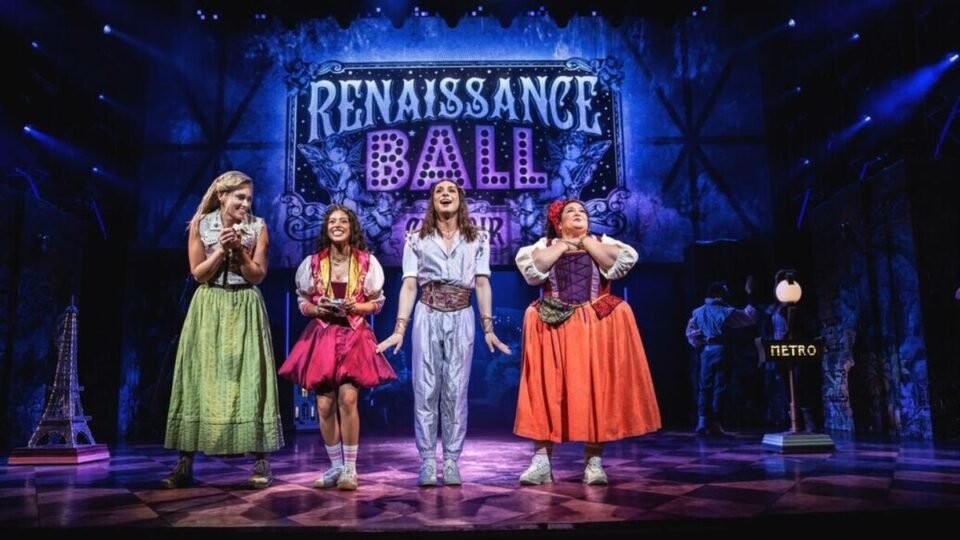
Luke Sheppard’s production combines the Elizabethan era with a garishly colourful pop aesthetic, setting historical silhouettes against clubwear, neon colours and iconic elements of contemporary pop culture. The contrasts between Renaissance and present day are more than a series of visual jokes: they form a coherent theatrical world that moves fluidly between risqué comedy, romantic drama and full-scale musical showstoppers. The production understands its entertainment value without sacrificing the emotional substance of the story.
Soutra Gilmour’s set design was one of the defining features of the Hamburg production, where its scale, attention to detail and versatility gave the staging considerable visual momentum. The revolve energised the travel scenes and major pop numbers, while a lift created different levels for the choreography and allowed Juliet to rise above the stage in her moments of triumph. A trap lift enabled characters and props to appear and disappear almost out of nowhere. The suspended swing added further visual accents, and the carefully designed carriage that carried the characters towards Paris fitted seamlessly into the production’s world. Together, the set and its technical possibilities supported the rapid scene changes and gave the storytelling a sense of expansiveness that is less apparent in Stuttgart.
The touring production has to work without much of that technical infrastructure. Its set is more compact, and transitions and choreographic sequences have consequently been adapted. The carriage has become a small rickshaw, while the suspended swing is replaced by a somewhat rickety-looking moon that fulfils its purpose without quite achieving the same fairytale effect. The opportunities to create different levels or raise Juliet physically during her triumphant moments are also more limited. The main set design, which impressed in Hamburg with its scale, quality and attention to detail, has since moved on to the Dutch production, leaving the Stuttgart staging to find alternative solutions for a number of transitions and movements.
These differences are most noticeable when the Hamburg production is still fresh in the memory. At times, the Stuttgart staging feels emptier and more stripped back, particularly in scenes that previously benefited from the original production’s technical scale. This is less a problem with Sheppard’s artistic concept than with the spatial and technical limitations of the touring version. Taken on its own terms, however, the production remains effective. Its pace, the performers’ commitment and a consistently maintained aesthetic vision compensate for much of the missing spectacle, even if the visual impact is not always quite as impressive.
Paloma Young’s costumes are central to that aesthetic. Historical influences meet modern silhouettes, striking colours and fashion references that distinguish the characters while allowing the different periods to blend into one another. The costumes do more than provide eye-catching imagery: they contribute to characterisation and reinforce the playful relationship between Renaissance and contemporary pop culture. Combined with Gilmour’s set, Howard Hudson’s lighting and Andrej Goulding’s video and projection design, they create a deliberately exaggerated world that nevertheless feels carefully considered. Neon colours and projections keep the action moving, while shifts in lighting and colour give individual scenes their own atmosphere. During the big pop numbers, the stage becomes a pulsating club; quieter, more dramatic passages rely on more restrained colours and intimate lighting to create effective contrast.
Jennifer Weber’s choreography is equally integral to the production. Her energetic blend of hip-hop, pop and contemporary dance evokes both major pop concerts and the visual language of music videos. Movement drives the plot forward, characterises the performers and gives the songs additional meaning. Even within Stuttgart’s more restricted stage space, the choreography remains precise, fast-paced and at times deliberately exuberant without suppressing the individuality of the performers. Associate choreographers Karina Rapley and Josh Baker, together with assistant choreographer Abbie Elmes, contribute to adapting and maintaining the sequences. For a show built around synchronised movement, rapid formation changes and sustained physical energy, their work is essential. The ensemble moves through the scenes with remarkable confidence, creating an effortless impression that disguises the demands of the choreography.
Hudson’s lighting design becomes particularly important in Stuttgart, where the set provides fewer opportunities to create depth and different levels. Its combination of dazzling pop aesthetics and carefully controlled changes of mood gives the musical numbers their concert atmosphere, highlights individual performers and lends quieter passages the necessary intimacy. Associate lighting designers Kathy Pineo and Liam Sayer, together with lighting programmer Tom Mulliner, help adapt the design to the technical and artistic requirements of the production. Lighting and projections structure the space and supply visual accents where the physical set cannot do as much of the work.
Goulding’s video and projection design adds another layer, embedding the action in the pop culture of past decades while supporting transitions between locations and connecting historical references with the musical’s contemporary visual language. Associate video designer Darren Kowacki and video programmer Kevin Buysse are also part of the team responsible for bringing this visual dimension to life. In a production that depends on rapid changes and the constant interplay of different periods, projections, lighting and movement must be precisely coordinated. This is generally convincing in Stuttgart, although the comparison with Hamburg’s more lavish technical setup remains apparent.
The sound design, originally created by Gareth Owen, provides the foundation for the show’s musical impact. Associate sound designer Matt Peploe and assistant sound designer Ewan Munro are part of the team overseeing its implementation. The songs have the necessary power and clarity, and the transitions between dialogue and music are generally smooth. The seven-piece band under the direction of Boris Ritter supplies the drive that carries Martin’s familiar hits into their new theatrical context. The challenge is not simply to reproduce recognisable melodies, but to connect their energy with the individual scenes and the performers’ voices. At its best, the musical arrangement allows the songs to make their full impact without sacrificing the details that give them their new dramatic function.
The songs are performed predominantly in their original English versions, while the dialogue is spoken in German. This preserves the familiar character of the international pop hits and allows the music to retain its full effect. Jana Mischke and Heiko Wohlgemuth’s German translation generally works well. Not every British joke or pop-cultural reference can be transferred without loss, but the dialogue has sufficient pace and character to stand on its own. Individual German passages within the songs provide narrative accents and, in some instances, feel even more naturally integrated than in the Hamburg production. The translation preserves the youthful tone and self-ironic attitude of the original, even if certain references inevitably work differently in German.
The expanded directing and musical teams also deserve credit for maintaining the coherence of the Stuttgart production. Associate director Denise Obedekah supports the staging and its adaptation to the conditions of the venue, while assistant musical supervisors Philipp Gras and Patrick Hurley work on implementing the musical concept. In a jukebox musical, the songs must function individually while also serving the story; transitions must be seamless, and the interplay between stage, band and performers must remain precise even at high speed. The production’s ability to maintain its rhythm and keep the musical numbers effective speaks to the work happening behind the scenes.
The Musical Lounge, discussed controversially within the musical theatre fan community before the Stuttgart premiere, adds a more sociable atmosphere to the traditional theatre visit. Given that & Julia is marketed in no small part on its party atmosphere and sing-along potential, there is a risk that such a concept could distract from the stage. At the performance attended, however, the disruption remained limited. The audience responded enthusiastically to the songs without the evening losing its character as a theatrical performance. For a show that already plays with the boundary between concert and musical, the concept can be a worthwhile addition, provided that the stage remains the focus. That was largely the case here, although audiences should remain mindful of their responsibility towards their fellow theatregoers and the performance itself.
At the centre of the Stuttgart evening is Sebeya, playing Juliet at the performance attended after previously appearing as an alternate in Hamburg. Her interpretation gives the character the complexity she needs to be more than a vehicle for big pop songs. Sebeya combines youthful innocence with a sometimes wonderfully naive overestimation of her own abilities. She is warm-hearted and caring towards May and François while revealing the vulnerability of a young woman whose world has been turned upside down by Romeo’s death. Her Juliet can be sad, defiant, a little edgy and occasionally wonderfully unreasonable. She has rough edges: one can laugh with her, shake one’s head at her, feel moved by her and cheer her on. That mixture makes her believable. When it comes to her singing ability, Sebeya is outstanding. She handles the demanding up-tempo numbers with impressive assurance while giving the quieter moments the emotional weight they require. Her development over the course of the evening is particularly effective. The initially heartbroken young widow does not suddenly become an all-knowing heroine; instead, she gradually discovers her own strength. “Baby One More Time” marks the beginning of that journey, “Since U Been Gone” accompanies her growing detachment from the past, and “Stronger” makes clear how far she has come. When Sebeya reaches “Roar”, the song becomes more than another pop showstopper: it is the emotional culmination of Juliet’s journey towards self-determination. She carries the story with confidence and gives the production a compelling focal point.
If anyone matches Sebeya’s presence on this evening, it is Sabrina Weckerlin as Anne Hathaway. Her performance is hilarious, endearing and deeply moving. Her Anne is quirky, quick-witted and wonderfully unpredictable, yet beneath the apparently carefree surface lies a recognisably human character. Weckerlin gives her numerous personal nuances, from comic reactions and impeccable timing to seemingly incidental gestures that make Anne feel like a person rather than simply Shakespeare’s outspoken wife. She is a woman who refuses to accept the role assigned to her by her husband and society, but who also longs for recognition, love and belonging. The combination of eccentric comedy and genuine vulnerability makes the character particularly compelling. Vocally, Weckerlin is in a league of her own. With “That’s the Way It Is”, she delivers one of the evening’s musical highlights, combining vocal command with emotional depth. She does not have to fight for attention; her presence commands it naturally. The humour arising from Anne’s self-presentation as April and her interference in Juliet’s story is as precisely timed as the quieter moments in which she reveals her vulnerability. Anne becomes the evening’s unsung heroine, and Weckerlin one of the strongest pillars of the Stuttgart cast.
Maximilian Mann plays William Shakespeare with considerable charm and a keen sense of the role’s comic possibilities. His Shakespeare is not an untouchable literary monument but a man struggling with his own creation, whose authority is challenged by a wife unwilling to remain a footnote in his life. Mann gives the character a pleasing sense of self-irony while keeping him grounded despite the exaggerated situations. His chemistry with Weckerlin turns the marital sparring into a comic delight without losing sight of the emotional development beneath it.
Jonathan Guth gives Romeo a more sensitive, at times almost melancholic quality than the exaggerated Gen Z boy the role might invite, while still making effective use of its comic possibilities. Romeo is not merely the target of ridicule and parody; he is also a young man confronting the limitations of his self-image. Guth balances the self-absorbed Casanova’s comic side with emotional openness, allowing Romeo room to grow without becoming a caricature.
Ibi as May brings considerable emotional sensitivity to the production. Loving and caring, and deeply connected to Juliet, May is nevertheless searching for an identity of their own and a place where they are not constantly measured against social norms. Ibi portrays this inner conflict with nuance, allowing May to be vulnerable without seeming weak and to grow in confidence without denying their insecurities. The transition from a search for recognition to the realisation that love and acceptance need not be earned by changing oneself is particularly moving. “I’m Not a Girl, Not Yet a Woman” becomes the central moment of that journey. Through Ibi’s interpretation, the song is more than a tongue-in-cheek reference to Britney Spears; it takes on an emotional significance of its own. The quieter passages reveal a remarkable sensitivity, while “Whataya Want from Me” gains weight from May’s vulnerability. Ibi establishes May as an independent character with desires, fears and hopes rather than reducing the role to its function as a queer figure of identification. This is one of the book’s great strengths, and the Stuttgart performance brings it convincingly to the fore.
Esmael Agostinho gives François, also known as Franky, a pleasantly understated quality. Rather than relying on extroverted comedy and grand gestures, he portrays the character as shy and introverted, creating a likeable young man whose journey of self-discovery feels relatable and human. His vocal colour distinguishes him from other interpretations of the role and gives François an identity of his own. Agostinho does not need to be at the centre of attention to make an impression, and his natural stage chemistry with Ibi allows the love story to unfold as an encounter between two people rather than as a statement of principle. François must learn to free himself from his family’s expectations and take his feelings seriously. Agostinho makes this development feel like a gradual process in which uncertainty and courage coexist, rather than an abrupt change of heart.
Jacqueline Braun returns as the Nurse, bringing warmth, dry humour and maternal determination to the role. Angelique is more than Juliet’s dependable companion: she is a woman who has put herself aside for long enough and must recognise that caring for others should not mean abandoning her own wishes. Braun gives this inner conflict down-to-earth credibility and comic precision, providing an appealing contrast to the show’s garish pop world. Her solo “f-ing Perfect” is one of the evening’s emotional touchstones. She captures the moment when the Nurse confronts what she has denied herself over the years without resorting to excessive sentimentality, making the possibility of a new beginning convincing even for someone who has spent so long taking responsibility for others. Braun’s scenes with Carlos de Vries as Lance provide some of the evening’s comic highlights. De Vries gives François’s father plenty of temperament and a pleasing dose of self-irony. The attraction between Angelique and Lance thrives on the friction between two characters who do not initially seem destined for one another, but whose encounter becomes all the more charming for that reason. Together, Braun and de Vries form a well-matched double act, delivering the show’s humour as reliably as its emotional moments.
Rahel Fuhrimann and Nayim give Lady and Lord Capulet a deliberately exaggerated, sometimes eccentric quality while allowing a certain menace to emerge. This contrast prevents them from becoming mere caricatures. Fuhrimann’s Lady Capulet is particularly memorable, developing a clear identity even within a comparatively small role. Beneath the comic exaggeration, the social expectations and family constraints weighing on Juliet remain palpable. The two characters thus represent more than the next punchline: they embody the world from whose limitations Juliet must free herself.
A production like & Julia stands or falls with its ensemble. Rapid scene changes, demanding choreography and the musical requirements call for technical precision as well as sheer performance energy. In Stuttgart, the cast maintains the production’s momentum without allowing the characters to disappear behind the movement.
Juliet’s crew, consisting of Lea-Katharina Krebs, Lee Anne Hierzer, Dorith Creebsburg and Mia Tsang, fills the smaller roles with remarkable presence. The four performers actively shape the action, switching between characters, supporting the large ensemble numbers and making their mark in solo vocal moments. Their versatility keeps the story lively beyond its central figures. The same applies to Romeo’s crew: Óscar Cochat, Daniel Délyon, Pablo Martinez-Garcia and Eloy Prophitius. They are not merely a decorative backdrop for the leading roles. Through their physical presence, they define spaces, facilitate transitions and provide the travel scenes with momentum that the more compact touring set can no longer supply on its own. Their dancing is precise and energetic, while their individual vocal qualities add further nuances to the songs. The big pop numbers reveal the amount of coordination involved: the choreography demands synchronisation, stamina and physical control without becoming mechanical. The performers fill the movements with character and enjoyment. The party on stage works not simply because of the songs, but because of the people bringing them to life.
The swings introduced on opening night will help ensure that the Stuttgart run maintains its energy and standard as the cast changes: Jessica Hailey Reese, Abbie Elmes, Linda Kikaj, Jesslyn Lopes da Luz, Kevin Schmid, Andrea Gorassini and Leon de Graaf. They are joined by the principal covers Helena Lenn, Bob van de Weijdeven and Tim Al-Windawe, as well as Puni, who alternates with Sebeya as Juliet. Their work often remains invisible to the audience, but it is indispensable for a production with such demanding choreography and musical requirements. The breadth of the cover team bodes well for maintaining the staging’s precision and energy throughout its run.
Another attraction is the announced guest appearance of Uwe Kröger, who will take on the role of Lance next year. His involvement should be particularly appealing to musical theatre fans with a connection to the history of German-language musical theatre. With his long career in the field, Kröger brings an additional dimension to a modern, pop-culture-driven production such as & Julia, creating a link between musical theatre tradition and the present.
& Julia is a brilliantly constructed jukebox musical that uses Britney Spears, the Backstreet Boys and Katy Perry for far more than nostalgia. Their songs become part of a story about the freedom to define oneself, challenge expectations and choose one’s own future. Flamboyant and heartfelt in equal measure, it is a plea for independence, tolerance and love in all its forms.
Erhalten Sie Broadway-News auf WhatsApp
Erhalten Sie aktuelle Nachrichten, exklusive Berichte und Theaterupdates direkt in der App.

Need more Germany Theatre News in your life?
Sign up for all the news on the Fall season, discounts & more…
Reader Reviews
To post a comment, you must register and login.