
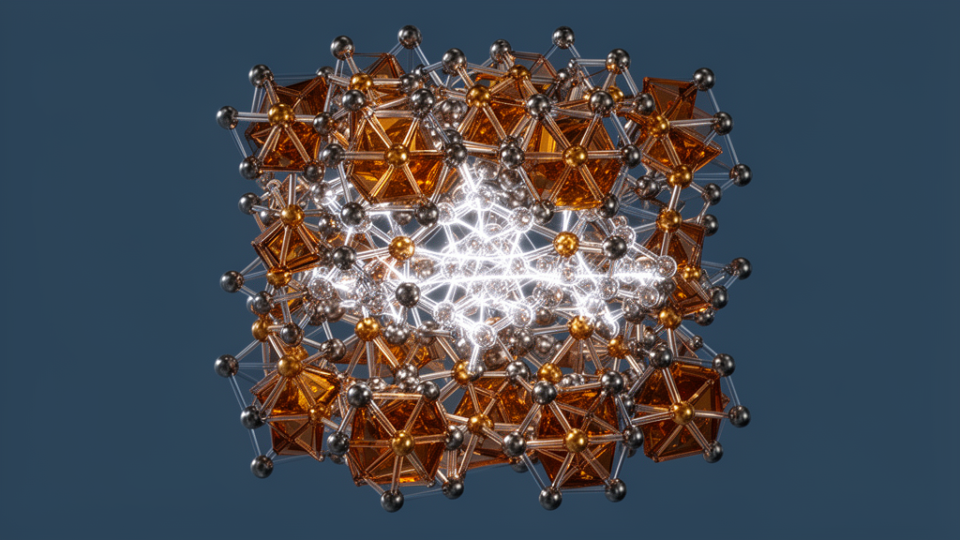
A computational investigation using first-principles density functional theory indicates that vacancy-ordered halide double perovskites formulated as A2RuBr6, where the A-site cation comprises cesium, rubidium, or potassium, display intrinsic electronic and optical profiles suitable for visible-light-driven photocatalytic oxidation alongside half-metallic ferromagnetism. Conducted by an international research team utilizing the WIEN2k solid-state simulation suite, the study evaluated the structural, mechanical, electronic, optical, and catalytic properties of these ruthenium-based materials. The calculations reveal that removing every second B-site cation to establish a vacancy-ordered framework stabilizes a cubic lattice structure while allowing the Ru 4d electron shell to introduce both spin-polarized electronic conduction and strong light harvesting across the visible spectrum.
The primary research focus addresses the operational shortcomings of conventional semiconductor photocatalysts and traditional halide perovskites in solar energy conversion. Conventional benchmark materials such as titanium dioxide possess wide band gaps of roughly 3.2 electron volts, which restricts their photoresponse to the ultraviolet regime that constitutes only about 5 percent of the solar spectrum. Conversely, standard ABX3 organometal halide perovskites demonstrate suitable optoelectronic traits but suffer severe chemical instability and degradation when exposed to aqueous environments during photoelectrochemical reactions. Vacancy-ordered double perovskites with the general stoichiometry A2BX6 provide an alternative architecture where structural vacancies enhance resilience under demanding conditions, yet ruthenium-based members of this family had previously remained largely uncharacterized despite ruthenium sharing key 4d electronic traits with active transition metals.
To model these systems with structural and electronic accuracy, the investigators implemented the full-potential augmented plane wave plus local orbitals method within the WIEN2k code. Ground-state geometric optimizations employed the Wu-Cohen generalized gradient approximation to capture electron density gradients without artificial shape approximations. Because conventional generalized gradient approximations underestimate localized orbital correlations and semiconductor band gaps, the team incorporated the Tran-Blaha modified Becke-Johnson exchange potential for electronic, optical, and magnetic property evaluations. In addition, relativistic spin-orbit coupling was integrated via the second-variational procedure to account for heavy-atom effects arising from the Ru 4d and Br 4p orbitals, which refined transition energies and narrowed computed fundamental band gaps by approximately 0.05 to 0.10 electron volts.
Structural analysis verified that Cs2RuBr6, Rb2RuBr6, and K2RuBr6 crystallize in the face-centered cubic Fm-3m lattice belonging to space group number 225. Total energy variations as a function of unit cell volume were fitted to the Birch-Murnaghan equation of state to extract equilibrium lattice constants, bulk moduli, and first pressure derivatives. The calculated equilibrium lattice parameters for the stable ferromagnetic state range from 10.23 angstroms in K2RuBr6 to 10.58 angstroms in Cs2RuBr6, expanding consistently with the ionic radius of the alkali metal cation, which increases from 1.38 angstroms for potassium to 1.52 angstroms for rubidium and 1.67 angstroms for cesium. These computed values align closely with experimental crystallographic benchmarks of 10.28 angstroms for K2RuBr6, 10.40 angstroms for Rb2RuBr6, and 10.60 angstroms for Cs2RuBr6, reflecting deviations of less than 0.5 percent across the series.
Thermodynamic stability was assessed by deriving formation energies and cohesive energies from total energy calculations. All three compounds demonstrated negative formation energies in the ferromagnetic state, ranging from -2.61 electron volts in K2RuBr6 to -3.57 electron volts in Rb2RuBr6 and -3.56 electron volts in Cs2RuBr6, establishing their exothermic formation relative to elemental constituents. Calculated cohesive energies remained positive, varying between 4.34 electron volts for K2RuBr6 and 7.34 electron volts for Cs2RuBr6, reflecting solid interatomic bonding. Goldschmidt tolerance factors computed from empirical ionic radii yielded values of 0.92 for K2RuBr6, 0.95 for Rb2RuBr6, and 1.00 for Cs2RuBr6, adhering to the standard 0.85 to 1.10 stability window for stable cubic perovskite networks. Energy comparisons between magnetic phases demonstrated that the ferromagnetic phase is energetically favorable over the non-magnetic phase by 0.011923 electron volts in K2RuBr6, 0.014181 electron volts in Rb2RuBr6, and 0.018913 electron volts in Cs2RuBr6.
Mechanical integrity was evaluated through calculated elastic constants, specifically C11, C12, and C44, obtained via cubic strain-energy relations under the Wu-Cohen approximation. All three compositions fulfilled the classic Born stability criteria for cubic systems, with C11 minus C12 remaining strictly positive between 43.66 and 49.65 gigapascals, C11 plus two C12 ranging from 96.19 to 112.38 gigapascals, and C44 spanning 13.49 to 15.12 gigapascals. The resulting bulk moduli span 32.06 to 37.46 gigapascals, while shear moduli extend from 16.61 to 19.88 gigapascals and Young’s moduli vary from 43.77 to 51.68 gigapascals, showing increased mechanical resistance as the smaller potassium cation contracts the lattice. Pugh’s ratio of bulk modulus to shear modulus produced values between 1.88 and 1.93, surpassing the empirical 1.75 threshold that delineates ductile from brittle mechanics, while positive Cauchy pressures from 4.02 to 5.79 gigapascals further verify ductile behavior capable of accommodating strain in thin-film architectures.
The electronic band structure computations demonstrate direct band gaps situated at the X-point of the Brillouin zone within the alpha-spin semiconducting channel. Under the combined GGA-WC, TB-mBJ, and spin-orbit coupling formalism, the direct band gaps measure 1.50 electron volts for K2RuBr6, 1.54 electron volts for Rb2RuBr6, and 1.68 electron volts for Cs2RuBr6. Band gap narrowing from cesium to potassium corresponds directly to unit-cell contraction, which enhances orbital overlap between Ru 4d and Br 4p states. Concurrently, the beta-spin channel exhibits metallic conduction as electronic bands cross the Fermi level, generating complete 100 percent spin polarization at the Fermi energy. Effective mass calculations at the conduction band minimum reveal lightweight electrons ranging from 0.64 to 0.71 free electron masses, whereas hole effective masses at the valence band maximum range from 2.03 to 2.27 free electron masses, creating an asymmetry that favors electron migration while slowing hole movement.
Intrinsic charge carrier transport evaluated through the deformation-potential method at 300 Kelvin determined acoustic-phonon-limited electron mobilities of 29.3 square centimeters per volt-second for Cs2RuBr6, 26.7 for Rb2RuBr6, and 24.8 for K2RuBr6. In contrast, computed hole mobilities are substantially lower, yielding 4.67, 3.94, and 3.28 square centimeters per volt-second across the series, indicating that intrinsic electron extraction proceeds approximately 5 to 9 times faster than hole transport. Density of states profiles confirm that the valence band edge is dominated by Br 4p states hybridized with Ru 4d orbitals, while the conduction band edge consists predominantly of Ru 4d states. This half-metallic ferromagnetic configuration allows spin-polarized charge transport, offering functional potential in spintronic switching devices while theoretically matching spin states during catalytic surface interactions.
Optical characterization derived via Kramers-Kronig transformations of the complex dielectric function indicates strong light harvesting across the visible and near-infrared domains. Maximum optical absorption coefficients range from 4.25 multiplied by 10 to the fifth power inverse centimeters for K2RuBr6 to 7.34 multiplied by 10 to the fifth power inverse centimeters for Cs2RuBr6. Peak absorption wavelengths span 610 nanometers in Rb2RuBr6 to 740 nanometers in Cs2RuBr6, corresponding to photon energy thresholds that cover an estimated 30 to 35 percent of the incident solar spectrum. Calculated optical penetration depths indicate that incoming light decays within 13.6 nanometers in Cs2RuBr6, 19.5 nanometers in Rb2RuBr6, and 23.5 nanometers in K2RuBr6, confirming that ultra-thin layers can harvest incident light efficiently while surface reflectivity remains moderate at 10 to 14 percent. Exciton binding energies derived from the hydrogenic model range between 139 and 167 millielectron volts, maintaining low enough barriers to facilitate charge separation upon illumination.
Analysis of absolute band edge alignments through Mulliken electronegativity calculations establishes the specific photocatalytic scope and fundamental thermodynamic constraints of the A2RuBr6 series. Calculated valence band edges range from 1.69 to 1.75 electron volts relative to the normal hydrogen electrode at pH 0, which comfortably exceeds the 1.23-electron-volt thermodynamic threshold required for water oxidation into oxygen. However, the calculated conduction band edges fall between 0.01 and 0.25 electron volts, lying entirely on the positive side of the standard hydrogen reduction potential of 0.0 electron volts. Consequently, unassisted proton reduction to generate hydrogen gas is thermodynamically unfeasible in these materials without external bias or heterojunction partners, confining their single-material photocatalytic utility strictly to half-reaction oxidation tasks such as oxygen evolution or environmental pollutant degradation.
Although the theoretical calculations indicate that A2RuBr6 perovskites possess visible-light absorption profiles superior to wide-band-gap benchmarks such as titanium dioxide and tungsten trioxide, the authors emphasize that experimental synthesis and real-world validation remain necessary. Because halide-based perovskite frameworks can be susceptible to surface degradation and dissolution under sustained aqueous photo-oxidation, resolving long-term chemical durability will require empirical testing. The computational findings establish that vacancy-ordered ruthenium double perovskites provide a defined theoretical platform for thin-film oxidation catalysts and half-metallic spintronics, provided subsequent research explores protective surface coatings, composite heterostructures, and physical material synthesis.
Subject of Research: First-principles investigation of vacancy-ordered ruthenium bromide double perovskites for photocatalytic oxidation and spintronics
Article Title: Vacancy-ordered A2RuBr6 double perovskites as dual-functional visible-light photocatalysts and half-metallic spintronic materials
Article References: Goutni, M. E. A. E., Abdullah, D., Batouche, M., Ferjani, H., Seddik, T., Shah, A. U. I., & Meyer, E. L. (2026). Vacancy-ordered A2RuBr6 double perovskites as dual-functional visible-light photocatalysts and half-metallic spintronic materials. Materials for Renewable and Sustainable Energy, 15(3), Article 42. https://doi.org/10.1007/s40243-026-00385-3
Image Credits: AI Generated
DOI: 10.1007/s40243-026-00385-3
Keywords: vacancy-ordered double perovskites, A2RuBr6, density functional theory, WIEN2k, half-metallic ferromagnetism, photocatalytic water oxidation, spintronics, ruthenium, band gap engineering, spin-orbit coupling, modified Becke-Johnson potential, optical absorption coefficient, exciton binding energy, elastic constants, carrier mobility, solar energy conversion, mechanical ductility