
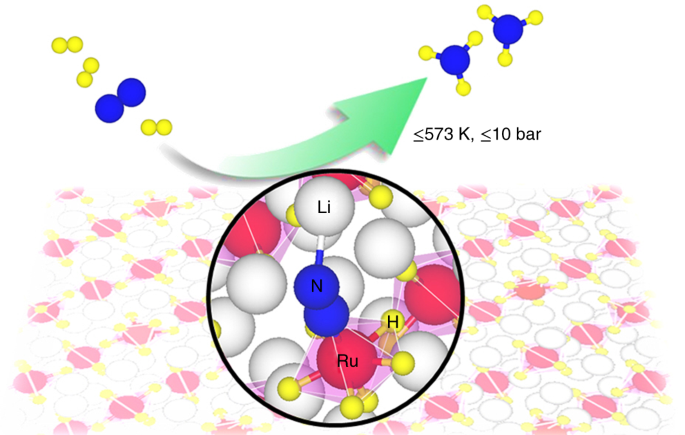
Hoffman, B. M., Lukoyanov, D., Dean, D. R. & Seefeldt, L. C. Nitrogenase: a draft mechanism. Acc. Chem. Res. 46, 587–595 (2013).
Sippel, D. et al. A bound reaction intermediate sheds light on the mechanism of nitrogenase. Science 359, 1484–1489 (2018).
Yandulov, D. V. & Schrock, R. R. Catalytic reduction of dinitrogen to ammonia at a single molybdenum center. Science 301, 76–78 (2003).
Ashida, Y., Arashiba, K., Nakajima, K. & Nishibayashi, Y. Molybdenum-catalysed ammonia production with samarium diiodide and alcohols or water. Nature 568, 536–540 (2019).
Nishibayashi, Y. Nitrogen Fixation Vol. 60, 1st edn (Topics in Organometallic Chemistry, Springer, 2017).
van der Ham, C. J. M., Koper, M. T. M. & Hetterschied, D. G. H. Challenges in reduction of dinitrogen by proton and electron transfer. Chem. Soc. Rev. 43, 5183–5191 (2014).
Jennings, J. R. Catalytic Ammonia Synthesis: Fundamentals and Practice 1st edn (Springer, 1991).
Dahl, S., Törnqvist, E. & Chorkendorff, I. Dissociative adsorption of N2 on Ru(0001): a surface reaction totally dominated by steps. J. Catal. 192, 381–390 (2000).
Honkala, K. et al. Ammonia synthesis from first-principles calculations. Science 307, 555–558 (2005).
Aika, K.-i Role of alkali promoter in ammonia synthesis over ruthenium catalysts—effect on reaction mechanism. Catal. Today 286, 14–20 (2017).
Vojvodic, A. et al. Exploring the limits: a low-pressure, low-temperature Haber–Bosch process. Chem. Phys. Lett. 598, 108–112 (2014).
Kozuch, S. & Shaik, S. How to conceptualize catalytic cycles? The energetic span model. Acc. Chem. Res. 44, 101–110 (2011).
Avenier, P. et al. Dinitrogen dissociation on an isolated surface tantalum atom. Science 317, 1056–1060 (2007).
Liu, J.-C. et al. Heterogeneous Fe3 single-cluster catalyst for ammonia synthesis via an associative mechanism. Nat. Commun. 9, 1610 (2018).
Zeinalipour-Yazdi, C. D., Hargreaves, J. S. J. & Catlow, C. R. A. Low-T mechanisms of ammonia synthesis on Co3Mo3N. J. Phys. Chem. C 122, 6078–6082 (2018).
Kitano, M. et al. Ammonia synthesis using a stable electride as an electron donor and reversible hydrogen storage. Nat. Chem. 4, 934–940 (2012).
Wang, P. et al. Breaking scaling relations to achieve low-temperature ammonia synthesis through LiH-mediated nitrogen transfer and hydrogenation. Nat. Chem. 9, 64–70 (2017).
Gong, Y. et al. Ternary intermetallic LaCoSi as a catalyst for N2 activation. Nat. Catal. 1, 178–185 (2018).
Tang, Y. et al. Metal-dependent support effects of oxyhydride-supported Ru, Fe, Co catalysts for ammonia synthesis. Adv. Energy Mater. 8, 1801772 (2018).
Wang, P. et al. The formation of surface lithium–iron ternary hydride and its function on catalytic ammonia synthesis at low temperatures. Angew. Chem. Int. Ed. 56, 8716–8720 (2017).
Yvon, K. & Renaudin, G. Hydrides: Solid State Transition Metal Complexes (Wiley, 2006).
Saitoh, H. et al. Li4FeH6: iron-containing complex hydride with high gravimetric hydrogen density. APL Mater. 2, 076103 (2014).
Humphries, T. D., Sheppard, D. A. & Buckley, C. E. Recent advances in the 18-electron complex transition metal hydrides of Ni, Fe, Co and Ru. Coord. Chem. Rev. 342, 19–33 (2017).
Orgaz, E. & Aburto, A. Electronic structure of ternary ruthenium-based hydrides. J. Phys. Chem. C 112, 15586–15594 (2008).
Nicholson, K. M. & Sholl, D. S. First-principles screening of complex transition metal hydrides for high temperature applications. Inorg. Chem. 53, 11833–11848 (2014).
Rosowski, F. et al. Ruthenium catalysts for ammonia synthesis at high pressures: preparation, characterization, and power-law kinetics. Appl. Catal. A 151, 443–460 (1997).
Xie, Y. et al. Long-term real-time monitoring catalytic synthesis of ammonia in a microreactor by VUV-lamp-based charge-transfer ionization time-of-flight mass spectrometry. Anal. Chem. 86, 7681–7687 (2014).
Jia, H. P. & Quadrelli, E. A. Mechanistic aspects of dinitrogen cleavage and hydrogenation to produce ammonia in catalysis and organometallic chemistry: relevance of metal hydride bonds and dihydrogen. Chem. Soc. Rev. 43, 547–564 (2014).
Ballmann, J., Munhá, R. F. & Fryzuk, M. D. The hydride route to the preparation of dinitrogen complexes. Chem. Commun. 46, 1013–1025 (2010).
Shima, T. et al. Dinitrogen cleavage and hydrogenation by a trinuclear titanium polyhydride complex. Science 340, 1549–1552 (2013).
Shima, T., Luo, G., Hu, S., Luo, Y. & Hou, Z. Experimental and computational studies of dinitrogen activation and hydrogenation at a tetranuclear titanium imide/hydride framework. J. Am. Chem. Soc. 141, 2713–2720 (2019).
Shima, T., Yang, J., Luo, G., Luo, Y. & Hou, Z. Dinitrogen activation and hydrogenation by C5Me4SiMe3-ligated di- and trinuclear chromium hydride complexes. J. Am. Chem. Soc. 142, 9007–9016 (2020).
Knoth, W. H. Dihydrido (dinitrogen) tris (triphenylphosphine) ruthenium. Dinitrogen bridging ruthenium and boron. J. Am. Chem. Soc. 94, 104–109 (1972).
Rod, T. H., Logadottir, A. & Nørskov, J. K. Ammonia synthesis at low temperatures. J. Phys. Chem. 112, 5343–5347 (2000).
Garden, A. L. & Skúlason, E. The mechanism of industrial ammonia synthesis revisited: calculations of the role of the associative mechanism. J. Phys. Chem. C 119, 26554–26559 (2015).
Castleman, A. Jr & Keesee, R. Clusters: bridging the gas and condensed phases. Acc. Chem. Res. 19, 413–419 (1986).
Rodriguez, M. M., Bill, E., Brennessel, W. W. & Holland, P. L. N2 reduction and hydrogenation to ammonia by a molecular iron–potassium complex. Science 334, 780–783 (2011).
Falcone, M., Chatelain, L., Scopelliti, R., Živković, I. & Mazzanti, M. Nitrogen reduction and functionalization by a multimetallic uranium nitride complex. Nature 547, 332–335 (2017).
McEnaney, J. M. et al. Ammonia synthesis from N2 and H2O using a lithium cycling electrification strategy at atmospheric pressure. Energy Environ. Sci. 10, 1621–1630 (2017).
Sato, T. et al. Raman and infrared spectroscopic studies on Li4RuH6 combined with first-principles calculations. Mater. Trans. 55, 1117–1121 (2014).
Kritikos, M. & Nore´us, D. Synthesis and characterization of ternary alkaline-earth transition-metal hydrides containing octahedral [Ru(II)H6]4− and [Os(II)H6]4− complexes. J. Solid State Chem. 93, 256–262 (1991).
Gao, W. et al. Barium hydride-mediated nitrogen transfer and hydrogenation for ammonia synthesis: a case study of cobalt. ACS Catal. 7, 3654–3661 (2017).
Guan, H. et al. Preparation of nanometer magnesia with high surface area and study on the influencing factors of the preparation process. Acta Physico Chimica Sinica 22, 804–807 (2006).
Ju, X. et al. Mesoporous Ru/MgO prepared by a deposition-precipitation method as highly active catalyst for producing COx-free hydrogen from ammonia decomposition. Appl. Catal. B 211, 167–175 (2017).
Toebes, M. L., Prinsloo, F. F., Bitter, J. H., van Dillen, A. J. & de Jong, K. P. Influence of oxygen-containing surface groups on the activity and selectivity of carbon nanofiber-supported ruthenium catalysts in the hydrogenation of cinnamaldehyde. J. Catal. 214, 78–87 (2003).
Gao, W. et al. Production of ammonia via a chemical looping process based on metal imides as nitrogen carriers. Nat. Energy 3, 1067–1075 (2018).
Bösenberg, U. et al. Characterization of metal hydrides by in-situ XRD. Int. J. Hydrogen Energy 39, 9899–9903 (2014).
Hua, L. et al. Single photon ionization and chemical ionization combined ion source based on a vacuum ultraviolet lamp for orthogonal acceleration time-of-flight mass spectrometry. Anal. Chem. 83, 5309–5316 (2011).
Qin, Z., Wu, X. & Tang, Z. Note: A novel dual-channel time-of-flight mass spectrometer for photoelectron imaging spectroscopy. Rev. Sci. Instrum. 84, 066108 (2013).
Rapp, W. et al. α- and neutron-induced reactions on ruthenium isotopes. Phys. Rev. C 66, 015803 (2002).
Andersen, S. Z. et al. A rigorous electrochemical ammonia synthesis protocol with quantitative isotope measurements. Nature 570, 504–508 (2019).
Anderson, J. S., Rittle, J. & Peters, J. C. Catalytic conversion of nitrogen to ammonia by an iron model complex. Nature 501, 84–87 (2013).
Liu, J. et al. Nitrogenase-mimic iron-containing chalcogels for photochemical reduction of dinitrogen to ammonia. Proc. Natl Acad. Sci. USA 113, 5530–5535 (2016).
Kammert, J. et al. Nature of reactive hydrogen for ammonia synthesis over a Ru/C12A7 electride catalyst. J. Am. Chem. Soc. 142, 7655–7667 (2020).
Siporin, S. E. & Davis, R. J. Isotopic transient analysis of ammonia synthesis over Ru/MgO catalysts promoted by cesium, barium, or lanthanum. J. Catal. 222, 315–322 (2004).
Blöchl, P. E. Projector augmented-wave method. Phys. Rev. B 50, 17953–17979 (1994).
Kresse, G. & Joubert, D. From ultrasoft pseudopotentials to the projector augmented-wave method. Phys. Rev. B 59, 1758–1775 (1999).
Kresse, G. & Furthmüller, J. Efficient iterative schemes for ab initio total-energy calculations using a plane-wave basis set. Phys. Rev. B 54, 11169–11186 (1996).
Cramer, C. J. Ed., Essentials of Computational Chemistry 2nd edn (Wiley, 2004).
Sprowl, L. H., Campbell, C. T. & Árnadóttir, L. Hindered translator and hindered rotor models for adsorbates: partition functions and entropies. J. Phys. Chem. C 120, 9719–9731 (2016).
Sprowl, L. H., Campbell, C. T. & Arnadottir, L. Correction to ‘hindered translator and hindered rotor models for adsorbates: partition functions and entropies’. J. Phys. Chem. C 121, 9655–9655 (2017).
Campbell, C. T., Sprowl, L. H. & Árnadóttir, L. Equilibrium constants and rate constants for adsorbates: two-dimensional (2D) ideal gas, 2D ideal lattice gas, and ideal hindered translator models. J. Phys. Chem. C 120, 10283–10297 (2016).
Henkelman, G., Uberuaga, B. P. & Jónsson, H. A climbing image nudged elastic band method for finding saddle points and minimum energy paths. J. Chem. Phys. 113, 9901–9904 (2000).