
Thank you for subscribing to my posts. If you’re not yet a paying supporter, please consider becoming one. That’ll allow you to DM me with questions and comments. Your contribution will help cover the cost of the data I use in my posts, which I fund out of my own pocket. Thanks so much for your support and feedback!
The debasement trade is powered by the fear that fiscal policy across many advanced economies is out of control. Markets fear that governments will be tempted to inflate away unsustainable debt burdens, which drove last year’s crazy rise in precious metals that are seen as safe havens. Even before this week’s events, I’d been flagging that the signs for this rally to resume were mounting, which I’d outlined here and discussed in my live stream two weeks ago. The US Treasury’s efforts to play with debt issuance to cap long-term yields adds fuel to this fire, because – as I noted yesterday – it signals an unwillingness to do what’s really needed (reign in the deficit) and instead resorts to financial engineering to cap yields. Markets take a dim view of this and so it’s no surprise that precious metals are up sharply since the buyback announcement.
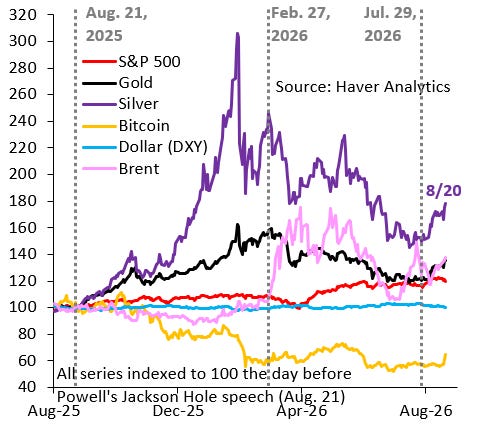
The chart above shows the debasement trade in broader context. It indexes various assets to be 100 on August 21, 2025, the day before then Chair Powell gave his dovish keynote at last year’s Jackson Hole, which is the catalyst that started this trade a year ago. Shown are the S&P 500 (red), gold (black), silver (purple), bitcoin (orange), the Dollar against the G10 (blue) and the front-month futures price for Brent (pink).
Three points are worth making. First, during the first phase of the debasement trade – from Aug. 22, 2025, to the start of the war with Iran in the night of Feb. 27, 2026 – the Dollar was flat as precious metals prices went crazy. This means that the debasement trade at the time wasn’t about the Dollar, but about debasement fears for much of the G10. That’s changing. The Dollar is tumbling after Treasury’s buyback announcement and rightly so. This phase of the trade will see much more Dollar weakness. Second, since the start of the war with Iran, gold and silver fell whenever oil prices and risk aversion spiked, the opposite of what safe haven assets should do. I put this down to lots of retail investors getting sucked into the debasement trade last year, which – as they’re more skittish than traditional holders – made gold and silver trade like high-beta assets. That’s over as I flagged two weeks ago. Gold and silver are up even as oil is rising. Third, unlike the first run of the debasement trade, when bitcoin did terribly, it’s now doing better. I’d stay well clear of bitcoin. Markets don’t see it in the same light as gold and silver. It definitely isn’t a safe haven.
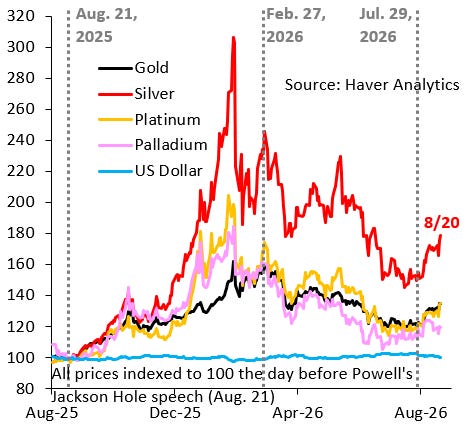
The chart above zeros in on precious metals. Since the buyback announcement, silver (red) is up a stunning eight percent, gold (black) four percent, platinum (orange) seven percent and palladium (pink) three percent. Silver was the “bad boy” of the debasement trade during its initial phase, rising more than anyone else. That’s playing out again, which I see as a signal that this trade is truly back.
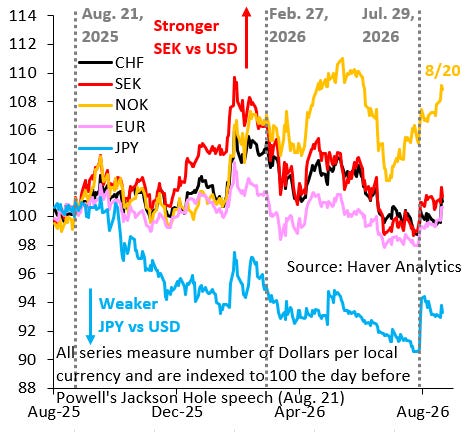
At its peak, the debasement trade wasn’t just about precious metals. Currencies of low-debt countries like Sweden (SEK) or Switzerland (CHF) were also rising, as the chart above shows. This is just getting started again and will be even more forceful this time around because of the downward pressure the Treasury buyback news puts on the Dollar. This round of the debasement trade is thus very much about Dollar weakness, which I flagged in yesterday’s post.