
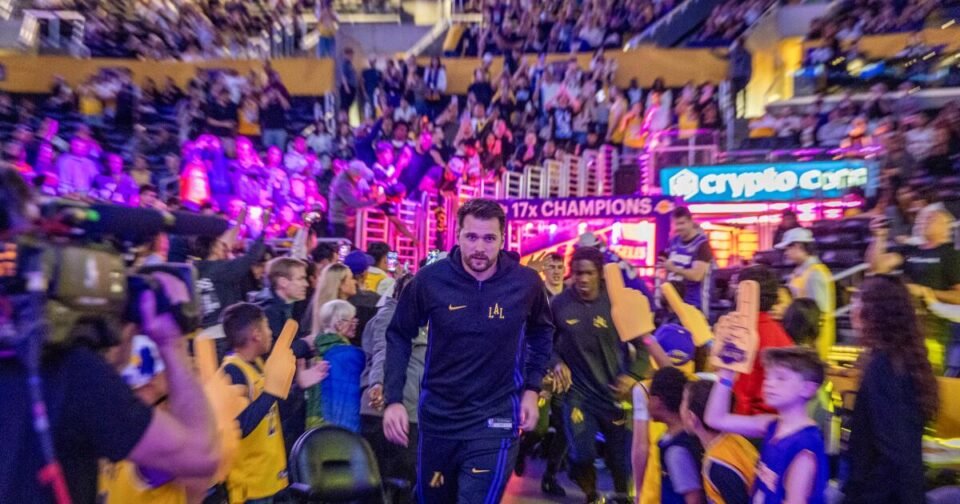
One of Los Angeles’ celebrated professional sports franchises was owned by one local family for more than 45 years. Catering to Hollywood royalty and leaning into its “Showtime” charm, the Lakers became synonymous with the star-studded city. Two quick transactions later, the team now belongs to a New York-based venture capital titan who made his billions in technology and software.
Joshua Kushner, founder of venture capital firm Thrive Capital, and former Disney Chief Executive Bob Iger agreed to buy a majority stake in the Lakers last week. The Buss family’s grip on the NBA’s glamor franchise loosened in 2025 when they relinquished their majority share to Mark Walter. His businesses are under federal investigation for undisclosed insurance loans and Walter flipped the team after just 14 months.
In 1979, Jerry Buss bought the Lakers, the Forum and the Los Angeles Kings for $67.5 million. Now the Lakers alone are worth $12.5 billion.
“It used to be, ‘Hey, I’m in this for the love of the game,’” said Ross Williams, a private-equity attorney and partner at law firm Reed Smith. “Like I measure the success of my investment based on whether we win championships. … And now it’s becoming apparent that these are really, really good financial investments.”

Mark Walter, left, talks with Jeanie Buss while the Lakers play the Bulls at Crypto.com Arena on March 12. Walter sold his majority share in the Lakers, while Buss is fighting to keep her family’s minority stake.
(Allen J. Schaben/Los Angeles Times)
The booming business of sports has attracted a flood of private-equity investment, and even the most notable franchises require the influx of cash to keep up in the arms race.
As of May, more than 74 North American professional teams had some level of private-equity involvement, according to the CFA Institute, an organization providing finance education to investment professionals. Private-equity-backed consolidators have been responsible for 61% of all mergers and acquisition transactions in the sports industry since 2019, according to Oaklins, a global M&A and financial advisory company.
“The real attraction of professional sports is it seems somewhat recession-proof,” said James Adams, director of CFA program curriculum and an adjunct professor at New York University. “It has had a very successful run, a high rate of growth, it’s not as subject to the fluctuations of the business cycle as maybe other things are.”
For private equity — in which investors buy into companies that aren’t available on the public market — sports offers safe harbor. Media deals provide predictable revenue over several years. The NBA’s current deal that stretches to the 2035-36 season is worth $6.9 billion per year. Additional revenue streams with merchandise, sponsorships and ticket sales pile on. Owning an arena, which the Lakers do not, opens the floodgates for concerts and events that add to the revenue.
“Sports is one of those rare instances where you can invest in something cool that also makes money,” Williams said.
The appeal of owning a sports team is growing.
The NBA averaged at least 22 million fans during each of the last three seasons, according to Sports Business Journal. Last season’s nationally televised games drew 170 million viewers, the most in 24 years and an 86% increase from the previous year. The NBA Finals between the New York Knicks and San Antonio Spurs were the most-watched Finals since 1998. And the outlook for future profits is strong, if fans’ appetites are any gauge.
The trend is prevalent across many sports. WNBA viewership is at an all-time high. Fox and Telemundo dominated the summer with their FIFA World Cup broadcasts. Of the top 100 TV broadcasts in 2025, 96 were sports, according to Neilsen data, including 48 NFL games and seven World Series games (between the Dodgers and Toronto Blue Jays).
Investors are clamoring to find the next venture that will hit it big with consumers. Live sports already have a dedicated market and more stability than other ventures constantly affected by technical developments.
“You read a lot about AI and there are a lot of companies that their fundamental existence is being questioned because of AI and what it can do,” Williams said. “We don’t want to watch robots play basketball.”
The NBA adopted its first private-equity ownership framework in 2021. Individual firms can own up to 20% of an NBA team, according to Sports Business Journal, and 30% of a single team can be owned by private-equity firms. Such firms were limited to five teams in 2021, but the number grew to eight in 2025.
Private equity even infiltrated the most exclusive ownership club in 2024 when the NFL was the last major U.S. league to open its doors. The league allowed preapproved firms to own up to 10% of a single team, up to six teams total with each stake being at least 3%.
The permanence of sports franchises were behind the formation of Kushner’s Thrive Eternal venture, a permanent holding company launched under Thrive Capital in April. Although venture-capital firms generally focus on turning profits from the most early stage companies, Thrive Eternal is “concentrated in a small number of assets that we can own and steward over many decades,” the company’s website says.
“These are assets with qualities that cannot be replicated by technology,” the homepage reads. “Iconic franchises and cultural institutions rooted in tradition, identity, and shared experience.”
How Kushner and Iger plan to finance the purchase of the Lakers has yet to be determined. Kushner, already a minority owner in the Miami Heat, must first divest from that team before the Lakers sale can be finalized, and the transaction must be approved by the NBA board of governors.
The board of governors announced last year that Jeanie Buss would remain in charge of the Lakers’ decisions after the Buss family’s sale to Walter. The family’s future is in limbo as Jeanie Buss contests her five siblings’ plans to sell their remaining stake of the team. The family feud over their remaining 17.8% stake is not expected to influence the sale from Walter to Iger and Kushner, a source familiar with the situation but not authorized to speak publicly told The Times, although it could affect who would represent the team on the board of governors going forward.
While analyzing the sale transaction, the board could look at where the money is coming from, Williams said: how much money from Kushner and Iger personally, how they are moving assets to provide the billions of dollars, and how much potential private-equity money from Thrive.
Thrive Enternal’s first entry into sports was purchasing a noncontrolling stake in the San Francisco Giants. Four months later, it is set to add the Lakers.
Private-equity firms can have a sliver of a team, but are not to have a controlling voice. Their influence trickles down to fans in other ways. Deep-pocketed new owners can help build stadiums or upgrade existing venues to maximize revenue from luxury suites. Ownership decisions also can lead to signing or retaining star players as teams hope to contend for championships. The influx of cash into sports has helped women’s sports take off with unprecedented investment and growth.
But just as a team’s valuation goes up, so has the price tags for fans. Just getting in the door to Dodger Stadium can cost a family of four nearly $250. In one season under Walter, season-ticket price increases rankled Lakers fans. A second row of courtside seats during the Lakers postseason changed what used to be an exclusive feel to a game.
Yet at each game, the seats were full.

Lakers star LeBron James hugs governor Jeanie Buss after winning the NBA championship on Oct. 11, 2020, in Lake Buena Vista, Fla.
(Douglas P. DeFelice / Getty Images)
“Passionate sports fans are not as price sensitive,” said Arianna Uhalde, an associate professor of clinical marketing at USC’s Marshall School of Business. “I think not as sensitive to some of these decisions that are getting made by ownership. It doesn’t mean that fans are not going to get upset, but they love their teams. They’re likely to still show up in good times and in bad.”
The business of sports has been great for owners, but isn’t guaranteed to last. A change in state or federal administrations and policies could affect tax laws that are advantageous for team ownership, said Mark Conrad, a director of the sports business concentration and professor of law and ethics at Fordham University’s Gabelli School of Business. Labor issues such as the one threatening Major League Baseball could put a freeze on valuations. A recession or another global pandemic could tank the economy. Even the NBA Finals ratings during the COVID-19 pandemic were at an all-time low, averaging just 7.45 million viewers for the Lakers’ six-game, bubble series win over the Miami Heat.
Fans have steadily marched back ever since.
“They’re going to pay for it,” Conrad said. “They can. They do. … And if that’s the case, the lords of the sport are going to be mighty happy.”