
The relationship between automotive emissions legislation and platinum group metal consumption is rarely straightforward. For decades, tightening emissions standards actually increased palladium demand, because stricter exhaust regulations required more sophisticated catalytic converters loaded with higher quantities of PGMs. Today, that dynamic has inverted. The same regulatory machinery that once drove autocatalyst demand upward is now the primary force threatening to dismantle it, as governments pivot from controlling what comes out of combustion engines to eliminating those engines altogether.
This inversion creates one of the most analytically complex demand forecasting environments in commodity markets. The central question is no longer whether UK zero-emission vehicle mandate palladium demand will decline, but at what rate, across what timeline, and whether near-term policy adjustments can meaningfully reshape the trajectory. The UK’s ongoing review of its zero-emission vehicle mandate has injected fresh uncertainty into that calculus, and understanding its implications requires unpacking both the mechanics of the mandate itself and the industrial realities driving the review.
When big ASX news breaks, our subscribers know first
What the UK ZEV Mandate Actually Requires and Why It Is Under Pressure
The UK’s zero-emission vehicle mandate operates on an escalating schedule. Under the current framework, 33% of new car registrations must be zero-emission in 2026, a threshold that rises to 80% by 2030. Critically, the mandate’s definitional architecture classifies petrol, diesel, hybrid, and plug-in hybrid vehicles as non-zero-emission, meaning the compliance pathway for manufacturers is narrow and demanding.
The broader policy endpoints remain fixed. The UK has committed to ending sales of new conventional petrol and diesel cars by 2030, with a full zero-emission requirement for all new cars and vans by 2035. These long-term commitments frame the outer boundary of the ICE vehicle market regardless of what happens in the interim review. Furthermore, understanding the ZEV mandate’s importance helps contextualise why even modest policy adjustments can have outsized consequences for commodity markets.
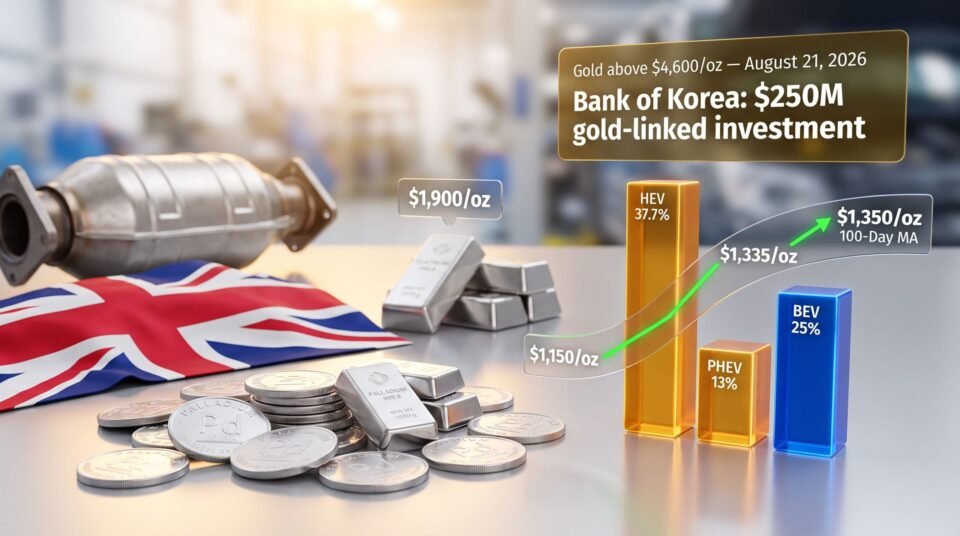
The pressure driving the current consultation is straightforward: real-world adoption is diverging from legislative ambition at a pace that is making compliance increasingly difficult. Battery electric vehicles captured only 25% of UK new car registrations in H1 2026, leaving an 8 percentage point gap below the headline 33% mandate threshold. While manufacturers retain several flexibility mechanisms within the current framework, the structural gap between BEV sales performance and mandate requirements is widening in a way that mirrors the conditions that prompted the European Union to revise its own EV transition requirements earlier.
The regulatory trajectory across major Western European automotive markets is converging toward a recalibration, as the gap between ambitious zero-emission targets and actual consumer behaviour becomes increasingly difficult to bridge through manufacturer flexibility mechanisms alone.
Hybrids as the Swing Variable: What the Sales Data Reveals
The powertrain composition of current UK new car registrations tells a story that has significant implications for palladium demand modelling. Hybrid electric vehicles accounted for 37.7% of UK new car registrations in H1 2026, making them the single largest powertrain category by market share. Plug-in hybrids contributed a further 13% of registrations in the same period.
This pattern is not an isolated UK phenomenon. In the EU market during the same period, hybrid electric vehicles were also the most popular powertrain category, representing 37.3% of EU new car registrations. The convergence across two of the world’s most significant automotive markets suggests that the hybrid transition is a structural feature of the current adoption curve, not a market-specific anomaly.
| Powertrain Category | H1 2026 UK Market Share | Palladium Autocatalyst Required? |
|---|---|---|
| Battery Electric Vehicle (BEV) | 25% | No |
| Hybrid Electric Vehicle (HEV) | 37.7% | Yes |
| Plug-In Hybrid (PHEV) | 13% | Yes |
| Conventional ICE (Petrol/Diesel) | ~24.3% | Yes |
The palladium relevance is direct. Unlike battery electric vehicles, which produce zero tailpipe emissions and require no exhaust treatment systems, hybrid powertrains retain internal combustion engines. This means they continue to rely on autocatalysts, the catalytic converter systems that deploy platinum group metals to transform harmful exhaust compounds including carbon monoxide, hydrocarbons, and nitrogen oxides into benign atmospheric elements.
A key technical detail worth understanding: autocatalysts are not interchangeable across powertrain types. The specific chemical reaction pathways involved in treating exhaust from petrol-engine hybrids primarily require palladium, while diesel applications lean more heavily on platinum. This distinction matters enormously for demand modelling, because the hybrid market’s growth directly maps onto palladium consumption in a way that broader ICE vehicle sales data can obscure. For a broader perspective on platinum and palladium dynamics across commodity markets, the divergence in their respective demand profiles is particularly instructive.
The Demand Stabilisation Thesis and Its Structural Limits
If UK manufacturers receive greater regulatory flexibility under a revised mandate, the commercial logic strongly favours extending hybrid production timelines rather than absorbing the cost and risk of an accelerated BEV rollout. This creates what can be described as a demand floor mechanism for palladium: not a recovery, but a slower erosion.
Heraeus, the precious metals specialist whose analysis covers global PGM market dynamics, has noted that palladium demand support emerging from mandate flexibility would slow the erosion of automotive palladium demand rather than reverse its longer-term decline as the market moves toward zero-emission vehicles. This distinction is analytically critical and worth examining in detail.
There are two conceptually distinct outcomes that investors and commodity analysts frequently conflate:
- Demand support refers to a deceleration in the rate of decline. The trajectory remains negative, but the gradient flattens. Palladium consumption falls more slowly than aggressive BEV penetration models had projected.
- Demand recovery implies an absolute increase in consumption volumes relative to a prior baseline. This would require not just slower BEV adoption but an active expansion of hybrid production beyond what current forecasts anticipate.
The current regulatory environment, even under a revised mandate, is structurally consistent with the former rather than the latter. The UK’s 2030 and 2035 zero-emission policy endpoints remain intact, which means the terminal direction of travel for ICE and hybrid vehicle sales is fixed. What a mandate review can alter is the speed of the journey, not the destination.
Investors should treat the ZEV mandate review as a timeline adjustment event rather than a demand reversal catalyst. The structural headwinds for palladium remain unchanged; only their near-term velocity is in question.
Palladium Price Dynamics: Reading the Technical Signals
The palladium price chart through mid-2026 reflects a market that has registered the possibility of demand support without yet committing to a recovery narrative. Palladium staged a significant rally from approximately $1,150/oz in late June 2026 to nearly $1,400/oz in early August 2026, a move of roughly 22% across six weeks that suggested genuine repositioning by market participants.
The subsequent price behaviour has been more cautious. Prices pulled back and consolidated, testing resistance in the $1,335/oz range, while the 100-day moving average sitting at approximately $1,350/oz has emerged as a meaningful technical ceiling that the market has not been able to decisively breach.
This stall carries informational content. A market genuinely pricing in a structural demand reversal would typically sustain momentum through near-term resistance levels as buying pressure accumulates. The failure to hold above resistance suggests that market participants are hedging between two competing interpretations: near-term demand stabilisation from hybrid market strength, and the longer-term structural erosion that electrification represents. Until one narrative clearly dominates, the price is likely to remain range-bound relative to current technical levels.
The supply dimension adds a layer of complexity that palladium-specific demand analysis sometimes underweights. Palladium production is geographically concentrated to an unusual degree, with South Africa and Russia together accounting for the substantial majority of global mine supply. Geopolitical risk premiums embedded in palladium supply chains interact with demand forecasts in ways that can amplify or dampen price movements independently of automotive consumption trends.
Platinum’s Diverging Demand Profile and Technical Recovery
Platinum’s price trajectory through the same period illustrates how differentiated demand fundamentals can produce divergent market outcomes within the same PGM complex. Platinum broke above significant resistance near $1,800/oz following a recovery from July 2026 lows, climbing from approximately $1,550/oz in early July and briefly exceeding $1,900/oz, its highest level since June 2026.
The 200-day moving average, positioned around $1,920/oz, represents the next meaningful technical threshold. A sustained close above this level would technically confirm the recovery phase and likely attract additional momentum-driven buying.
The fundamental basis for platinum’s relatively stronger position lies in its more diversified demand profile. While platinum also faces automotive demand headwinds from electrification, it has a growing exposure to hydrogen economy applications including proton exchange membrane fuel cells and PEM electrolysers, which use platinum as a catalyst. The green hydrogen buildout is consequently creating a structural demand growth vector that palladium currently lacks, giving platinum a more complex and arguably more resilient long-term demand outlook.
The next major ASX story will hit our subscribers first
Minor PGMs: Stable Prices and the Hydrogen Economy Connection
| PGM | Price (August 2026) | Primary Demand Driver |
|---|---|---|
| Rhodium | $9,200/oz | Gasoline autocatalyst systems |
| Ruthenium | $1,745/oz | Emerging anode technologies; potential PEM electrolyser applications |
| Iridium | $8,300/oz | Proton exchange membrane electrolyser catalysts |
Rhodium, ruthenium, and iridium prices have remained broadly flat, but the longer-term demand narrative for ruthenium and iridium is evolving in ways that are not yet fully reflected in current pricing.
PEM electrolysers, a critical technology in green hydrogen production, rely on both iridium and platinum as catalysts in the electrochemical process that splits water into hydrogen and oxygen. Iridium’s role as an anode catalyst in PEM systems has made it a key beneficiary of hydrogen infrastructure investment. However, its extreme scarcity constrains the scalability of this demand vector. The broader PEM technology expansion across global energy infrastructure is, nonetheless, steadily reshaping demand assumptions for several minor PGMs.
A less widely understood development involves ruthenium’s potential in lower-iridium anode formulations. Researchers and technology companies working on next-generation PEM electrolyser designs have been exploring ruthenium-based anode catalysts as a partial substitute for iridium, which would both reduce costs and alleviate supply constraints. If these technologies achieve commercial-scale adoption, ruthenium could access a new demand channel entirely independent of automotive markets, a prospect that current spot prices do not appear to fully price in.
Gold: Central Bank Behaviour and Sovereign Reserve Reallocation
The gold market context in August 2026 reflects a convergence of institutional and macroeconomic forces that are reshaping sovereign reserve allocation globally.
Gold prices broke above $4,600/oz on August 21, 2026, the highest level since early June, following a period of consolidation that had kept prices pinned near $4,000/oz throughout July. The early August rally of approximately 7% preceded the more recent breakout, establishing a pattern of range consolidation followed by momentum-driven breakouts that has characterised gold’s price behaviour throughout 2026.
The Bank of Korea’s gold market activity adds a significant institutional dimension to this backdrop. The bank executed its first gold-linked investment in 13 years, acquiring gold shares valued at approximately $250-million, providing metal-equivalent exposure of roughly 62,000 oz (approximately 1.9 tonnes) of gold. Importantly, this transaction did not alter the Bank of Korea’s physical gold reserves, which have remained static at around 104.4 tonnes since 2013. The distinction matters: the investment provides gold exposure through a financial instrument rather than physical accumulation.
Separately, the Bank of Korea has signalled its intention to establish a framework for purchasing domestically refined gold, a mechanism that could eventually enable physical reserve expansion. This development aligns with a broader global trend in which central bank gold demand is rising relative to holdings of US Treasury securities, a structural shift in sovereign asset allocation that has been building since 2022. In addition, the trend toward gold reserve diversification among sovereign institutions continues to underpin the metal’s structural demand outlook.
The Bank of Korea’s return to gold exposure after a 13-year absence, combined with its separate signalling of a physical gold purchasing framework, represents a meaningful shift in one of Asia’s more conservative central bank reserve management approaches.
The US Treasury’s intervention in the long-dated bond market adds a macro dimension relevant to gold’s store-of-value demand. On August 19, 2026, the Treasury announced it would at least double the maximum size of its buybacks of longer-dated securities covering 10 to 30-year maturities, increasing per-operation capacity from $2-billion to at least $4-billion. The programme runs between September 9 and November 4, 2026, with seven scheduled auctions under the revised parameters, creating at least $14-billion in additional purchase capacity.
This intervention follows US borrowing costs rising to approximately 20-year highs, a macro backdrop that has historically supported gold as an alternative store of value relative to sovereign debt instruments. The combination of elevated government borrowing costs, central bank reserve diversification away from Treasuries, and the Bank of Korea’s renewed gold exposure creates a mutually reinforcing demand environment for the metal.
Strategic Monitoring Framework: What to Watch and Why It Matters
For investors and industry participants navigating the UK zero-emission vehicle mandate palladium demand relationship, the following indicators carry the most analytical weight in the near term:
- UK ZEV mandate consultation outcomes: The specific flexibility mechanisms offered to manufacturers will determine the effective extension of hybrid production timelines. Broad flexibility that allows manufacturers to use credits, pooling, or extended hybrid sales windows will have a larger demand impact than narrow technical adjustments.
- H2 2026 UK and EU hybrid registration data: Continuation of the H1 2026 hybrid market share above 37% would validate the demand stabilisation thesis and provide a concrete empirical basis for revising palladium demand models.
- Palladium price relative to the $1,350/oz 100-day moving average: A sustained breach above this level would signal market conviction in near-term demand support; failure to hold this area would suggest the market is already looking through the mandate review to the structural decline thesis.
- Iridium and ruthenium anode technology milestones: Commercial-scale deployment announcements for lower-iridium PEM electrolyser anode systems could trigger a significant rerating of ruthenium’s demand outlook.
- Central bank gold reserve reporting: Quarterly IMF reserve data will reveal whether the Bank of Korea’s framework for domestic gold purchasing has translated into physical reserve accumulation, and whether similar shifts are occurring at other sovereign institutions.
The analytical framework for the UK zero-emission vehicle mandate and palladium demand ultimately resolves to a tension between two timescales. In the near term, regulatory flexibility creates genuine demand support for autocatalyst consumption through an extended hybrid transition period. Over the medium to long term, fixed policy endpoints at 2030 and 2035 constrain any demand recovery narrative and leave palladium’s structural trajectory intact. The metal’s investment case in 2026 and beyond depends critically on which timescale a given market participant is positioned to act upon.
Disclaimer: This article is intended for informational purposes only and does not constitute financial advice. Commodity price forecasts, market projections, and policy outcome assessments involve inherent uncertainty. Past price performance is not indicative of future results. Readers should conduct their own due diligence before making investment decisions.
Want to Stay Ahead of the Next Major ASX Mineral Discovery?
Discovery Alert’s proprietary Discovery IQ model delivers real-time alerts on significant ASX mineral discoveries — instantly transforming complex commodity data into actionable insights for both short-term traders and long-term investors. Explore Discovery Alert’s dedicated discoveries page to understand how historic mineral discoveries have generated substantial market returns, and begin your 14-day free trial today to position yourself ahead of the broader market.