
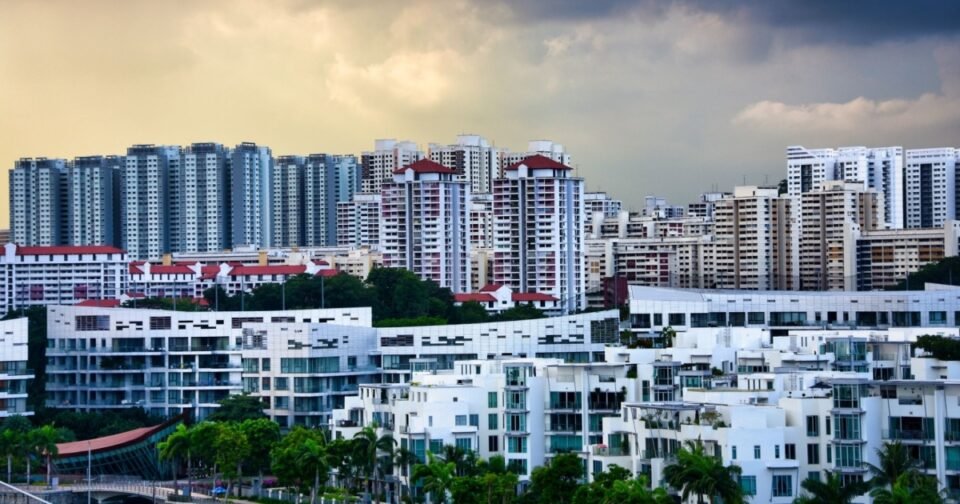
Three- and four-bedroom homes remain popular with families.
Singapore property buyers are gaining bargaining power as lower borrowing costs and wider access to market data make them more selective on price and property quality.
“Whilst liquidity is improving and investors remain keen to deploy capital, the price gap between buyer and seller expectations continues to be a key obstacle,” Tricia Song, head of research for Singapore and Southeast Asia at CBRE Group, Inc., said in an emailed reply to questions.
Lower borrowing costs have encouraged sellers to bring more assets to market, whilst recent large transactions have boosted confidence in liquidity, she said.
Nuris Alicia, an associate senior director at OrangeTee & Tie Pte Ltd., said transactions have become more calculated as buyers scrutinise prices and property quality more closely.
“A desirable unit that is correctly priced can move very quickly, whilst another property in the same estate may remain on the market simply because buyers do not see sufficient value at the asking price,” she said in an email.
CBRE data showed Singapore property transaction volumes more than doubled in the first half to $34.7b, surpassing the $34.3b recorded for all of 2025.
Growth was spread across most sectors as lower domestic interest rates and Singapore’s safe-haven status supported activity despite war and economic risks.
CapitaLand Integrated Commercial Trust bought Paragon mall for $3.9b, whilst IOI Properties Group acquired Asia Square Tower 2 for $2.476b, CBRE said.
Urban Redevelopment Authority (URA) data showed office and retail price indexes rose to 111.3 and 104.4 in the second quarter from 110.9 and 103.6, respectively, a quarter earlier.
Private residential prices also increased, with the URA index rising to 219.4 from 218.3. The Housing and Development Board resale index, however, fell 0.3% to 202.8, marking a second straight quarterly decline.
Alicia said buyers are scrutinising properties more closely, considering factors such as access to public transport, renovation costs, remaining lease, space for future family needs, and resale prospects.
Alexis Quek, group associate director at OrangeTee & Tie Pte Ltd., said demand remains strong among homeowners upgrading from two-bedroom private properties to three-bedroom homes as their families grow. Connectivity remains a major consideration for both owner-occupiers and investors.
More information is also making negotiations harder, Alicia said, since buyers and sellers can more easily compare prices and assess financing, policy changes, and market conditions.
Industrial assets continue to attract investors because of their yields relative to other asset classes, Song said. Office and retail transactions are also expected to remain active on expectations of rental growth and sustained tenant demand.
Resale properties are also drawing buyers, particularly HDB flats and private condominiums, Alicia said.
The removal of the 15-month wait-out period has allowed eligible private property owners to move directly into HDB resale flats when right-sizing.
Private residential resale transactions increased to 3,813 in the second quarter from 3,225 in the first, URA data showed.
Quek expects three- and four-bedroom private homes to remain popular, particularly among HDB upgraders who are accustomed to having more space.
Bigger units could also attract buyers seeking greater flexibility because of their more limited supply, she said.