
Thank you for subscribing to my posts. If you’re not yet a paying supporter, please consider becoming one. That’ll allow you to DM me with questions and comments. Your contribution will help cover the cost of the data I use in my posts, which I fund out of my own pocket. Thanks so much for your support and feedback!
Back in the fall of last year, when the rally in gold and precious metals was at its peak, I did a series of posts on the “debasement trade,” summarizing what we know and don’t know. This trade is a new phenomenon, so it’d be foolish to think it’s well-defined or encompasses a fixed set of assets. Neither of these things are true. What’s clear is that this thing is increasingly entering the mainstream vernacular and growing in popular appeal. So this post updates my summary of what we know. I’ll cover the underlying driver of this trade, what assets are in it, and how much further it has to run.
-
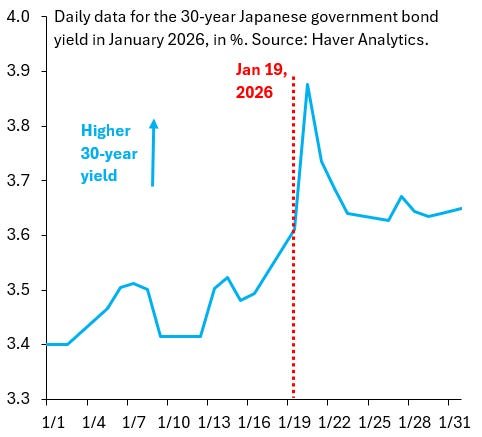
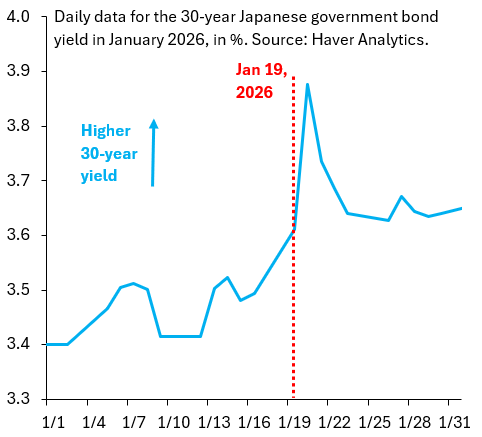
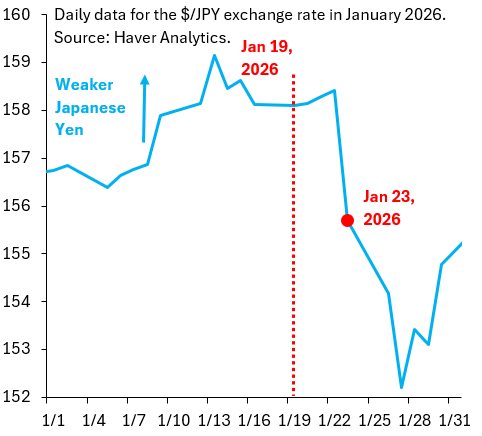
What’s driving the debasement trade? At its core, this thing is about fiscal policy running out of control across much of the G10. Markets are increasingly fearful this will result in governments trying to inflate away unsustainable debt burdens, so they’re looking for assets that are a safe haven from fiat money debasement. If this sounds grandiose and hyperbolic, there’s a growing list of market “accidents” that tell us – at high frequency – that this is happening. The chart above shows Japan’s 30-year government bond yield in January of this year. In the evening of January 19, Prime Minister Takaichi said her government would put an end to “excessive” fiscal austerity. Japan’s 30-year yield spiked the next day and, as the chart below shows, the NY Fed did it’s infamous “rate check” – verbal intervention to strengthen the Yen – on January 23, to head off what might have become an uncontrolled slide in Japan’s currency. This is just one example that shows how market patience with irresponsible fiscal policy is running out. A more recent example is the surprise buyback announcement by the US Treasury on August 19, which saw the Dollar tumble and gold as well as other precious metals prices soar. Going further back, the ECB did aggressive intervention in 2022 to cap Italian and Spanish yields and the UK had its bond market blow-up the same year after Liz Truss tried to increase deficit spending. Market patience with fiscal laxity is running out, but – since there’s no plans for debt consolidation anywhere – the debasement trade is the inevitable market response.
-
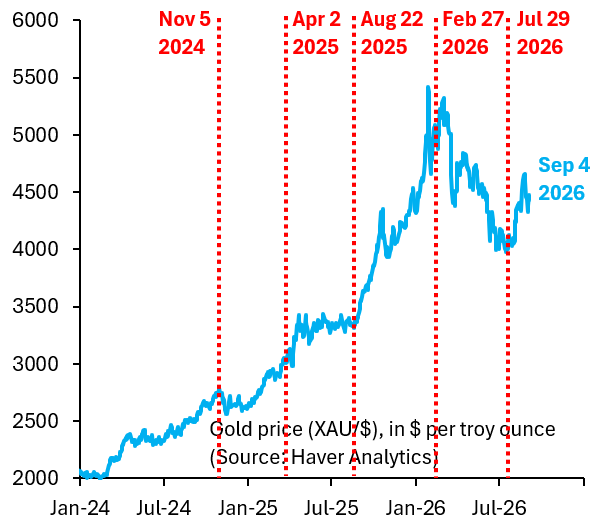
What assets are in the debasement trade? This trade encompasses any asset that is a hedge against high-debt sovereigns inflating away their debt. There’s a range of assets that fall in this category, so let me rank them from least to most risky, i.e. where is the beta to global swings in risk appetite least pronounced versus where is it highest. Low-beta implementations of this trade are Switzerland, Sweden and other low-debt countries in the G10. These places have seen their currencies rally whenever gold and precious metals take off, just with much less volatility. I’d put the S&P 500 and the Dollar versus emerging markets (EM) down as moderate beta implementations. Both hedge debasement risk, but are somewhat more volatile. Finally, there’s gold and other precious metals, which are at the high-end of the risk spectrum. As we’ve seen in recent months, gold has started trading like a risk asset instead of a safe haven. That’s an inevitable consequence of the growing popularity of the debasement trade, which is sucking in lots of new retail money. A higher beta is the inevitable result, but this doesn’t negate gold as a debasement asset.
-
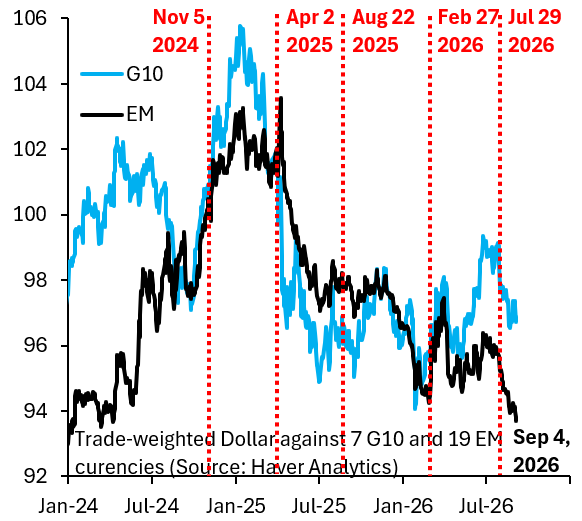
How much further will this trade go? I have two ways of thinking about this. First, there’s absolutely no hope that fiscal policy is going to get fixed without a crisis. So things will have to get worse before they get better and you basically want to stay long the debasement trade until debt consolidation happens for real. We’re a long way from that happening. Governments are busy playing games to give the impression that everything is fine, something that can easily continue for another decade. Second, if you look at the Dollar versus EM – the black line in the chart above – we’re only just starting to make new lows, so – by this metric – the debasement trade has lots of room to run. As the chart below shows, that’s less obvious for gold and other precious metals, but this is precisely why these assets have morphed into high-beta assets. Nothing about their underlying appeal has changed and I think they still have lots of upside.
My bottom line is that you want to be short the Dollar versus EM and low-debt G10 countries, long the S&P 500 and foreign equities and – finally – long a broad basket of precious metals, which should include gold, silver and platinum. Then – and this is the most important part – you resist the temptation to day-trade this portfolio and lock it away for the next ten years. That’ll protect you from the fiscal trainwreck we’re on.