
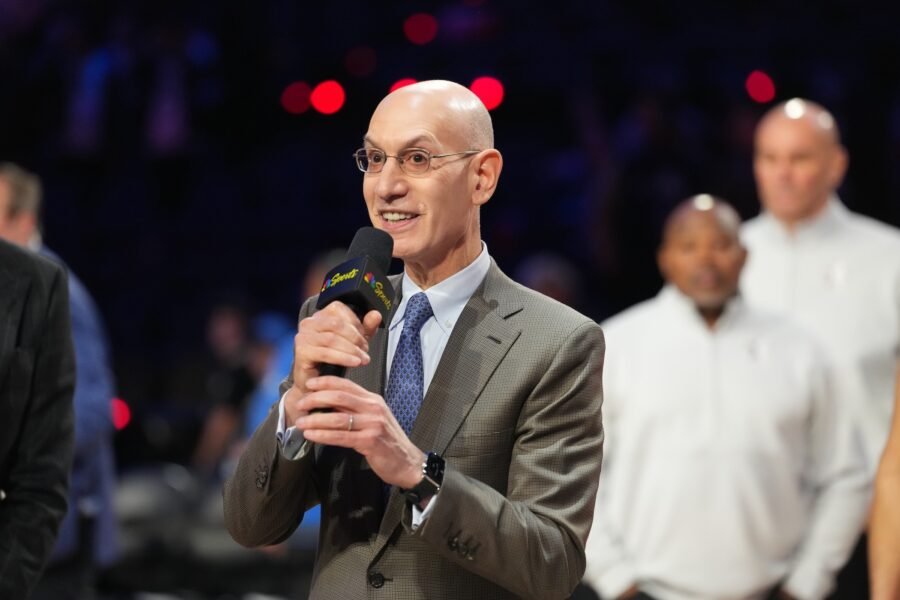
Appearing on CNBC ahead of the first of two Mavericks/Rockets games in Macao over the weekend, NBA commissioner Adam Silver expressed confidence that the NBA will work out an agreement to merge with the EuroLeague (video link).
Reporting last week indicated that EuroLeague shareholders turned down the NBA’s initial proposal for a merger, but the sense at the time was that those talks would continue. The belief is that the NBA, which has partnered with FIBA as it looks to establish its own European league, will either submit a new offer or the EuroLeague will make a counter-proposal of its own.
“It’s like any negotiation, it’s ongoing,” Silver told CNBC’s Contessa Brewer, who suggested that talks between the two sides had hit a “rough patch” in the last week. “I think it’s too extreme to say it’s a rough patch. We’ve been going back and forth with the EuroLeague. … We’re hoping we’ll work something out with the EuroLeague. I think we will.”
When Brewer asked if the league office intends to move forward on plans for NBA Europe with or without the EuroLeague, Silver replied, “Yes, but we’re going to get something worked out.”
The NBA commissioner also addressed a few other notable topics during a pair of interviews with Brewer on Friday and Sunday. Here are some of the highlights:
On prediction markets such as Kalshi and Polymarket, and their impact on the NBA:
“Whether it’s called a prediction market, whether it’s sports betting, it’s the same issues for our league and I think for all the leagues, there’s issues around integrity, first and foremost. Then for us, it’s a desire to capture data, so that we can regulate those markets when we see aberrational behavior — whether it’s insider information or whatever else, we can detect it. So we want access to that data.
“We also want control of the markets. That’s particularly relevant in prediction markets, where currently they’re taking trades on when a coach might get fired, odd behavior that you don’t necessarily want people placing contracts on or betting on. … We want to have control over our intellectual property. We want to make sure we’re protecting the integrity of our competition.”
On working with Wilson to develop a “smart ball” with a tracker embedded inside it:
(Video link)
“We’re experimenting with putting a small chip in the ball that weighs roughly a gram. To put it in perspective, as I understand it, a ball weighs roughly 620 grams, which is roughly 1.4 pounds. So even though it’s 1/620th or so of the weight, we wanted to make sure that the players, who are so sophisticated and have bounced a million balls, wouldn’t sense something was off. So we tested in the G League, we tested in Summer League, and we A/B tested the ball with a chip, without a chip, and nobody could tell the difference, so that’s a good sign.
“(There are) a few different applications. One is, in terms of officiating, we think it’s an opportunity whereby any change in the spin of the ball, you can tell – for example – if a finger touched the ball when it’s going out of bounds. For goaltending, you can tell if the arc changed in the shot.
“I think there’s also going to be other applications, ultimately for consumers. As you know, great shooters put spin on the ball and arc on the ball. So (with) the chip, you’ll be able to graph — let’s say, you take 500 shots, you’ll then see the graph and you’ll see the angle of the shots that went in and are more likely to go in, so you can adjust how to become a better player.
“I think you could see – as soon as next year – us using it for officiating in our games. I think the consumer application is a few years away, but it’s a really exciting opportunity.”
On implementing player wearables for tracking/data purposes:
“We haven’t come to an agreement yet with the Players Association about how to use them in games. I think there’s a lot of sensitivity – particularly from the players’ union – about how that data might be used. I guess, essentially, if you could see a player was slowing down or something like that, they’re worried that that could get used in bargaining, and I get that. So I think we have to come to some agreement on exactly how the information is used, but it seems like everybody wants that information.
“I think the players are in position right now where they’re essentially wearing wearables 22 hours a day and the only time they’re not wearing them is when they’re playing in a game, so that can’t make sense. So we’ll work something out with them.”