
- Circle said it launched the ‘Arc’ public mainnet, its proprietary Layer 1 blockchain, and aims to build on-chain foreign-exchange infrastructure.
- Global financial institutions and South Korean firms including BlackRock, DTCC, Mastercard, Visa, and Upbit have joined as initial validators and ecosystem participants.
- Arc’s success will hinge on USDC circulation and liquidity, and 370 million USDC flowed onto the network within two hours of launch.
Forecast Trend Report by Period


Circle Unveils ‘Arc Mainnet’
Targets Global Foreign-Exchange Market
BlackRock, DTCC Among Participants
Absorbing USDC Supply Is Key
Circle, the issuer of USDC, the world’s second-largest dollar stablecoin, has officially launched the public mainnet of its proprietary Layer 1 blockchain, Arc. With the launch, the company said it aims to turn Arc into on-chain foreign-exchange infrastructure. The push targets the global FX market, the world’s largest financial market, where daily trading volume totals $9.6 trillion.
Circle launched the Arc public mainnet on Sept. 16, according to the industry. A white paper released the same day said Arc is designed to connect stablecoins, tokenized assets and global financial markets on a single blockchain. Circle identified FX infrastructure, cross-chain transfers and payments as the network’s core services.
Arc’s biggest distinguishing feature is that it is built around stablecoins. Users can pay transaction fees with stablecoins such as USDC instead of holding a separate network token.
That structure appears aimed at institutional users, said Kim Min-seung, head of research at DigitalX. When fees are paid in a network’s native digital asset, as on Ethereum or Solana, fiat-denominated costs are harder to predict because of price volatility. For institutions and corporations, that can create an accounting burden. Arc’s fee model appears to target that issue directly by allowing fees to be paid in stablecoins.
Arc also offers fast, predictable settlement finality for financial transactions, along with privacy features that let users control how much transaction information is disclosed. The design is intended to preserve the advantages of a public blockchain while making the network usable for institutions sensitive to information exposure.
Global financial institutions have also joined the early ecosystem in force. BlackRock, the Depository Trust & Clearing Corp., Intercontinental Exchange Inc., the parent of the New York Stock Exchange, Mastercard, Visa, Standard Chartered and SBI Group are participating as initial validators. In South Korea, Upbit was listed among major ecosystem participants. It plans to support USDC access, custody and cross-chain transfers on Arc.
Targeting the $9.6 Trillion FX Market
Arc is taking aim at foreign exchange, the world’s largest financial market. According to the Bank for International Settlements, the global over-the-counter FX market recorded average daily trading volume of about $9.6 trillion as of April 2025.
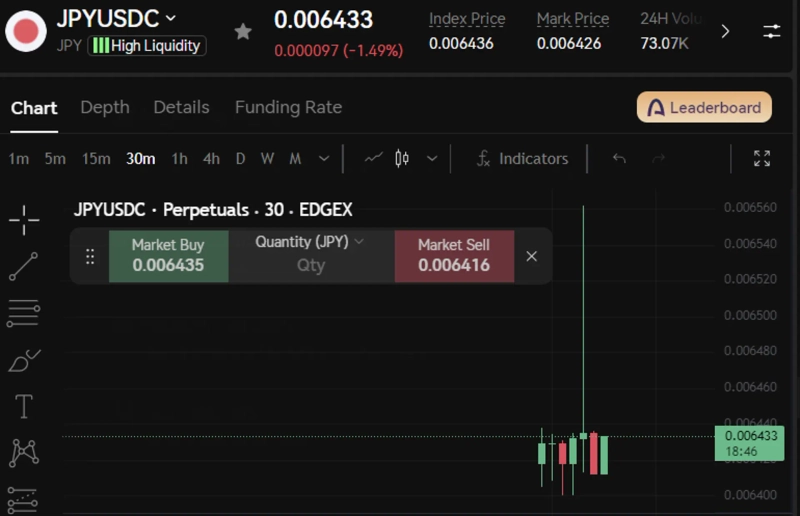
Arc aims to directly link the dollar-centered FX market with USDC. After the Arc public mainnet was unveiled, decentralized exchange EdgeX immediately launched JPYUSDC perpetual futures based on the Japanese yen.
For now, activity is limited to perpetual futures, but spot foreign-exchange trading could eventually emerge on Arc. EdgeX has said it plans to build a spot FX market for direct exchange with USDC once sufficient liquidity forms in non-dollar stablecoins.
Unlike traditional FX markets, Arc can support trading 24 hours a day, including on weekends. It can also handle trading and settlement on a single network, setting it apart from existing financial infrastructure.
Still, if foreign-exchange trading shifts on-chain in earnest, regulation may prove a bigger variable than technology. FX is tied to national rules on cross-border capital movements, financial-industry licensing and anti-money-laundering requirements.
For foreign exchange, laws and regulations in each country are likely to matter more than the blockchain technology itself, Kim said. USDC, however, has relatively greater legal clarity than other stablecoins, suggesting Circle is trying to use that advantage to move first in the FX market.
“USDC Liquidity Must Be Secured”
Another requirement for Arc’s success is how much USDC liquidity it can attract from the many blockchain networks where the token is currently spread.
Circle said total USDC in circulation stood at $73.3 billion at the end of the second quarter of 2026. The company has expanded the ecosystem by issuing USDC on external blockchains including Ethereum, Solana, Arbitrum and Base.
On Arc, USDC plays a central role across the network, including in payments and transaction fees. That means the amount of USDC circulating on the chain will be critical to future growth. Jeremy Allaire, Circle’s chief executive officer, said recently while preparing for the Arc mainnet launch that the goal was to make day-one USDC liquidity the deepest and most capital-efficient in the world. He added that Circle wants to create an environment attractive enough for value moving across the internet to pass through Arc.
USDC liquidity appeared to flow in quickly at launch. Within two hours of the Arc mainnet going live, the amount of USDC on the network had exceeded 370 million, while the number of on-chain addresses reached 176,000.
Prospects for institutional inflows are also adding to optimism. BlackRock plans to deploy its tokenized money-market fund BUIDL on Arc. DTCC plans to build infrastructure that will allow assets in its custody to be tokenized on Arc starting in the second half of 2027.