
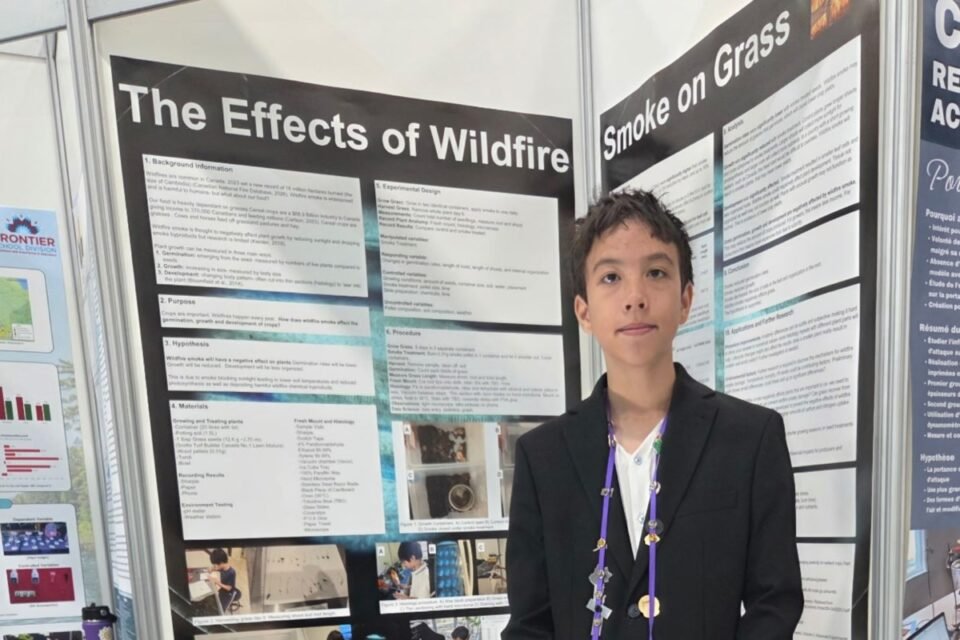
CREMONA – A Grade 7 student at Cremona School recently earned national recognition alongside the country’s brightest up-and-coming young minds eager to wield the scientific method on a mission to make the world a better place.
Eli Bird brought home a silver medal from the Canada-Wide Science Fair in the junior category of excellence for his project called The Effects of Wildfire Smoke on Grass.
Considering the caliber of contenders, Bird said coming away with a silver medal was a major personal achievement.
“It felt really great because there’s so many participants there and all of the projects were well established,” he said.
Bird said he developed a passion for learning more about how the world around him works early on when a science teacher demonstrated a mini project that piqued his curiosity.
“I was really interested in that, so I wanted to do projects on how stuff works,” he said.
Drawing from his life’s own experiences, Bird said his project was directly inspired by the fact his father relies on crops to feed cows.
“You know how we get warnings to go inside when wildfire smoke is super bad? Well, the crops can’t really go inside,” he said.
“I wanted to see how wildfire smoke would affect those crops, and that’s what led me to this project.”
He developed an experiment using two containers in which to grow grass – one was a control without the presence of smoke and he used a smoke pellet in the other.
“I would then measure the grass in different ways through germination, growth and development,” he explained.
Throughout the process, Bird said he observed grass exposed to smoke had a 13 per cent reduction in germination.
“We also had a reduction in growth, so smoke would negatively impact the grass,” he said.
“And then for development, the smoke would disorganize the cells in the leaf and the root.”
That all translates to potentially massive financial losses for Canada’s agricultural sector amounting to billions of dollars as a result of the impact of wildfire smoke, he said.
But he also learned about more than just science.
“I learned that dedication and hard work really pays off, because that’s how I got my silver medal,” he said.
Not one to slow down, Bird is already looking forward to pursuing a related research project for next year’s science fair by studying the impact wildfire smoke has on animals and their nervous systems.
“I’m going to be testing to see how wildfire smoke affects the brain and ways we can stop that negative effect.”
Bird sees science as an invaluable tool that can be used to improve not just communities but the planet and he considers research a worthy investment.
“I believe we should fund scientific research because there’s such big problems in our world, and if we fund scientific research then we could solve big problems and help communities worldwide.”
The Canada-Wide Science Fair celebrates excellence in youth science, technology, engineering, and mathematic achievement through an array of awards and recognition.
Each year, nearly $1.3 million in prizes, scholarships, and exclusive opportunities are presented to Canada’s top young scientists and innovators.
The awards ceremony was held Thursday, May 28 at Northern Alberta Jubilee in Edmonton.