
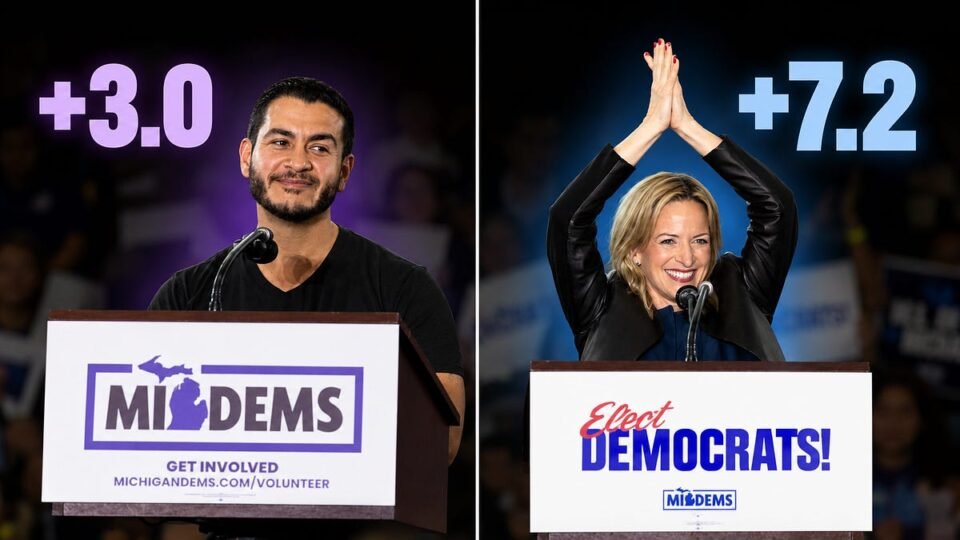
One consistent story this cycle is that Democratic Senate candidates are doing surprisingly well in traditionally red states such as Texas, but in bluer states — most obviously Michigan and Minnesota — their polling has been less than stellar. Don’t bet on that changing dramatically in the final days leading up to the election. Thanks to relatively stable polling, and a somewhat surprising dearth of new polls compared to past cycles, FLIPR’s topline forecast hasn’t moved much since the beginning of the month. And at this point, most of the remaining uncertainty in our forecast comes down to potential polling error, not late shifts in the polls themselves.
But in gubernatorial races, that story is less clean-cut. Jocelyn Benson’s lead in the Michigan gubernatorial polls is about 4.2 points larger than Abdul El-Sayed’s in the state’s Senate contest, and while James Talarico leads Ken Paxton by 2.4 points in the Silver Bulletin average, Gina Hinojosa trails Republican governor Greg Abbott by 2.7 points in the gubernatorial race.
It wouldn’t be unreasonable to suggest those gaps reflect differences in candidate quality: that Paxton is an especially weak candidate, for instance, or that El-Sayed’s progressivism will hurt him. But those are the polls. How much ticket splitting should we reasonably expect in such a polarized environment?

To level set, split-ticket voting is getting less and less common. According to DDHQ, the median gap in margin between Senate and gubernatorial contests back in 1990 was about 25 points. Fast forward to 2014, and the median margin gap between major statewide contests drops to about 13 points. It was just eight points in 2022. Based on FLIPR’s current projections, we expect statewide ticket-splitting to decrease even further, with a median gap of just six points in 2026.
That’s not exactly surprising. Politics is increasingly nationalized, so even though it’s easier for gubernatorial candidates to buck a state’s partisan trends than it is for their Senate counterparts, it’s getting more difficult to be a blue-state Republican or red-state Democrat. Still, the national median can hide some big splits within individual states. In 2022, for example, Republican Phil Scott won Vermont’s gubernatorial race by 47 points, while Democrat Peter Welch won the Senate contest by 40 points. That same year, Kansas elected a Republican senator and Democratic governor.
We’re almost certain to see similar splits in 2026, even as crossing the party line becomes rarer on average. So for this Model Talk, let’s go through the races where FLIPR expects the most ticket splitting. Then we’ll consider a couple of more technical questions. Do Senate and gubernatorial candidates tend to sink or swim together? In other words, if El-Sayed underperforms his polls, will Benson do so as well? Or alternatively, do their numbers tend to converge? Does Talarico’s narrow lead in the polls tell us anything about Hinojosa’s chances?