
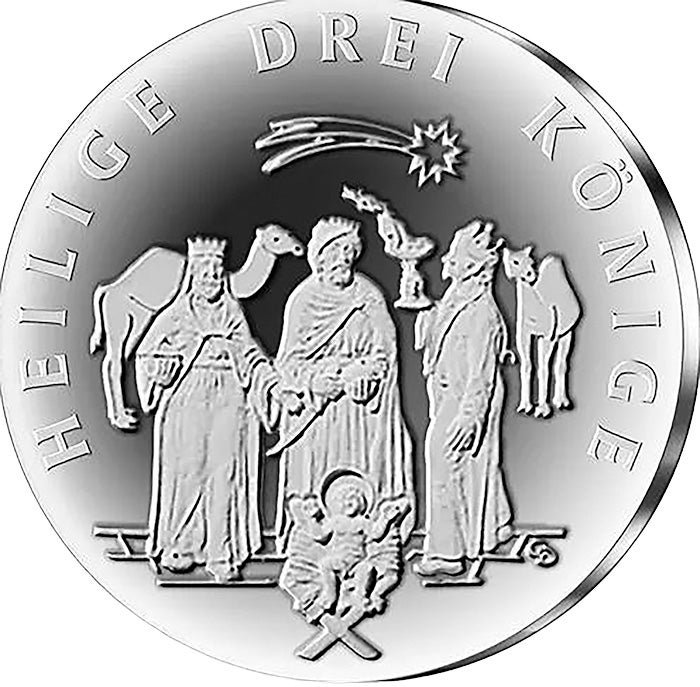
In late October 2025, Germany made the decision to halt the release of two commemorative coins due to the soaring price of their silver content. The Bundesbank, Germany’s central bank, said the decision was made by the Federal Ministry of Finance.
The coins involved were the commemorative €25 and €20 Heilige Drei Könige (Three Holy Kings) and the 125 Jahre Wuppertaler Schwebebahn (125 Years of the Wuppertal Suspension Railway) issues. Both are part of an ongoing series marking German culture and innovation.
As far as the Federal Ministry of Finance is concerned, the spot price of silver hasn’t improved since that time. Silver was priced at just under $50 an ounce on October 30. At the time this article was written, more than five months later, silver was priced in excess of $70 an ounce.
In March, the German government announced it will be debasing its future commemorative silver coins issued in uncirculated quality. Future €35 and €50 coins will be composed of more copper at the expense of the silver previously planned to be part of the mix. Specifically, the planned €35 150th birthday of German author Hermann Hesse issue, scheduled for 2027, will have its silver fineness reduced from .925 to .500, approximately 46% less silver by fineness than previous issues. The total weight of the coin will be reduced from 18 to 17 grams. The €35 Elisabeth Schwarzhaupt commemorative, originally planned for 2026 and postponed to January 2027, was specified at 18 grams and .925 fine (sterling) silver. The denomination expressed on Germany’s silver commemorative coins has been increased recently from €20 to €35. The diameter of the coins remains at 32.5 millimeters. Proof-quality coins will retain their original silver specifications.
A Federal Ministry of Finance statement reads, “It is intended to prevent the coins from becoming the subject of speculation regarding precious metal price trends or from their issuance becoming impermissible for budgetary reasons.”
There is a finagle factor involved in altering the metal content of these coins. German commemorative euro coins are legal tender. Uncirculated versions are issued at face value, while proof versions are sold at a price higher than their face value. The government’s economics become less favorable when the value of silver increases.
Up until the recent announcement, Germany was one of the few eurozone countries that still issued good silver-content legal-tender coins. Previous tributes have included coins dedicated to Goethe, Albert Einstein, and German-born Pope Benedict XVI.
The debasement of the precious metal content of circulating coinage has been going on almost since the dawn of coinage during the 5th century B.C. Sometimes this has been out of economic necessity. Other times it may have been a convenience to the issuing authority. A change in the metal content of commemorative coins doesn’t occur as often since the initial sale price of these coins, as well as their face value, can be controlled before their release.
Plated coins are likewise commonplace as alternatives to full metal content issues. The recently terminated U.S. cent was changed to a plated piece in 1982. In 2019, Canada released a gold-plated silver $8 “Pandas: A Golden Gift of Friendship coin on which the framed letter P appears below the obverse portrait of Queen Elizabeth II.
Since the time of the German Empire (1871–1918), the precious metal content of Germany’s coinage has fluctuated significantly. The circulated 2-, 3-, and 5-mark coins of that time contain .900 fine silver. During the time of the Weimar Republic (1924–1933), 1-, 2-, 3-, and 5-Reichsmark coins were issued composed of .500 silver following severely debased coinage during the initial period ravaged by hyperinflation.
Post World War II, West Germany issued .625 fine silver 5-Deutsche mark coins between 1951 and 1974. The following year, these coins were demonetized due to their silver content having exceeded their face value. East Germany issued commemorative 5-, 10-, and 20-mark coins varying in silver content between .500 and .800 fineness between 1966 and 1990.
Germany reunited as a nation in 1990. German 10-Deutsche mark coins issued through 1997 are struck of .625 fine silver, while those issued between 1998 and 2001 are composed of .925 fine silver. Today, silver coins from this period are commonly traded as junk silver rather than for a value tied to their face value.
Coins and other objects identified as German silver should not be confused with objects made of true silver. German silver is composed of a silvery-white alloy of copper, nickel, and zinc. There is no true silver in something made with German silver.