
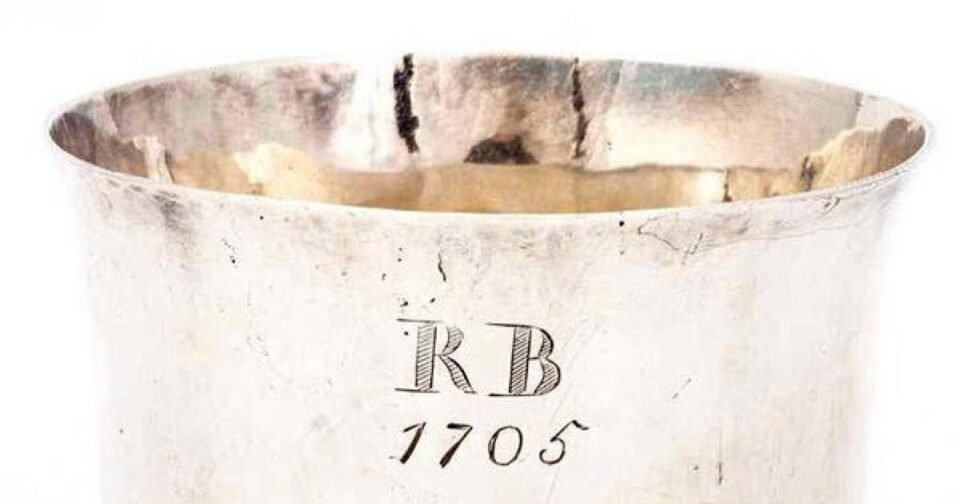
Historically, there have always been a few lady silversmiths; many were producing high-quality silverware back in the 18th century.
Here in Norwich, we were blessed with many active silversmiths during the 18th century, producing domestic silver of high quality and ecclesiastical items as well.
Among the active local group of makers was the only female silversmith in the city; she was Elizabeth Haselwood (1644–1715).
Her first work appeared in the late 1600s.
Elizabeth came from a prominent family of silversmiths in the city.
She took over the business after the death of her husband, Arthur Hazelwood II.
Recently, a beaker made by Elizabeth was sold for some £5,800; this item dated to 1688 but was later engraved around 1705.
Elizabeth lived to the age of seventy.

Some fifteen church items and nine secular items are known to survive from her output.
When rare pieces of silver of this type are sold, the actual weight of the silver is not always taken into account.
You have to balance the rarity factor with the intrinsic value of the metal.
Another, possibly more well-known female smith, was Hester Bateman, whose products always had a cult following, and items by her have always been at a premium.
She also ran the business after her husband died and managed to bring up five children at the same time.
Hester made fine quality items for the middle-class customers and ran the business for some thirty years in London.
Recently, a local lady silversmith was confronted by a problem.
The price of new silver grains has reached a point where it is impossible to buy to make things.
This lady made bangles, bracelets, and necklaces, and has her own hallmark, and would sell them at craft fairs.
Her problem was that to obtain silver to make the items she wished to sell, the lady had a dilemma.
She had a fine Georgian family teapot, which she well remembers being used by her mother every day, but she had no alternative but to cut this up in order to make the products that she was selling.
This was the only way she could buy silver at a zero cost to enable her to carry on with the manufacture of the items she was known for.
Such a difficult decision, which, if the price of the raw material stays high, is only likely to get worse.
It has to be borne in mind that on the one hand, many people are pleased with the high price of silver if they are selling, but if you are making silver, this is a big problem.
Mike Hicks has run Stalham Antique Gallery at 29 High Street, Stalham (NR12 9AH) for more than 30 years. His business is open Mondays to Fridays from 9am-1pm and 2-4.30pm, and on Saturdays from 9am-1pm. You can contact Mike on 01692 580636 or info@mikehicksantiques.co.uk or www.mikehicksantiques.co.uk