
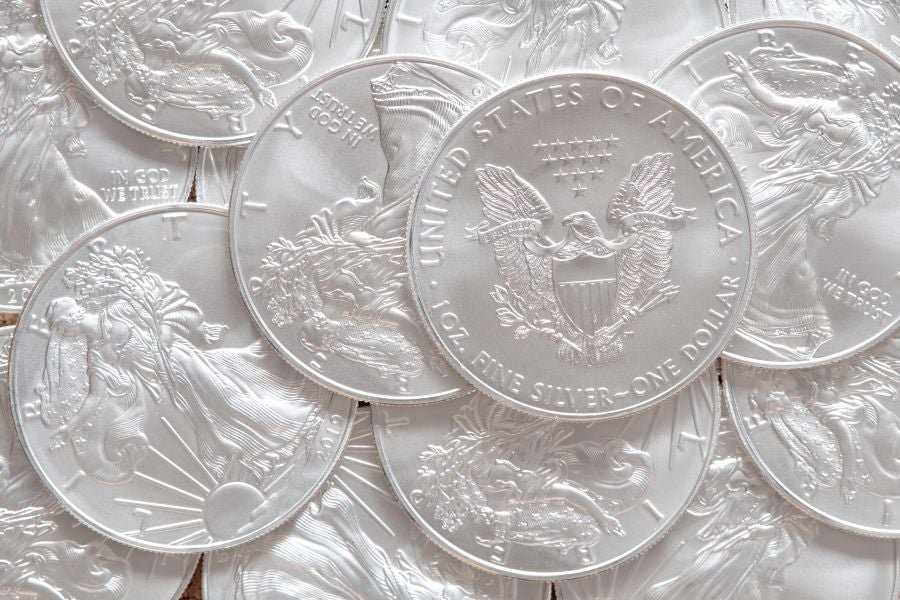
After the U.S. Mint stopped striking 90 percent silver dimes, quarters, and half dollars for circulation, savvy people started to hoard them. Over the decades, such a large volume had been minted that, up into the 1980s, a large percentage of all bullion-priced physical silver transactions outside of commodity futures markets involved 90 percent silver coins.
Over time, increasing numbers of bars and rounds were struck to fill the void in supply of bullion-priced silver. Then, in the 1980s, a growing number of countries began to issue .999 fine silver one-troy-ounce coins at bullion prices.
When the silver spot price fell sharply during the Great Recession in late 2008, fabricators and mints were unable to produce enough silver issues to meet investor demand. U.S. 90 percent silver coins, out of production for more than 40 years but still available on the market, saw their retail premium rise to more than 30 percent above the value of the silver in the coins.
In normal markets, U.S. 90 percent silver coins over recent decades had traded at premiums relatively at par with bars and rounds.
But the price of silver has not traded normally over the past three years. Its price jumped +460.1 percent from the COMEX close on Oct. 5, 2023, at $20.84 to settle at $116.73 on Jan. 28, 2026.
When silver’s price rose so fast, and so high to its late January peak, an extraordinary number of sellers came onto the market. Where industrial fabricators acquire 1,000-ounce bars of pure silver, the overwhelming amount of liquidated silver was in 1) smaller pure bars and coins, 2) those of sterling silver (92.5 percent) purity, 3) or of lesser purity content, and 4) flatware, holloware, and jewelry of mostly sterling silver purity.
So much silver was being liquidated early in 2026 that refiners were unable to handle the deluge in a normal, timely fashion. As a backlog developed, many refiners for a time limited what forms of silver they would accept, specifying only .999 fine coins and bars. Refiner payments fell to 4-6 weeks’ delay, which pushed bullion wholesalers to postpone dealer payments, which then forced coin and precious metals dealers to either stop purchasing any form of silver or accept only .999 purity forms, or set maximum transaction limits on what they would purchase.
One result of the market logjam is that, like what happened in late 1979 into January 1980, physical silver prices were discounted, sometimes steeply, below the COMEX spot price. The only form of physical silver in America worth the spot price was the 1,000-ounce pure bars already in COMEX bonded warehouses.
Investors and collectors grew frustrated with the inability to readily sell their physical items at the market peak in January either anywhere near the COMEX spot price, or in some instances, not being able to sell at all!
This market logjam is one reason that silver’s price dropped by a greater percentage from its respective January peak than did gold or platinum. A continuing negative impact is that subsequent investment demand for silver has not ramped up as strongly at recent prices in the $50s and $60s as happened after major price declines in the past. There has been at least some reluctance to invest in silver at current lower prices when there is concern that it might not be possible to sell it for a “fair” price and maybe not at all should the future price skyrocket.
One consequence of the lesser enthusiasm to acquire silver is that most coin and precious metals dealers are still today selling U.S. 90 percent silver coins to retail customers at a discount to the silver spot price. Their early 2026 reduced liquidity has pushed more silver buyers toward coins and bars of .999 fine purity.
Still, industrial demand for silver for use in solar panels, cell phones, electric vehicle batteries, military equipment, medical applications, and much more just keeps growing. Industrial demand will continue to displace shrinking investment demand.
Because industrial demand is less erratic than investment demand, in most future markets U.S. 90 percent silver coins (and other world coins of less than .999 fineness) will trade as liquid as the pure forms and trade for close to the same prices. The only time I foresee where U.S. 90 percent silver coins might again be heavily discounted from pure coins and bars would be in markets of skyrocketing prices in a short time period. Therefore, when you can purchase U.S. 90 percent silver coins today at a lower cost per ounce of silver content, those looking to acquire bullion-priced physical silver should consider placing a high percentage or all of their acquisition into these budget-priced coins.
Another consideration: The most common alloy in sterling silver and other forms of non-pure silver is copper. With copper also recently reaching all-time record high prices, refiners who purchase non-pure silver such as U.S. 90 percent silver coins and pay only for the silver value have the potential to make a higher profit margin by being able to sell the residual copper content in addition to their sales of 1,000-ounce pure silver bars.
Last column’s numismatic trivia question
Last time I asked, how is the U.S. Dollar Index calculated? The U.S. Dollar Index was established in 1973 with a base value of 100, using a geometrically weighted average today against six other currencies—the euro (57.6 percent), Japanese yen (13.6 percent), British pound (11.9 percent), Canadian dollar (9.1 percent), Swedish krona (4.2 percent), and Swiss franc (3.6 percent). The euro replaced the German mark and French franc as components of the Index when the euro displaced those two currencies in January 1999. There is advocacy that the Index should be expanded to include the Chinese yuan, Mexican peso, South Korean won, and the Brazilian real since these nations are major U.S. trading partners, more significant than Sweden and Switzerland.
This column’s trivia question
Here is this column’s question. What are the components of the “paper” of U.S. currency? Come back next week for the answer.
Patrick A. Heller was honored as a 2019 FUN Numismatic Ambassador. He is also the recipient of the American Numismatic Association 2018 Glenn Smedley Memorial Service Award, the 2017 Exemplary Service Award, the 2012 Harry Forman National Dealer of the Year Award, and the 2008 Presidential Award. Over the years, he has also been honored by the Numismatic Literary Guild, Professional Numismatists Guild, National Coin & Bullion Association, and the Michigan State Numismatic Society. He is the communications officer of Liberty Coin Service in Lansing, Michigan, and writes “Liberty’s Outlook,” a quarterly newsletter on rare coins and precious metals subjects. He now volunteers with the National Coin & Bullion Association as its Industry Issues Advisor. Past newsletter issues can be viewed at www.libertycoinservice.com. Some of his radio commentaries, “Things You ‘Know’ That Just Aren’t So,” and “Important News You Need To Know,” can be heard at 8:45 a.m. Wednesday and Friday mornings on 1320-AM WILS in Lansing (which streams live and becomes part of the audio archives posted at www.1320wils.com).
Look for the silver lining: