
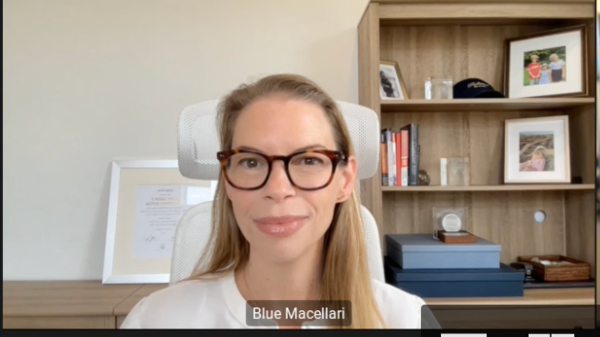
Crypto investing has evolved in recent years, offering investors more opportunities to add crypto and digital assets to their portfolios. From crypto ETFs to the latest blockchain-related investments, these options may prompt investors and advisors to ask: where do they fit? Blue Macellari, head of digital assets at T. Rowe Price, recently addressed this and other key questions during a VettaFi webcast.
- Crypto investing opportunities have blossomed; where and how to use those assets remains a question for many.
- Where many see volatility in crypto assets as a negative, it can actually be a benefit if used properly.
- T. Rowe Price offers a multi-token active ETF, TKNZ, that can help triangulate allocations.
Macellari joined VettaFi head of research Todd Rosenbluth to explore the role that crypto investing assets can play in portfolios. The conversation for the T. Rowe Price Digital Assets and Active Crypto Strategies touched on the size and type of allocation to consider.
Macellari explained that the growing appeal for crypto investing is due to accessibility, but also a generational shift. Younger investors, she suggested, are more comfortable with trying crypto assets. We may see growing interest in the category amid the generational transfer of wealth, she added.
Rosenbluth prompted Macellari to share how she and her team see the landscape outside of Bitcoin. In her view, she explained, Bitcoin behaves more like a “macro asset.” Other tokens, meanwhile, are disruptive technologies with even different blockchains being specialized.
“Hyperliquid is a highly specialized decentralized exchange for trading perpetual futures on any sort of underlying name, stocks, oil, other crypto,” she explained. “(Then there are) things like Solana, which is extremely well suited for payments or what we call internet capital markets for everybody who’s hearing about tokenization these days.”
“We have AI focused chains, essentially the execution layer for a lot of the stuff we think AI is doing. We have different types of chains that just provide data,” Macellari added.
When asked by Rosenbluth whether digital assets take an equity or alternative slice, Macellari spoke to the size of allocation as a key step. After assessing a client’s risk tolerance, advisors may find that even a small allocation can have a meaningful impact.
“I think sizing is a really important question. I would say start out pretty small,” she said. Shen explained that many investors start with a one to 3% allocation, with some people going as high as 5%.
See more: T. Rowe Price Digital Assets Head Macellari on Active Crypto
Macellari also noted that many advisors will often start an allocation and then increase it later on. What’s more, she explained that where many investors and advisors are concerned about volatility in crypto, that’s actually a feature, not a bug.
“In a portfolio construction context, if you have an asset that you like that sort of can give you diversified returns, if it’s a consistently high vol asset, even a small allocation can move the needle on your portfolio,” she said.
“Meanwhile, if you have an asset that you love that has incredibly low volatility, you would sort of have to back a truck up to the asset in order to get the size that moves the needle for your overall portfolio,” Macellari added.
To help investors gain digital asset exposure, T. Rowe Price launched the (TKNZ) in July. The fund’s multi-token approach charges a 75 basis point fee and leverages T. Rowe Price’s fundamental research capabilities and active, bottom-up management.
For more news, information, and analysis, visit our Active ETF Content Hub.