

For much of its history, cryptocurrency investing existed on the fringes of the financial world. Investors interested in Bitcoin or other digital assets often had to navigate unfamiliar exchanges, custody concerns, private wallets, and an uncertain regulatory environment. While enthusiasts viewed crypto as the future of finance, many traditional investors remained on the sidelines.
That has changed dramatically.
The approval and launch of spot Bitcoin ETFs marked a turning point for the asset class. What was once considered a speculative niche has become increasingly integrated into traditional portfolios. Institutional investors, financial advisors, pension funds, and retail investors now have access to cryptocurrency exposure through familiar investment vehicles.
Asset managers are now taking that one step further. New strategies incorporate staking rewards, options overlays, tactical allocation decisions, active trading, income generation, and risk management techniques—all with an active touch.
From Fringe To Mainstream
The basics behind cryptocurrencies are easy to understand. Think of them as digital dollars stored in the cloud or accessed through a digital key. For years, this concept was relegated to the fringes, and Bitcoin and cryptocurrency investors were seen as mavericks and risk-takers.
Then that all changed a few years ago.
The SEC began approving spot Bitcoin ETFs. Rather than opening a crypto wallet or managing private keys, investors could purchase shares through traditional brokerage accounts, with the ETF provider handling custody, administration, and operational complexities.
The result was a major milestone for cryptocurrency adoption.
Financial advisors who previously could not recommend direct cryptocurrency purchases suddenly had access to regulated investment vehicles. Institutional investors gained a more efficient way to allocate capital, and individual investors received a familiar structure that fit seamlessly within retirement accounts and brokerage platforms.
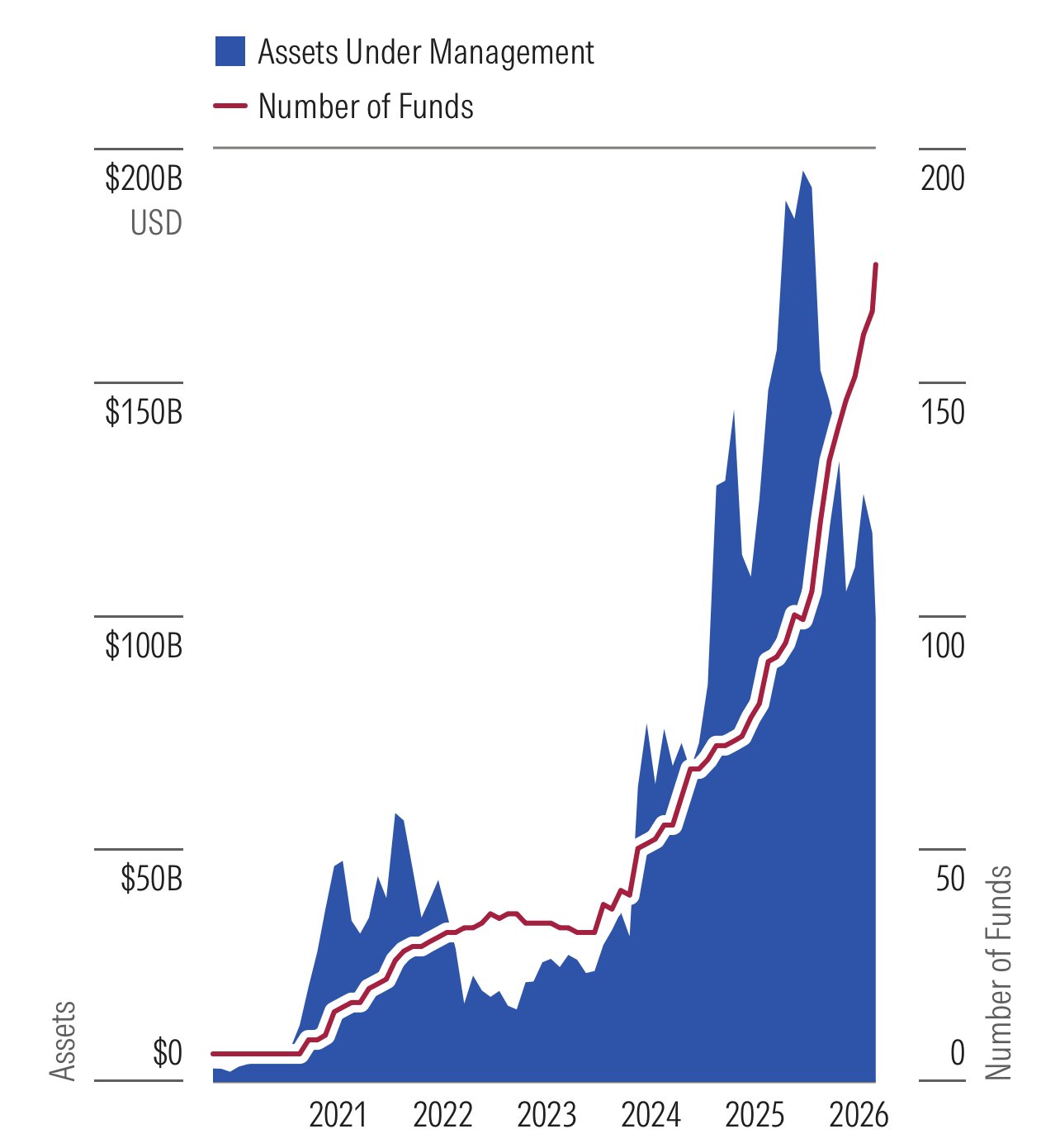
Because of this, the growth of Bitcoin and other digital assets has been breathtaking over the last five years. What started as a niche idea has quickly gone mainstream, with more than $100 billion in assets now sitting within crypto ETFs.
This chart from Morningstar highlights the asset growth. The decline reflects the drop in Bitcoin prices rather than investor withdrawals.
The Rise of Active Crypto ETFs
The primary appeal of Bitcoin and other cryptocurrencies has largely been their potential to generate significant alpha for a portfolio. Those massive returns, however, have come with extraordinary volatility—more than four times that of the S&P 500.
Active management could therefore provide a real entry point into the asset class, and Wall Street has been happy to oblige. So far in 2026, there have been 30 new crypto ETFs, and nearly all of them have used active management.
Rather than simply tracking Bitcoin or Ethereum, active crypto ETFs seek to enhance returns, generate income, manage volatility, or provide broader exposure across the digital asset ecosystem.
The success of covered-call and option-income ETFs in traditional markets has encouraged asset managers to explore similar approaches within cryptocurrency. Actively managed crypto products are also beginning to incorporate staking strategies into ETF and ETP structures, allowing investors to potentially earn staking rewards without managing the process themselves. Participants who stake their tokens receive rewards for helping maintain network operations, and those rewards function somewhat like income.
Some managers are taking active management even further by actively adjusting exposures based on market conditions rather than maintaining fixed allocations. Managers may rotate between Bitcoin, Ethereum, stablecoins, and other digital assets, increasing or decreasing exposure based on momentum, valuation, volatility, or macroeconomic trends, with the objective of improving risk-adjusted returns.
Active management is now coming to the cryptocurrency ETF universe.
Active Management May Work Better in Crypto
In highly efficient markets, active management faces significant challenges because information is rapidly incorporated into prices.
Crypto markets may be different.
The asset class remains fragmented, with trading occurring across multiple venues, regulatory developments capable of dramatically impacting prices, and technological changes occurring rapidly. Investor sentiment often plays a larger role than traditional valuation metrics.
These factors create an environment where active management may have a greater chance of success than in more mature markets.
Additionally, risk management may be particularly valuable.
The volatility that attracts many crypto investors can also create significant portfolio challenges. Active strategies that seek to reduce drawdowns or generate income may appeal to investors who want exposure without fully embracing the asset class’s volatility.
Buffered Bitcoin ETFs
These ETFs were selected based on their exposure to Bitcoin using a buffered strategy. They have expenses between 0.61% and 6.15%. Sorted by one-year total return, which ranges from -4% to -57%, they currently pay no dividends.
| Ticker | Name | 1-year Total Ret (% | Exp Ratio | Security Type | Actively Managed? |
|---|---|---|---|---|---|
| CBOJ | Calamos Bitcoin Structured Alt Protection ETF – January | -4.01% | 0.69% | ETF | Yes |
| CBXJ | Calamos Bitcoin 90 Series Structured Alt Protection ETF – January | -20.78% | 0.69% | ETF | Yes |
| CBTJ | Calamos Bitcoin 80 Series Structured Alt Protection ETF – January | -30.7% | 0.69% | ETF | Yes |
| QBF | Innovator Uncapped Bitcoin 20 Floor ETF – Quarterly | -35.3% | 0.79% | ETF | Yes |
| MAXI | Simplify Bitcoin Strategy PLUS Income ETF | -57.55% | 6.1% | ETF | Yes |
Standard Bitcoin ETFs
These ETFs were selected based on their exposure to spot Bitcoin, with AUM between $730M and $87B. Sorted by one-year total return, which ranges from 88% to 93%, they carry expense ratios from 0.19% to 1.50% and currently pay no dividends.
| Ticker | Name | AUM | 1-year Total Ret (%) | Yield (%) | Exp Ratio | Security Type | Actively Managed? |
|---|---|---|---|---|---|---|---|
| BITO | ProShares Bitcoin Strategy ETF | $2.76B | 92.7% | 0% | 0.95% | ETF | No |
| IBIT | iShares Bitcoin Trust | $86.7B | 90.9% | 0% | 0.25% | ETF | No |
| HODL | VanEck Bitcoin Trust | $1.3B | 90.9% | 0% | 0.25% | ETF | No |
| FBTC | Fidelity® Wise Origin® Bitcoin Fund | $19.2B | 90.7% | 0% | 0.25% | ETF | No |
| ARKB | ARK 21Shares Bitcoin ETF | $4.75B | 90.7% | 0% | 0.21% | ETF | No |
| EZBC | Franklin Templeton Digital Holdings Trust | $732M | 90.7% | 0% | 0.19% | ETF | No |
| BTCO | Invesco Galaxy Bitcoin ETF | $856M | 90.5% | 0% | 0.39% | ETF | No |
| GBTC | Grayscale Bitcoin Trust | $21B | 88.4% | 0% | 1.50% | ETF | No |
Cryptocurrency investing has entered a new phase.
The first generation of products focused on accessibility and adoption, with spot Bitcoin ETFs successfully bringing digital assets into the mainstream financial system.
The next generation appears focused on optimization.
Asset managers are increasingly applying active management techniques to cryptocurrency portfolios, introducing strategies that seek to generate income, improve risk-adjusted returns, reduce volatility, and capture opportunities beyond simple buy-and-hold investing.
Staking, options overlays, tactical allocation, and active trading are transforming crypto from a single-asset exposure into a broader investment category.
Bottom Line
For investors, the growing range of active crypto ETFs represents an important evolution, as cryptocurrency exposure is no longer limited to simply buying Bitcoin and hoping prices rise.