
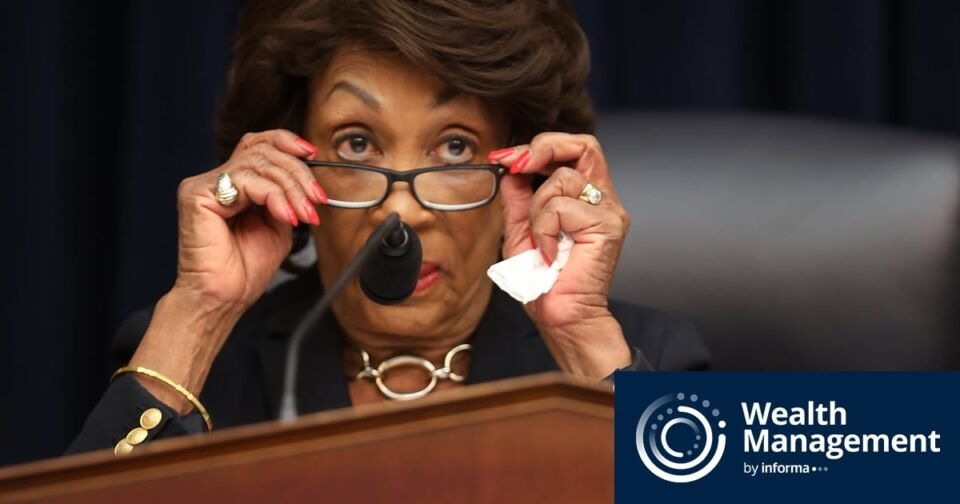
The head Democratic lawmaker on the House of Representatives’ Financial Services Committee is calling on the Labor Department to drop its proposed rule concerning alternative assets in 401(k)s, arguing the rule would “entrench the very two-tier market it purports to remedy.”
In the letter to Acting Labor Secretary Keith Sonderling, U.S. Rep. Maxine Waters (D-Calif.) stressed her “strong opposition” to the DOL’s proposed rule released in March, saying it would expose retirees to “assets that sophisticated investors are working to shed,” and accelerate the “decline” of public markets.
“A rule marketing as ‘democratizing’ access to private markets would in fact ratify a system in which the public markets—the markets that are actually open to, and protective of, hardworking Americans—continue to wither, while retirement savers are enlisted to backfill the capital issuers no longer need to raise in public view,” Waters claimed.
The rule followed President Donald Trump’s executive order last August, requiring the DOL to re-evaluate guidance on alternative asset investments in retirement plans under the Employee Retirement Income Security Act.
While 401(k) plan providers are technically allowed to include alts (such as private equity, private credit and real estate) in retirement plans, many have shied away from doing so, wary of exposing themselves to potentially costly class-action lawsuits.
However, the new rule would allow 401(k) plan managers to take steps when mulling alternative assets that would create “safe harbors” for plan fiduciaries to avoid litigation. The safe harbor request had long been sought by those pushing for more private-market exposure in 401(k) accounts; they claimed that retail investors with retirement savings plans have been shut out of the same alts opportunities enjoyed by institutional investors.
Waters acknowledged the oft-cited decline in the number of public companies (with estimates finding a 57% drop since 1997, coupled with a 67% rise in the number of private companies). However, she argued that this drop wasn’t “a market phenomenon to which the department is responding; it is the direct product of decades of regulatory choices.”
“The decline of the public company is not a condition to be accommodated; it is a development that warrants concern, precisely because the public markets are where most Americans can invest on equal terms,” Waters wrote.
Waters worried the rule would deepen companies’ incentives to remain private longer, arguing that private capital’s attraction comes from the lack of disclosure and accountability obligations. She feared that if the DOL “effectively guarantees private funds a new and durable stream” of 401(k) funds, it would reduce companies’ motivations to go public at all.
Waters also questioned the inclusion of cryptocurrency and other digital assets as alts, noting that the Securities and Exchange Commission is still in the midst of constructing a “tailored framework” (including its own disclosure, exemption, safe harbor and market structure rules) for crypto.
“It is incoherent for the department to bless digital assets as suitable for the retirement savings of everyday Americans while the SEC is still building the investor-protection regime intended to make those same assets safe for ordinary investors,” Waters wrote.
Finally, Waters saw a “disqualifying” conflict involving Assistant Labor Secretary Daniel Aronowitz, who’d previously founded and led Encore Fiduciary, which she described as a “fiduciary-liability insurance underwriting company” selling litigation exposure coverage to plan sponsors.
Waters argued that insurers like Encore help cover the kind of litigation the rule is meant to slow, with the company paying legal defense costs and settlements when its clients (plan fiduciaries) are sued.
“A rule that makes such suits harder to bring and to win, therefore reduces the claims these insurers must pay in the first place,” Waters wrote. “Fewer and smaller claims mean lower loss ratios and a more profitable fiduciary-liability insurance business.”
According to a Labor Department spokesperson, Aronowitz “fully divested his interest in Encore Fiduciary five months before he joined the Department of Labor and continues to follow all rules outlined in his ethics agreement.”
In an interview with Wealth Management, Andrew Oringer, the head of the New York office of The Wagner Group (which specializes in ERISA matters), noted that Waters’ concerns differed from common critiques of the rule (namely, that comparatively unsophisticated, less wealthy investors will take untoward risks), instead focusing on the importance of preserving public markets.
Oringer speculated that Waters might be raising this issue because members of her own party may also be sympathetic to the argument that retail investors have been locked out of access to private-market opportunities.
Oringer agreed that the manner in which 401(k) plans are invested could “dramatically” affect the market, though he was less certain that allowing private capital a greater stake would, in and of itself, diminish public market interest; instead, he surmised the “desire to unlock the increased liquidity of being public” would transcend concerns about accountability, despite the influx of 401(k) funds.
“Will people believe that this may actually slow down a desire to go public?” Oringer asked. “And then the second thing is—this idea that going public itself is a good thing for the ordinary investor and the ordinary person. Those are interesting points, and it’ll be interesting to see whether those things now wind up getting greater traction in the general discourse.”
The comment period closed late last month, with the DOL receiving over 47,000 public comments. In an analysis, the law firm Gibson Dunn noted most of those submissions (about 43,000) were “form comments,” based on templates provided by organizations supporting or opposing the proposals.
Of these, about 12,000 comments supported the proposal, compared with about 31,000 opposing it. Of “substantial” comments totaling 500 words or more, 121 supported the rule, with 101 in opposition.
According to Gibson Dunn, support for the proposal ranged from employer plan sponsors and industry representatives to minority business and community organizations (many of which advocate for conservative policies), government officials, labor unions and 401(k) investors. The opposition mainly included comments from individual workers and retirees, as well as labor unions and progressive public policy groups.
However, Oringer acknowledged that while there may be “some room” to reconsider cryptocurrency’s place under the rule because of its newness, this was ancillary to Waters’ broader concerns about risks to public markets. It was a chasm Oringer believed the DOL and Waters would be unlikely to bridge.
“I’m not sure what that in-between is here,” he said. “I don’t know how the Department of Labor winds up saying, ‘I don’t want to facilitate movement toward these non-public high return, high risk investments,’ and I likewise don’t know how the DOL finds a way to facilitate those investments but less so than in the proposal.”